Here's why the EVM haunts us
Updated On: 17 February, 2020 05:01 AM IST | Mumbai | Ajaz Ashraf
While it does not turn the tables for parties, the Electronic Voting Machine gives us enough reasons to question the ECI's competence





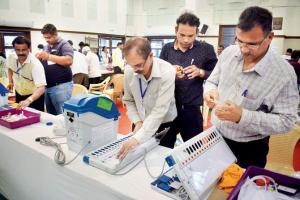
ECI staff check and seal EVMs, control units and VVPAT machines to be kept in a strong room ahead of the 2020 Lok Sabha polls. File pic
 When it became certain that the Aam Aadmi Party would win the Delhi Assembly elections, veteran journalist Shekhar Gupta, on February 11, tweeted, "I suppose we could count this as one more nail hammered hard and deep in the coffin of EVM conspiracy theories." Gupta's was a reference to the many variations of the fundamental theory that the party ruling at the Centre could use its influence over the Election Commission of India (ECI) to rig or hack the Electronic Voting Machine (EVM) and subvert popular mandate.
These theories gained currency as the Bharatiya Janata Party threw the familiar community voting pattern into disarray to sweep the 2019 Lok Sabha elections. Would not the BJP have tampered with the EVMs, in case it was possible to do so, to stave off a humiliating defeat in Delhi? Yes, which is the answer Gupta's tweet rightly suggests.
Yet there is no denying that election results often challenge the exactitude of electronic recording of votes and their computation. In Delhi's 16 constituencies the tally of votes counted was higher than the number of people who had voted. In another 22 constituencies, the votes counted were lower than the turnout figure in each. Delhi's Karol Bagh had an excess of 1,155 votes; Sangam Vihar a shortfall of 864 votes.
Trending Stories
Latest Photos
Latest Videos
Latest Web Stories
ADVERTISEMENT
Mid-Day Fast
ADVERTISEMENT