Identifying internalised misogyny
Updated On: 01 July, 2022 07:18 AM IST | Mumbai | Rosalyn D`mello
When certain forms of toxicity and sexist behaviour are normalised and we grow up watching them, it affects our ability to see the violent patterns as they are, till they manifest as a physical act



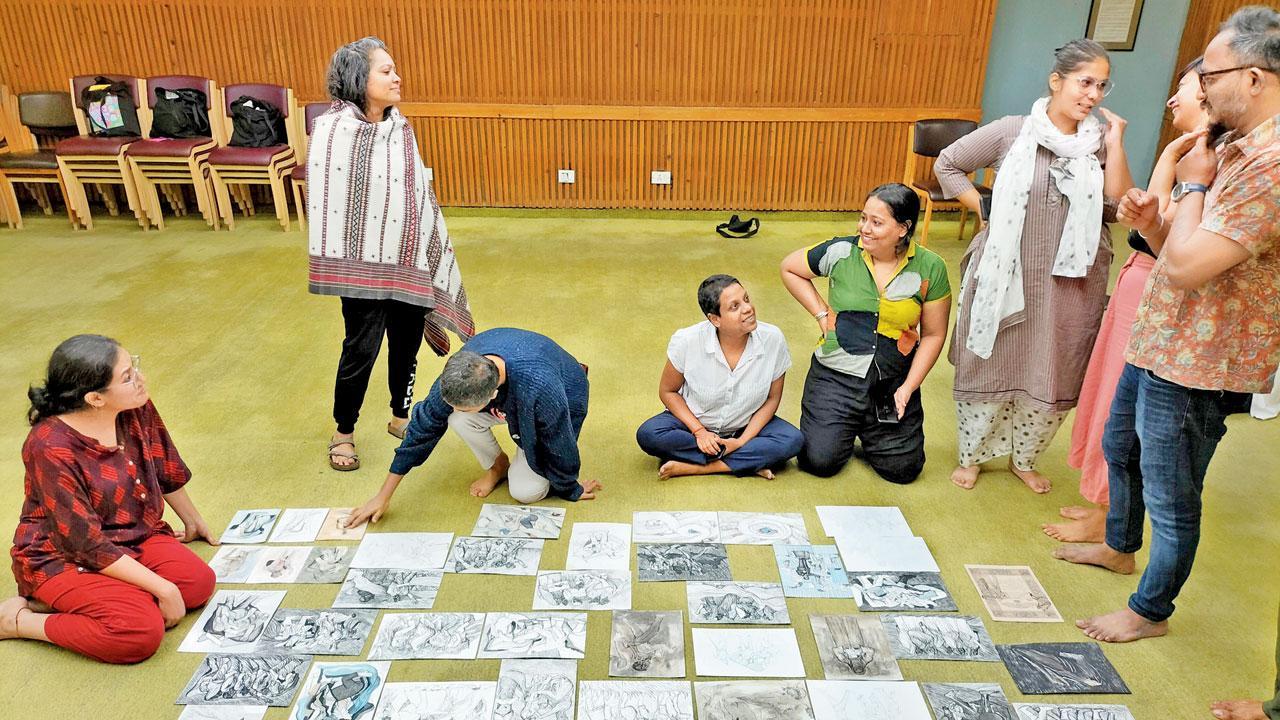
Artists and team members of Gender at Work India at a closed-door artists workshop organised to explore pedagogical practices for young feminist leadership building programme supported by UN Women India. Pic/Gender at Work India
 Despite seeing it coming, the overturning of Roe versus Wade by the US Supreme Court still registered as a sinking feeling once the shock of it wore off. I’ve always felt confused by the hypocrisy of this ‘first-world’ country, that it brazenly calls itself the ‘land of the free’, though the land in question was stolen from native people whose sovereignty has never been acknowledged, and was built by people who were brought in like transatlantic cargo and put to work as slaves, who have never received reparation. The overturning of the order puts all people with wombs at risk, because it refuses to accept their bodily autonomy, rejects the agency to which they are entitled, and unfairly affects those from already marginalised sections of American society. It is not just a blow in the face of feminist movements and mobilisations but also a punch in the gut. Imagine the contradiction when the highest court of an allegedly democratic country decides in favour of guns and against people with wombs. It offers a startling perspective on what constitutes the ‘pro-life’ argument—this in a country in which parents of infants have been coping with an acute shortage of formula, a problem that was magnified by current import policies, and where children need to be trained on dealing with situations of gunfire in schools.
It’s temptingly easy to look at a situation outside of one’s immediate reality and to critique its existence as a folly, and to delude oneself into thinking you have it so much better. In India, abortion is not illegal, but it is still intertwined with shame, guilt, taboo and secrecy. A woman seeking an abortion is a woman racked with all of these emotions and more, and has to seek out that one friend who won’t judge her, find the financial resources to ‘get it done’, and then never speak about it again. That abortion in India is legal is not necessarily a testimony to the fact that the bodily autonomy of people with wombs is being upheld, it has more to do with population control; and between abortions and the documented over-use of the i-pill, there must be enough concrete data to show how the burden of contraception is not shared equally between the sexes. As a fly-on-the-wall member of specialised Facebook groups that offer support to Indian mothers, I am frequently horrified by the levels of emotional abuse young or even middle-aged mothers face from their immediate and extended family, how their authority is constantly undermined by meddling in-laws and mousy husbands who cannot stand up for their partners. It all points in the direction of sexism and misogyny.
How do you like the new new mid-day.com experience? Share your feedback and help us improve.
Trending Stories
Latest Photos
Latest Videos
Latest Web Stories
ADVERTISEMENT
Mid-Day Fast
ADVERTISEMENT

ADVERTISEMENT