Kamasi - shaken, stirred, enthralled
Updated On: 30 August, 2019 07:20 AM IST | | Rosalyn D`mello
Kamasi's control over his instrument was as if he were completely one with it. He was never garrulous, no note was ever excessive





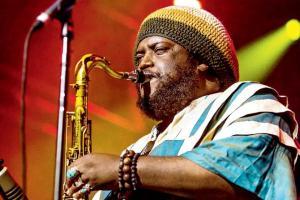
Kamasi's saxophone notes are bathed in the glory of a communal hymn
 I took my seat a little before 9 pm. It was left-most in the front row — A16. I was slightly tipsy from pre-concert drinks. I kept all my belongings on the floor beside me and gathered myself, wrapping a shawl around me in anticipation of my hyper-sensitivity to air conditioning. The lights of the lovingly restored Royal Opera House dimmed. The curtains lifted, revealing a set stage with two drum kits poised across from each other. Out came Kamasi Washington with his band. There was no introduction. None was needed. He launched into 'Street Fighter Mas', soon arriving at the peak of musical inebriation. Upfront, I saw Kamasi stare into the centre of the auditorium, but it seemed as though he was peering into a third space that was neither here nor there. It was a mentally accessible dimension and his inhabitation of it seemed to add to his on-stage presence. It was like he was checked into himself and was drawing out a soul wail.
Over the next two hours, I frequently found myself clutching onto something as if to hold myself back from slipping into the exhilarating vortex. I briefly mused that the significant difference between Miles Davis's music and Kamasi's is that while Miles's seems to come quite obviously from a space of deep suffering and pain, Kamasi's scores are exuberant, celebratory. Miles's trumpet solos feel solitudinal while Kamasi's saxophone notes are bathed in the glory of a communal hymn. The fullness of the music gives it the aura of a church congregation that's been collectively possessed by the spirit and is now speaking in harmonious tongues. Miles was a noted misogynist. Kamasi's leadership style, on the other hand, leans towards a feminist sensibility. His performance style hadn't even a trace of narcissism. He introduced each of his fellow musicians, including his father, multiple times so their names registered in your consciousness. And, he spoke of love, and how our differences shouldn't be merely tolerated so much as celebrated. His masculinity seemed to me like an internalisation of the empowering self-confidence of Malcolm X, the inspiring kindness and love-centric discourse of Martin Luther King, with a smattering of the intellectual grace of Cornell West. But that's probably me projecting.
Trending Stories
Latest Photos
Latest Videos
Latest Web Stories
ADVERTISEMENT
Mid-Day Fast
ADVERTISEMENT