Mumbai scrap makes it to Harvard
Updated On: 06 October, 2019 07:13 AM IST | Mumbai | Sumedha Raikar Mhatre
Sculptor Sakshi Gupta enters Harvard's South Asia-centric classroom to ponder over cities, like her own water-logged Mumbai, where the past is being fast-discarded in exchange of a 'redeveloped' future





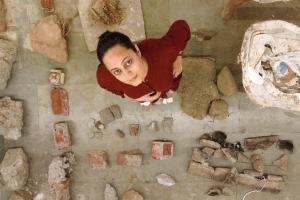
Seeking an after-life for industrial scrap: Sculptor Sakshi Gupta at her workshop in Reay Road. Pics/ Suresh Karkera
 Industrial scrap, rusted beams, cement debris, crushed stones, discarded objects, and other familiar cast-off material in Mumbai's mega construction sites and industrial areas form the quintessential aspects of sculptor Sakshi Gupta's visual language. She picks up the discarded, forgotten or rendered useless, to give it new meaning and value while exploring notions of space and form. Her recently exhibited work was developed using rubble from around the city and she continues to investigate the potential of this material in the new body of work she's making currently at her studio in Reay Road. She is obviously not carrying the scrap to Harvard University's South Asia Institute where she is going to spend the next two months. She is there to explore the unexpected in a new environment of a residency.
Gupta, 40, one of the Visiting Artist Fellows for Fall 2019 will showcase some of her key works, which are her attempts to frame abstruse human conditions, and also her take on materiality. The exhibition starts on October 15 at the institute. But display of her art works are not the focus of her stay. She is there to connect with the faculty of the School of Design as well as students with similar research interests. She will gain access to data and archives of the Harvard libraries and museums. The fellowship comes as a moment of pause that she was looking for within her practice, having worked independently for the last 10 years in Delhi, Baroda and Mumbai. It is a time to recalibrate her relationship with the immediate workspace and also review her place in the larger much-discussed South Asian demographic. "For all you know, I may come back with new collaborators from Nepal and Bangladesh or fellows from within India who have thoughts on an artist's role in our emerging future," says a hopeful Gupta who believes that geographical distance triggers fresh perspective. She started her classes on October 1. In the days to come, she is going to study art and design in public spaces as well as focus on themes of permanence-impermanence of spaces and form. Towards the end, she hopes to make a site-specific installation using found objects from within the campus.
Trending Stories
Latest Photos
Latest Videos
Latest Web Stories
ADVERTISEMENT

Ganeshotsav 2026

ADVERTISEMENT