‘Samurai’ in rubber chappals
Updated On: 27 May, 2021 04:40 PM IST | Mumbai | Meenakshi Shedde
Karna, of course, was the son of Kunti and Surya, the sun god, who was abandoned; Kunti later became mother to the Pandavas, but avoided acknowledging Karna, who remained the perennial outsider.





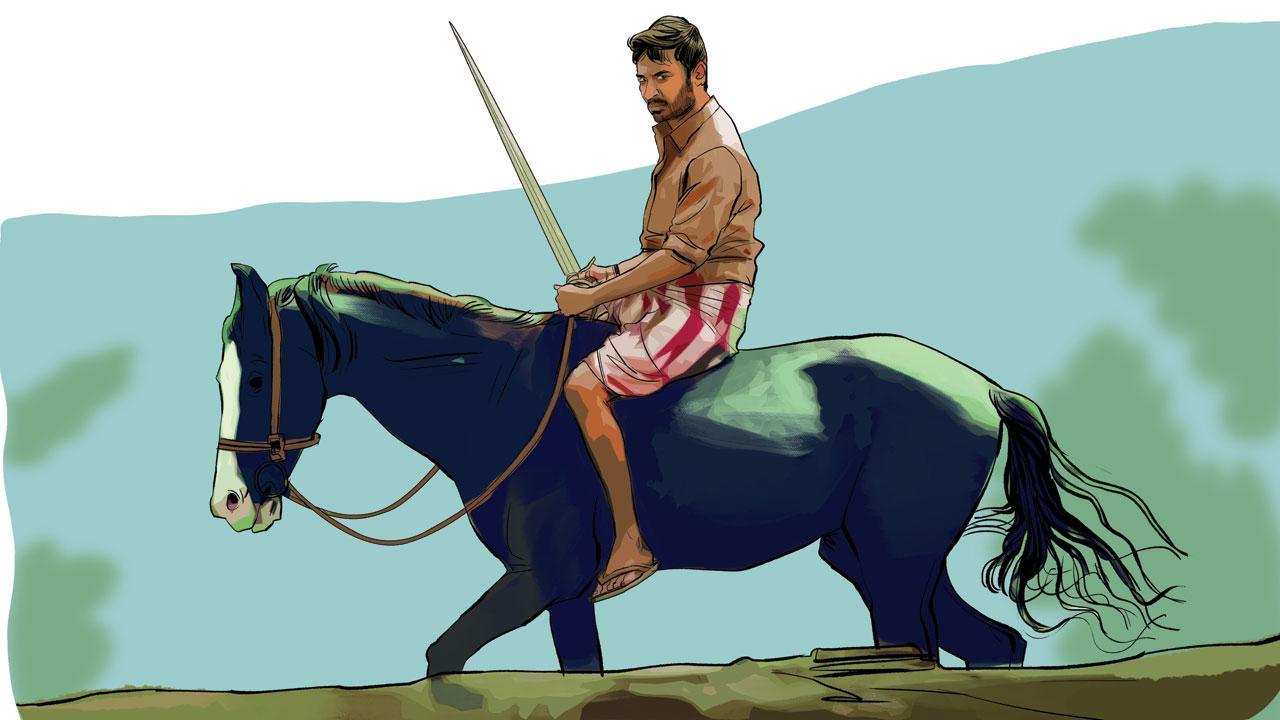
Illustration/Uday Mohite
 One of the most unforgettable moments in Mari Selvaraj’s Karnan (Tamil), starring Dhanush, is when a murderous police officer destroying a village, bursts into a house, and is cravenly offered a tiny baby, just born at that instant, dripping blood. Extreme violence is momentarily paralysed when confronted by extreme vulnerability and innocence. It is one of many epic moments in Karnan, a ferocious, explosively good film, streaming on Amazon Prime Video. A modern retelling of the myth of Karna from the Mahabharata, it is set amid the struggles of the low castes, led by Karnan, a Tamil ‘Samurai’.
Karna, of course, was the son of Kunti and Surya, the sun god, who was abandoned; Kunti later became mother to the Pandavas, but avoided acknowledging Karna, who remained the perennial outsider.
In Selvaraj’s stunning debut Pariyerum Perumal (The God on a Horse, 2018), a law student tries to use discussion to dissuade violent upper castes. By his second feature Karnan, Selvaraj acknowledges that only a smash-and-grab approach will work if the low castes want justice in today’s India. His narrative, more expansive and layered, is imbued with mythology, metaphors and magic realism. Despite Karna having illustrious precedessors in Shyam Benegal’s Kalyug and Mani Ratnam’s Thalapathi, Karnan walks tall.
Trending Stories
Latest Photos
Latest Videos
Latest Web Stories
ADVERTISEMENT

Ganeshotsav 2026

ADVERTISEMENT