Sarojji's jhatkas and matkas
Updated On: 12 July, 2020 07:00 AM IST | Mumbai | Meenakshi Shedde
sarojjis scornful smirk tells us what she thinks of Indian morality, and the firm knowledge that men will be men.





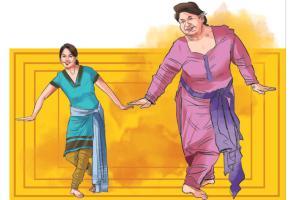
Illustration/Uday Mohite
 Indian filmmakers have a very ambivalent attitude towards song and dance, Indian cinema's USP, especially in an international setting. Once I was on the FIPRESCI Jury (International Federation of Film Critics) of the Berlin Film Festival in 2000, and watching Mani Ratnam's Dil Se (From the Heart). He had sent an 'international cut' with hardly any songs. Fellow juror Derek Malcolm protested, "What! A Mani Ratnam film without the songs? Tell him we want only the songs." He was half-jesting, of course, but it tells you how much the Indian art of song picturisation and choreography is also admired worldwide.
I was recalling this as ace dancer-choreographer Saroj Khan, who left her distinctive stamp on Bollywood song and dance, died of a heart attack, at 71, on July 3. Winner of three National Film Awards for choreography, she had choreographed over 2,000 songs in a rich, 66-year-long career as dancer-choreographer, from Aagosh (1953) to Kalank (2019). Since independently choreographing for Geeta Mera Naam (1974), she became famous for Hawa Hawai with Sridevi (Mr India, 1987), followed by a long collaboration with Madhuri Dixit from Ek do teen (Tezaab, 1988) onwards. Her most popular dances included these and Dola re dola (Devdas), Choli ke peeche kya hai (Khalnayak), Nimbooda (Hum Dil De Chuke Sanam) and countless others. Although best known for her raunchy songs with jhatkas and matkas, her repertoire also included a wide range from classical and folk, to seductive, saucy and fun dances, from the folksy Bichua in Bimal Roy's Madhumati to classical Bharata Natyam in Sharada Ramanathan's Sringaram, which got her her first National Film Award.
Trending Stories
Latest Photos
Latest Videos
Latest Web Stories
ADVERTISEMENT
Mid-Day Fast
ADVERTISEMENT