
TEER has proven to be the most advanced treatment option for treating severe Mitral Valve Leakage.
TEER
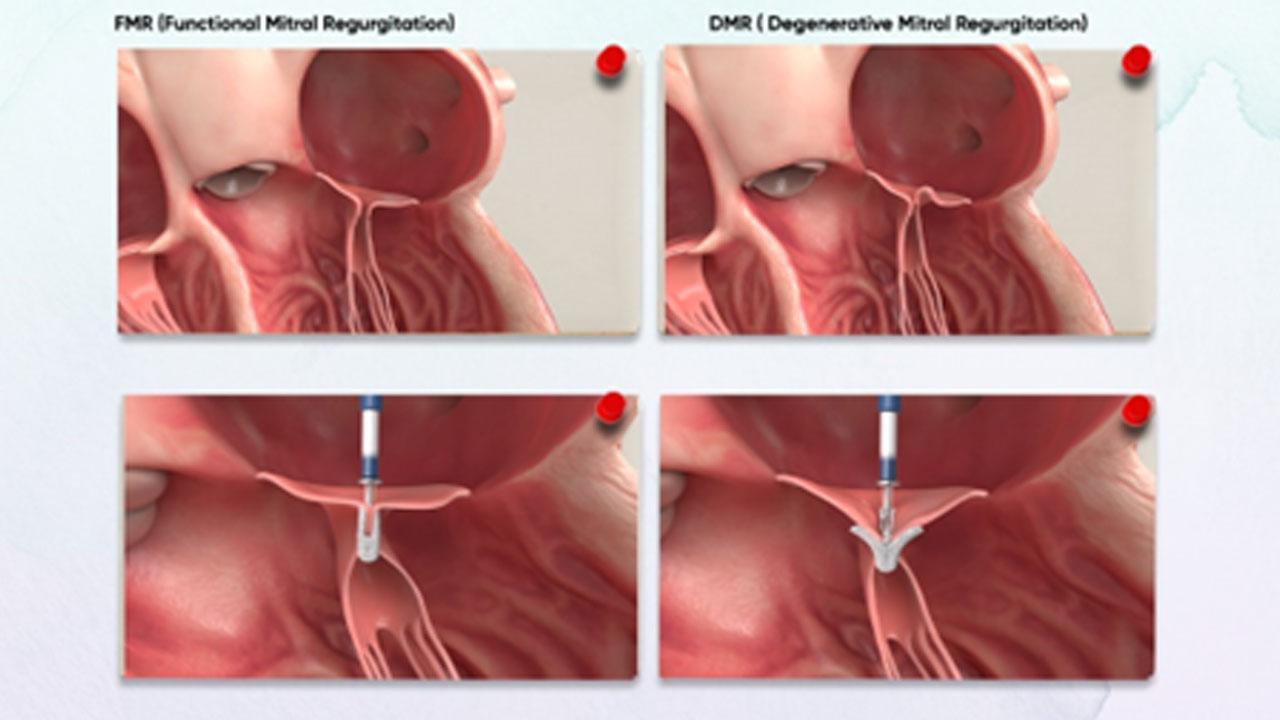
Transcatheter Edge-to-Edge Repair (TEER) is a minimally invasive treatment option for high-risk patients with Mitral Valve Leakage. TEER has proven to be the most advanced treatment option for treating severe Mitral Valve Leakage.
Mitral Valve Leakage, also known as mitral regurgitation, is a symptomatic, cardiovascular condition wherein the mitral valve does not close tightly. This causes blood to flow backwards into the left atrium when the left ventricle contracts and onwards in towards the lungs causing severe blood pressure and symptoms. This is a serious heart condition usually observed in patients who have experienced heart attacks and have a dilated heart but can also occur in patients who are elderly and have diseased mitral valve which do not close properly. Reportedly more than 70% of the population on conventional medical treatment may die in case they are not offered treatments such as valve replacement, mitral annular surgery or TEER procedure.
Mitral Valve Leakage:
The Mitral Valve is a unidirectional valve located between the left atrium and the left ventricle, and it facilitates the flow of purified / oxygen rich blood from the lungs to the body. In a healthy heart, the mitral valve opens and closes tightly with each heartbeat preventing the blood flowing in reverse direction towards the lungs. When the mitral valve does not close tightly, the blood flows back into the left atrium, and the heart compensates for the blood leakage by pumping harder, masking the issue in the early years. As the severity of blood leakage increases with years within a few years it leads to compromised heart conditions which is irreversible and eventually fatal.
Cause:
The common observed causes for Mitral Valve Leakage are Degenerative Mitral Valve disease caused due to progressing age, atrial fibrillation, Rheumatic fever from untreated gum or throat infection, Heart attacks that cause damage to valve structures, Infective endocarditis, also known as Valve infection, and Congenital valve defects that arise due to birth defects.
Symptoms:
The early symptoms of the disease are usually observed at the age of 60 years and above.
- Shortness of breath
- Palpitations
- Swollen feet or ankles
- Heart murmur
- Light headedness or fatigue
- Chest discomfort, or weakness
- fainting
Detection:
Mitral Valve defect can be diagnosed early through:
- Echocardiogram, a simple ultrasound of the heart
- Fetal Echocardiogram to detect valve defects during pregnancy or before birth,
- Electrocardiogram to detect Atrial fibrillation, and
- X-ray to check for heart enlargement.
Early detection of the disease allows surgeons to manage the symptoms with medication and to avoid heart failure or atrial fibrillation.
Treatment:
For managing mild symptoms, surgeons usually prescribe medicines such as Diuretics to reduce fluid build-up, and Beta-Blockers and ACE inhibitors to improve heart function. Other newer medications include ARNI, SGLT-2 inhibitors which also improve heart function. In some patients where the pumping capacity of the heart is sufficient (>30%) the surgery may be considered. In majority of these patient the pumping capacity is severely compromised (<30%) and they are usually on medication and may be recommended TEER procedure based on its suitability.
Transcatheter Edge-to-Edge Repair (TEER):
The TEER procedure is highly recommended for patients who are considered high surgical risk due to pre-existing issues like hypertension, diabetes, obesity, advanced age, physical frailty, enlarged or weak heart, and patients with kidney, lung and liver problems.
TEER is a minimally invasive procedure that is performed in a CATH Lab under general anaesthesia. During the procedure, a catheter is inserted through a incision near the groin, usually into the femoral vein, and guided to the mitral valve using real-time 3D Transoesophageal Echocardiography (TEE) and Fluoroscopy (X Ray imaging). A small clip is then attached to the Mitral valve leaflets to help them close tightly and reduce the backflow of blood (regurgitation) into the left atrium. The TEER procedure is usually completed within 3 hours.
Benefits of the TEER procedure:
- Minimally invasive procedure that negates the need for open heart surgery
- Recommended for high-risk surgical patients with comorbidities
- Limited hospital stay of 3 to 5 days
Reduced repeat heart failure hospitalisation
Improves quality of life
- Lower post-surgical complications and faster recovery period
- Allows for future intervention, if required
Post-surgery Hospitalisation and Recovery:
Post the TEER procedure, the patient is kept under observation in an ICU for 24 hours to monitor heart rhythm, valve function, blood pressure, kidney function, symptoms of bleeding, arrhythmias or for any other valve-related complications. Patients are often discharged within 3 to 5 days of the procedure if they are well.
Under medical guidance, patients usually resume daily activities like walking and non-strenuous work within a short period post the procedure. Post 6 weeks of the TEER procedure, patients have been observed to resume regular activities under medical supervision.

Doctors may prescribe blood thinners or antiplatelets, with continuation of blood pressure or heart failure medication. Planned medical follow-ups are recommended to monitor valve function.
Disclaimer:Mid-Day holds no responsibility or liability for any direct, indirect, implied, punitive, special, incidental, or consequential damages resulting directly or indirectly from the use of this content. It is advisable to seek guidance from an expert advisor or health professional as the information on the site is not a substitute for professional medical advice, diagnosis, or treatment. The information provided should not be used for diagnosing or treating a health problem or disease, and individuals seeking personal medical advice should consult with a licensed physician. The views and opinions expressed are those of the sponsor/author/agency and do not represent the stance or views of Mid-Day. Any purchases made from the branded segment are at your own discretion and risk.
 Subscribe today by clicking the link and stay updated with the latest news!" Click here!