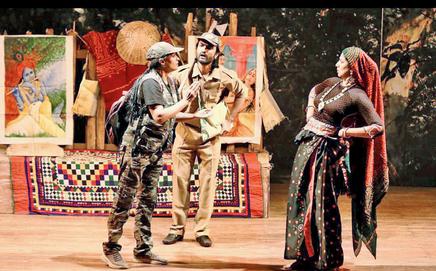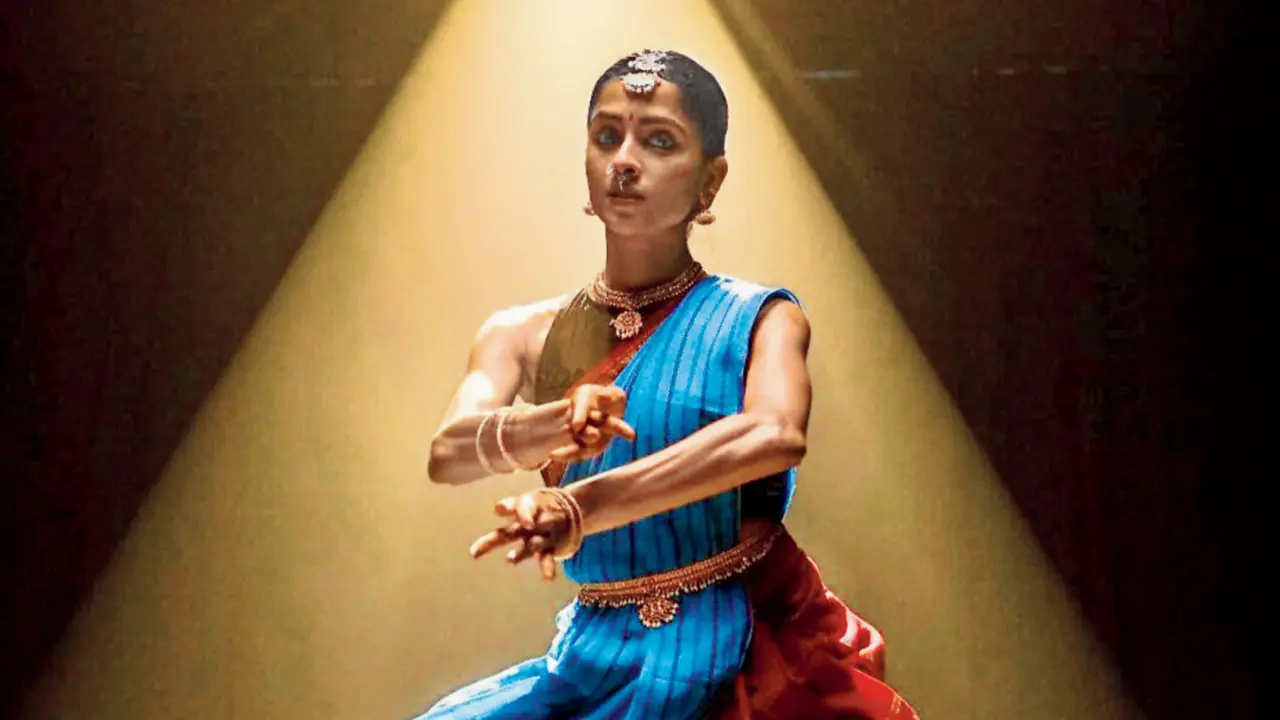
For decades, Gujarati theatre has flourished in Mumbai — comic, philosophical and closely tied to the rhythms of everyday life. While its roots remain strongest in Ahmedabad, Vadodara and Surat, the city serves as an important stage for its evolution. That legacy comes into focus this week as the Vasant – Gujarati Theatre Festival returns to the National Centre for the Performing Arts (NCPA) with a four-day programme of plays, poetry, comedy and workshops that highlight the many forms Gujarati storytelling can take. Aditi Desai and Bruce Guthrie “We are delighted to welcome Gujarati-speaking audiences back for Vasant,” says Bruce Guthrie, head of theatre and films at the NCPA. “Gujarati theatre plays a central role in Mumbai’s cultural life, and this year’s programme reflects both its depth and its range.” Director Aditi Desai adds that festivals like this help bring regional theatre to wider audiences. “Our play Akoopar, based on the novel, Akoopar by Dhruv Bhatt, explores the Maldhari community and their relationship with the lions of Gir Forest National Park. At a time when coexistence with nature is increasingly urgent, their way of life feels especially relevant. This is our 97th performance, and the play is ultimately about the search for truth — Satya.” Till March 15At NCPA, Nariman Point. Log on to ncpamumbai.comCost Rs 360 onwards (members); Rs 400 onwards (non-members) The guide’s top Picks Shakespeare Mharo Jamai A performance of Shakespere Mharo Jamai A Rajasthani folk play where Banjara storytellers begin to notice uncanny parallels between Shakespearean drama and their own oral traditions, this one has satire, humour and live folk music.ON March 12; 7 pmAT Experimental Theatre Akoopar by Aditi Desai Set in the landscape of the Gir Forest National Park, this adaptation explores the life and philosophy of the Maldhari community and their delicate coexistence with wildlife.ON March 14; 7 pmAT Experimental Theatre Lagna – The Musical The festival closes with a lively musical that reimagines traditional Gujarati wedding songs while playfully examining family expectations, rituals and humour. ON March 15; 8 pmAT Tata Theatre Choggo An experimental poetry-led performance by Saumya Joshi with poets Anil Chavda and Bhavesh Bhatt, that blends spoken word, rhythm and theatrical expression to explore contemporary Gujarati verse.ON March 15; 5.30 pmAT Tata Theatre That’s So Viraj Stand-up comedy joins the line-up as Viraj Ghelani mines everyday Gujarati family life for humour, exaggeration and moments of instant recognition.ON March 13; 7.30 pm AT Tata Theatre Socrates Revisiting the trial of the Greek philosopher Socrates, Manoj Shah’s play draws parallels with Indian traditions of debate and reflects on the value of free thought.ON March 15; 3.30 pmAT Experimental Theatre
12 March,2026 09:33 AM IST | Mumbai | Rumani GabhareThursdayDance to freedom Improvisational games brought alive through dance, Errors Onleee might be the inspiration you need to get up and move this weekend.Time 8.15 pm onwardsAt Veda Black Box, Versova. Log on to jainilmehta.orgEntry Rs 500 FridayMagic of sounds Pic courtesy/@jyotimayi.music Sit back, unwind, and listen to artiste Jyoti Mayi (right) blend Sanskrit mantras, experimental electronics in her immersive album, Acoustic Levitation.Time 7.30 pmAt Harkat Studios, Versova. Log on to altshows.comEntry Rs 350 SaturdayPoetry for everyone Pic courtesy/Brain Bristle Foundation Words can be magical, and transport you from the city’s chaos to a fantastical world. Ask Devangana Mishra (above), as she guides you into a lyrical session.Time 7 pmAt Fictionary Bookstore and Cafe, Bandra West. Log on to urbanaut.appEntry Rs 499 onwards Sketch your feelings Pic courtesy/@the.inkpot Heal with art, as illustrator Sneha Dasgupta teaches you to draw your emotions onto your canvas in this guided creative session. Time 11 am to 1 pmAt Bombay Sweet Shop, Oshiwara. Log on to @bombaysweetshopEntry Rs 800 (per person) SundayFestive feast Pic courtesy/kadak You cannot go wrong with this Iftar Dawat, that delivers on fare from Seasonal Fruit Chaat to spiced kebabs. Time 7 pm onwardsAt Kadak, ICONIQA Hotel, Andheri East.Call 8655691535 Cost A la carte (individual dish pricing); Rs 499 onwards (dessert buffet)
12 March,2026 09:31 AM IST | Mumbai | Trisha GhoshKolkata-based urban sociologist and writer Rahul Singh’s debut novel, Unfolding (HarperCollins India), is an example of sophisticated character study. It traces the lives of two gay protagonists Ralph and Ojas, who set out to explore an open relationship. It also observes the life of their domestic help, Zubina. While Ralph, a chef at a major Kolkata hotel, struggles with the non-monogamous set-up and holds on to the memories of his mother, Zubina considers love and its various manifestations. Singh began writing the book in 2020, amidst reading novels featuring queer characters; he wanted to read one where the character’s narrative arc was not confined to their coming-out. “I wanted to see that if there are two men who are already together, how are they making it? And I saw Ralph and Ojas in this sort of a relationship which is appealing to one and not to the other.” This nudged him to tap into these novel dynamics that can be witnessed more visibly today, especially among the queer communities. Illustration courtesy/Veer Misra, Harpercollins India Two prominent voices emerge in the book, Ralph’s and Zubina’s, though others’ lives unfold around them too. Zubina provides an outsider’s perspective into this relationship. Singh recollects drawing her character after he imagined Ralph and Ojas. “I thought if these are two men, there has to be someone who is continuously working as a help,” he tells us. Zubina holds conservative values, is God-fearing, and believes in propriety. It is not rare to find voices like hers in literature, but it is uncommon to read her perspective in novels about queer lives. As Ralph’s help, she’s privy to his world. At the same time, in imagining her domestic life, Singh makes us privy to her world and her negotiation with love at home. Rahul Singh “Zubina was developed because of my training as an ethnographer,” Singh, who is currently pursuing a PhD in sociology, shares. “I’ve been visiting neighbourhoods, so I observed the different ways of life around me. But I wasn’t observing it with the intent of writing about Zubina.” He learnt about habitats and the various kinds of indispositions that people live with. “These went into me imagining a Zubina,” he adds, grateful that his editors helped bring out the finer nuances of the Muslim woman. The novel at its core is about intimacies and its precariousness. The title is both arresting and unassuming. In his first draft, Singh recalls writing a scene where a character unfolds a bedsheet. “That image stayed with me; that’s what I saw this novel as,” he says. At the time, he was also reading Marcel Proust, whose profound meditation on memory and love stirred something in him. The title speaks to the many lives the novel deals with. “In a way, it universalised their divergent language of uncertainty and desire where there was still hope,” he concludes. Available: Leading bookstores and e-storesCost: Rs 599 Author Reccos >> Garth Greenwell’s Small Rain>> Sylvia Townsend Warner’s Summer Will Show>> Brandon Taylor’s The late Americans>> Violet Trefusis’s Broderie Anglaise>> Vasudhendra’s Mohanaswamy
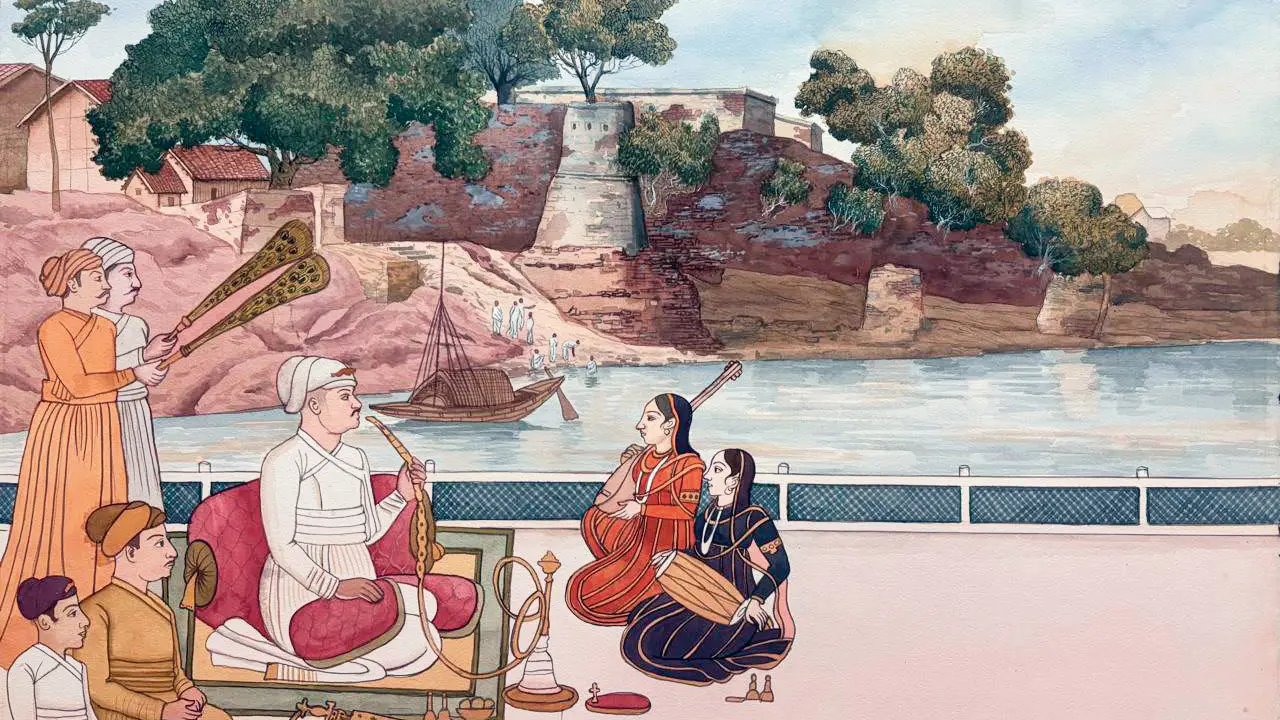
12 March,2026 09:28 AM IST | Mumbai | Nandini VarmaBeauty and its secrets Shivratri procession at the Purab Darwaza. Pics Courtesy/Artists, strangers House Gallery In the age of new colonialism, Akshay Singh Maksudpur and Mahesh Soundatte’s Veerane Pe Kya Guzari reminds us of the familiar slip-ups hidden behind the beauty pf that age. Maksudpur, a cinematographer, collaborates with Soundatte, a portraitist and painter from Ichalkaranji, to create an album on the city of Patna, drawing from the famed Patna Kalam Company paintings.ON Tomorrow; 5.30 pm to 9.30 pmTILL April 9; 11 am to 7pmAT Strangers House Gallery, Old Wodehouse Road, Colaba. Ancestral threads To Find the Hidden Self, 1, Kaveri Raina. Pics Courtesy/Artist; Experimenter Gallery Kaveri Raina finally makes her India debut with an exhibition that delves into memory, history and personal journey. The new series of works, of fire-harpoons, draws inspiration from the 14th Century Kashmiri poet, Lal Ded, becoming an inspiration for Raina’s own exploration of her obscured and complex ancestry.Till April 18; 10.30 am to 6.30 pmAT Experimenter, first floor, Sunny House, Merewether Road, Colaba. Encounter the unknown Installation view, Goutam Ghosh. Pic Courtesy/artist; Project 88 Tactile, immediate, and arresting, Goutam Ghosh’s Bite the Bullet, interrogates our visual perspective, and historical memory through sculpted creations. The work stands at an intersection of the artist’s long examination of ideas. Till May 2; 11 am to 7 pm (Tuesday to Saturday)AT Project 88, BMP Building, Colaba. The price of progress Navjot Altaf, Gudhal/White Hibiscus, Hibiscus Arnottianus; Waste Archives as Landscape, 2024-25 What does innovation mean? What is the true cost of progress? Straddling the distinct worlds of Bastar and Mumbai, Navjot Altaf’s latest examination questions the existential tensions between the ideas of progress and ecology through the visual memory of things left behind. Waste Archives as Landscape follows the remnant evidences of innovation and progress in an increasingly consumerist society. Waste Archives as Landscape, 2024-25. Pics courtesy/the artist; Volte Gallery Till June 10; 10.15 am to 6 pmAT Jehangir Nicholson Art Foundation, second floor, Chhatrapati Shivaji Maharaj Vastu Sangrahalaya, Mahatma Gandhi Road, Fort. ENTRY Museum tickets apply
12 March,2026 09:26 AM IST | Mumbai | Shriram IyengarWalking on sunshine Glowing in a vibrant yellow ensemble on Wednesday, Malaika Arora stepped into Sweeney, Khar, to launch her new lifestyle accessories line, Maejoy — and yes, the restaurant happens to be hers too. Two birds, one very stylish stone Skin glowing, Wit showing The internet will tell you Malishka Mendonsa is an Indian radio personality. Having known her for nearly three decades — we went to college together — I can assure you the operative word in that description is the last one: personality. ‘Mumbai ki Rani’ Malishka is less a job title than a full-blown presence. Her wit is quick, her laugh quicker, and her switch to ‘on’ appears to have been permanently installed sometime in the early 2000s. Malishka Mendonsa Take, for instance, her social media tell-all from a spa session on Tuesday. Alongside the picture we’ve reproduced here, Malishka writes, “Me trying to get my payment app to open through face recognition while getting a facial… Access denied. Skin aglow.” Peak personality. And then — because she can’t resist — she tops it off with a message to me when I ask for the image: “Babe, when you finally decide to write about me, you’re going to use this picture where no one can see my face?” Some people have good timing. Malishka, naturally, has the last word. Desi Triumph One of my early lessons in journalism — and easily the one I remember the best — came from the brilliant Bachi Karkaria. Her point: people care far more about the dead dog on their doorstep than a war on the other side of the world. It’s been ages, so forgive the paraphrase, but the lesson sticks. Vikas Khanna Underscoring that sentiment this week is chef Vikas Khanna. In a yet-to-be-released podcast with Vir Sanghvi, Vikas recounts his journey to stardom, peppered with tales of racism and despair, all with one message: “Let’s turn this pain into purpose.” Mission accomplished, clearly, because these days the Michelin-starred chef is fielding calls from Jeff Bezos, who wants to know how one scores a reservation at NYC’s Bungalow — Vikas’s East Village eatery. But back to our main mudda. In August 2024, Bungalow was awarded a prestigious three-star rating by The New York Times. Apparently, it marked the first time in nearly 25 years that an Indian restaurant has received such a high honour from the publication. Understandably excited, Vikas rushed to share the news with his mother in India. “Mumma ne sidha bola ki Punjab Kesari mein toh aaya nahi,” the chef recalls. Perhaps this piece, published closer to home, will finally deliver the news to her doorstep. Brand Stand Celebrity brand ambassadors don’t always put their money where their mouths are, but that can’t be said of Sachin Tendulkar. Literally walking the talk in Ten x You sneakers, Sachin showed up to support son Arjun during a practice session at Bandra’s MIG Cricket Club last month. No planned press conference, no staged photo op — just Sachin being Sachin, and yes, actually wearing his own brand. Sachin Tendulkar. PIC/SHADAB KHAN This kind of commitment is commendable, especially since it isn’t the norm. We find local ambassadors for Louis Vuitton or Gucci wearing their brand one day and Dior or Hermès the next — as evidenced by ample airport looks. Perhaps there’s an aspect of good sportsmanship to it, because another cricketing icon showed the same sort of commitment during a photoshoot with yours truly some years ago. Yuvraj Singh is the man in question, whom I had kitted out as a Keanu Reeves-inspired Matrix hero. Fashion designer Narendra Kumar Ahmed was tasked with getting the ensemble on point (which he did with aplomb), and that left us to match Neo’s signature Matrix micro-sunglasses. Chuffed to have found the perfect pair, we were met with pandemonium on set when Yuvi refused to wear anything but Oakley because he was associated with the brand at the time. No amount of cajoling worked and eventually we went with what he wished. Because in a world of flexible brand loyalties, that kind of consistency is its own quiet heroism. History in silk Vijay Deverakonda Baroda royal Radhikaraje Gaekwad is a custodian of culture and a connoisseur of the arts. She wears legacy with a lightness and grace that makes her relatable, but don’t mistake that ease for ignorance — this maharani knows her history. Which is precisely why she had an unexpected observation when actor Vijay Deverakonda popped up on her Instagram feed, dressed in a regal Falguni and Shane Peacock ensemble for his recent sangeet ceremony. Radhikaraje Gaekwad While the internet fawned over Vijay as the season’s best-dressed groom, Radhikaraje clocked something else entirely: the cape. To her trained eye, the look carried echoes of royal wardrobes from decades past — the powder-blue silk cape recalling the very cloak Maharaja Sayajirao wore in 1919, when the British Empire awarded him one of its highest honours. For everyone else, this was just another stylish celebrity moment. For the Maharani of Baroda, it was proof that fashion has a long memory. And to us, a reminder that a royal eye sees what the crowd cannot.
12 March,2026 09:24 AM IST | Mumbai | Sonali Velinker KamatThe final episode, a special two-and-half-hour episode of M*A*S*H (Mobile Army Surgical Hospital), which was watched by 77 per cent of TV viewers in the USA, made it the highest percentage to watch a single TV show at that time, underlining its immense popularity. For viewers like this writer, and we are sure there were many like us, who watched the show much later, in the late 1990s and early 2000s, after satellite television had arrived in India, it came as a breath of fresh air. The 14-Emmy-Award-winning show directed by Robert Altman, introduced humour and drama through an empathetic lens, against the backdrop of the Korean War (1950-53), thanks to its brilliant ensemble cast, and screenwriter Larry Gelbart and his team. (Left to right) Alan Alda, Mike Farrell, and Harry Morgan The team of surgeons, nursing and support staff at a fictional camp in South Korea captured our imagination, with leads, Captain Benjamin Franklin ‘Hawkeye’ Pierce (played by Alan Alda) and Captain John ‘Trapper’ McIntyre (Wayne Rogers). Trapper later made way for Captain BJ Hunnicutt (Mike Farrell). Their other key characters included Major Margaret ‘Hot Lips’ Houlihan (Loretta Swit), the ranking nurse; Major Frank Burns (Larry Linville) who was replaced in the later seasons by Major Charles Emerson Winchester (David Ogden Stiers). The commander was Lieutenant Colonel Henry Blake (McLean Stevenson), followed by Colonel Sherman Potter (Harry Morgan) in the later seasons. Other characters like Corporal ‘Radar’ O’Reilly (Gary Burghoff) and Corporal Max Klinger (Jamie Farr) and Father Mulcahy (William Christopher) were equally memorable. It’s title song, Suicide is Painless, composed by Johnny Mandel, became a cult track, and went on to top the UK charts at one point. To find reasons to smile amidst the helplessness of war was its overarching theme that remained at its core till the last episode. Old-timers will never tire of watching reruns. We suspect the show’s vintage appeal might pique the interest of first-time viewers, including later Millennials, Gen Z and Gen Alpha generations. Sit back and enjoy its crisp and seamless writing that balanced hilarity with poignant storytelling in the time of war. Log on to: YouTube
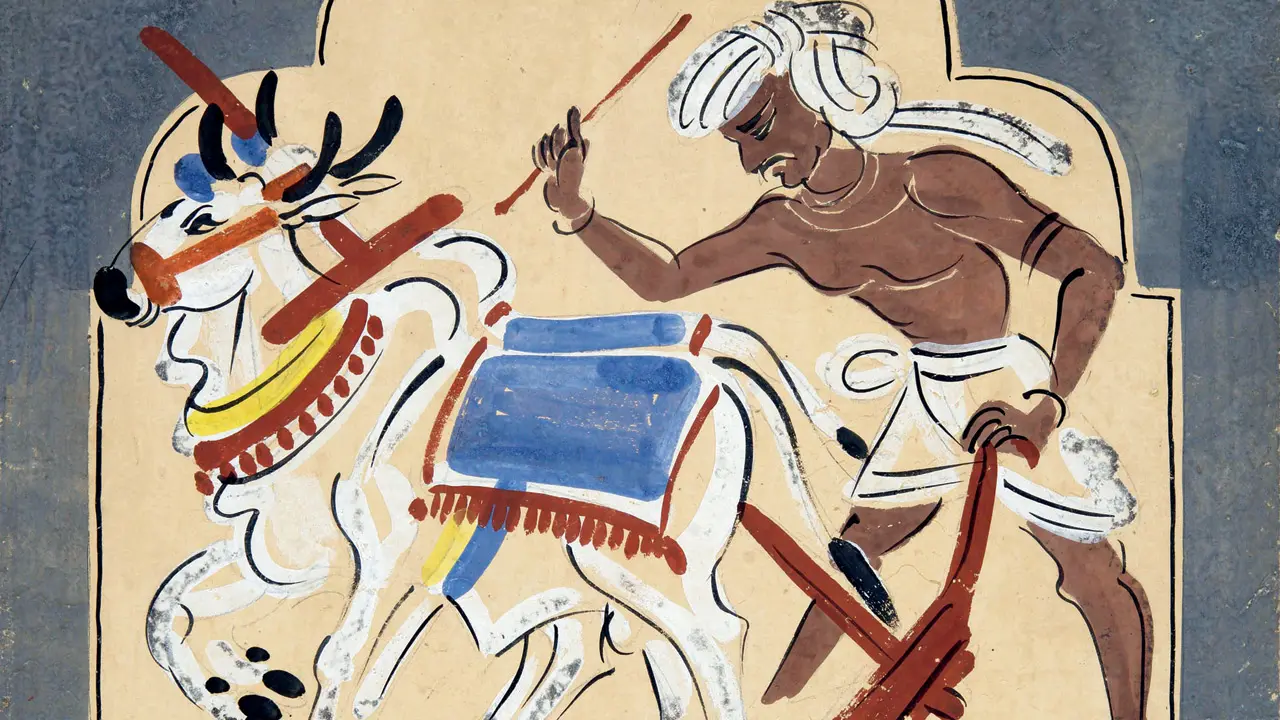
11 March,2026 09:57 AM IST | Mumbai | Fiona FernandezIt is February 1938. The Indian National Congress calls for a session at Haripura in Gujarat, under the presidency of Netaji Subhash Chandra Bose. The quiet moment of resolve is boiling over, as Bose arrived in a convoy of 51 bullock carts. It was for this iconic moment that artist Nandalal Bose created the Haripura panels, a celebration of India’s past and its freedom on the horizon. The panels, along with a series of rare films and works by the contemporary master arrive in the city for the latest exhibition, Colours of Swades: From Haripura to the Constitution at the National Gallery of Modern Art (NGMA). Veena Vadini. Pics courtesy/NGMA “Nandalal Bose is widely regarded as one of the nine masters of Indian modern art. His works are profoundly Indian in their ethos, practice, and themes, reflecting a deep engagement with the cultural and social life of the country,” IAS Nidhi Choudhari, director, NGMA reminds us. The works are remarkable in their simplicity and boldness, and celebrate the rustic ethos of the India Bose portrays — potters, weavers, farmers, musicians among others — in a style that blends styles from Kalighat paintings to Pattachitra art, and the mural works from Ajanta. A view of the ornate page of the Preamble illustrated by Bose “Most strikingly, a significant number of these works celebrate women. Nearly one-third of the panels depict women engaged in diverse activities — performing household chores, dancing, singing, practising archery, riding horses, and participating actively in community life,” Choudhari points out. Deputy curator Shruti Das adds, “Bose was deeply influenced by major intellectual figures of Indian art history, including Abanindranath Tagore, Rabindranath Tagore, Ananda Coomaraswamy, and E B Havell. Their ideas about reviving India’s artistic heritage profoundly shaped his vision, which he later transmitted to his students.” This language finds expression primarily through the iconic panels, set in an installation that replicates the original pavilion. These are accompanied by a physical copy of the Indian Constitution — that Bose illustrated, with his students. Nandalal Bose “The exhibition also introduces a contemporary digital layer through AI-generated films and animated interpretations of Bose’s artworks created by filmmaker Ebyug Akhil, making the experience visually engaging and accessible for present-day audiences,” shares Das. “This integration ultimately creates a layered narrative that connects history, art, and technology,” the curator concludes. A timely reminder at a time when soft power is slowly waning. Till June 9; 11 am to 7 pm (closed on Mondays)At NGMA Mumbai, Sir Cowasji Jehangir Public Hall, Fort.
11 March,2026 09:50 AM IST | Mumbai | Shriram IyengarAt the showcase by Gucci during the recently concluded Milan Fashion Week, Alia Bhatt proved that black is never just black — it is a statement. As the luxury house’s global ambassador, Bhatt showed up in a sleek leather coat-dress that balanced sharp tailoring with a subtle hint of drama. The structured, yet bold silhouette, punctuated with glossy gold buttons, gave her a commanding edge; somewhere between boardroom boss and runway rebel. Bhatt styled it with pointed heels and barely-there accessories giving it that effortless I-woke-up-like-this look that fashion insiders swear by. Against the old-world elegance of Milan’s skyline, Bhatt stood out with quiet confidence. There was no excess, no distraction, just a bold attitude and the power of minimalism done right. Bhatt offered the perfect reminder: When styled well, the darkest shade can steal the brightest spotlight. Log on to: @aliaabhatt
11 March,2026 09:45 AM IST | Mumbai | Rumani GabhareIn restless dreams I walked alone, narrow streets of cobblestone,” the 1964 lyric by Simon and Garfunkel might as well have been about every Indian artiste’s dream of reaching the famed streets of Scotland, where the legendary Edinburgh Fringe Festival takes place. Better late than never, the fringe format is finally making its way to Mumbai as artistes and audiences prepare to hop between neighbourhood venues to catch standout acts. ON March 11 to 15AT 3 Art House, Khar West; Gharaonda, Bandra West; Khar Comedy Club; Khar West. LOG ON TO in.bookmyshow.com (for timings and entry) Funny business The festival opens with an all-star night in SoBo with a line-up featuring Kanan Gill, Varun Grover (below), Sapan Verma, Shreeja Chaturvedi, and international acts Michael Ahern and David Hoskin, that will leave you in stitches, happy ones.ON Today; 8.30 pmAT NCPA, Nariman Point. The Guide’s top picks Chai pe charcha Two queer lovers reunite 15 years after their first romance in Taranjit Kaur’s Chai Queens, an internationally acclaimed tale of queer lives in India. If you’re feeling contemplative, stop by the newly opened café to reflect over a cup of chai.ON March 13 to 15AT 3Art House, Khar West. A word on war Described as a ‘superior poet with the ability to engage reluctant audiences’ by critics, David Lee Morgan’s (below) Uncle Tom’s War explores revolution, resistance and the lessons of history through the spoken word. Timely as it can get, we say.ON March 12 to 15AT Gharaonda, National College Lane, 32nd Road, Bandra West. The Scottish solo Pic Courtesy/VeronaSkyFringe London-based theatre company, The Shakespeare Edit brings alive the Bard’s Macbeth. Director Paul Goodwin (below) performs the Scottish drama to the memorable compositions of Ukrainian composer, Dmitriy Saratsky. It plays onstage ‘tomorrow, and tomorrow, and tomorrow’; or in layman speak, all four days of the main festival. ON March 12 to 15 AT 3 Art House, Khar West. Holmes’ homecoming David Stuart Davies’ Sherlock Holmes: The Last Act begins with Holmes returning from the funeral of Dr Watson. Over the next hour, he revisits their most remarkable cases in a monologue to his departed companion. Nigel Miles-Thomas (below) plays 14 characters. Should you catch it live? Elementary, my dear Watson.ON March 12 to 15AT 3ArtHouse (March 12 to 15); Khar Comedy Club (March 14) Whole new world Richard Watkins. PICS COURTESY/ARTISTES’ INSTAGRAM What if your favourite Disney films had queer characters? In Happily Ever Poofter, Richard Watkins (left) plays the only gay prince stuck in a classic fairy tale kingdom. Expect some witty reworking of familiar Disney numbers.ON March 12 to 15AT Khar Comedy Club (March 12, 14, and 15); 3ArtHouse (March 13 and 15)
11 March,2026 09:25 AM IST | Mumbai | Devashish KambleThe diamond standard Aneet Padda channels pure Disney-princess poise, trading a glass slipper for a high-fashion exit in Juhu on Monday. Appearing as an ambassador for a jewellery brand, the Saiyaara starlet proves that while diamonds dazzle, confidence and a flawless silhouette are the ultimate accessories. Gems of love It takes strength to turn loss into a tribute, and love into a legacy — and this month, Farah Khan Ali is set to do just that. We hear the celebrated jewellery designer will open her new flagship store in South Mumbai on March 21, marking an important milestone in her 30-year journey with gems. Farah Khan Ali One has already come to expect opulent design and refined craftsmanship from Farah, but this launch comes with a collection that goes beyond glamour — delivering heart. Alongside her signature monogram pieces, she will unveil a special line of jewels inspired by her late mother, Zarine Khan, who passed away in November last year. Farah believes that jewellery carries a feeling, a moment, an intention. “Long after the day has passed, a jewel remembers,” she says. If that is so, what finer way to honour her mother’s memory than with a collection that transforms love and loss into lasting beauty? And with sisters Sussanne Khan and Simone Arora lending solid support, this event promises to be far more than a store launch, serving instead as a sparkling tribute to love, legacy, and a life well-lived. Slay all day Throughout this T20 World Cup campaign, Tilak Varma has offered up some crucial cameos, but his all-star moment appears to have arrived after we claimed the cup! Still buzzing from the high of Sunday’s victory, we woke up on Monday to find Tilak took the trophy to bed with him — if only for a few photos. Tilak Varma In a series of super-sexy shots on social media, the shirtless star is seen in his hotel room, toothbrush in one hand and trophy in the other. The pièce de résistance, however, is the last image in the carousel: trophy, tattoo sleeve, medal and the man himself on display like art against soft white sheets. The tournament may be over, but the fun has clearly just begun — and honestly, who would stop at play when you can truly slay? Outlook: Sunny If there was ever any doubt the Little Master has a big heart, let’s put that debate to rest. As our boys in blue lifted the T20 World Cup trophy on Sunday, Sunil Gavaskar kept his promise to Suryakumar Yadav (we told you all about that on February 17) — breaking into a brief jig to celebrate our colossal cricket triumph at the Narendra Modi Stadium in Ahmedabad. Sunil Gavaskar The 76-year-old legend, usually the picture of restraint in the commentary box, let his guard down for a few seconds as India Waale blared in the background. And in doing so, Gavaskar reminded us that cricket, beyond statistics and scorecards, is still — first and foremost — about joy. Ek tha Tiger “I really do believe that I stand on the shoulders of amazing artists and talents that came before me,” Priyanka Chopra Jonas told an audience of eager students during the India Conference at Harvard last month. Arguably our most recognisable face in Hollywood today, Priyanka credited Aishwarya Rai Bachchan and the late Irrfan Khan with paving the path to global recognition. But long before these trailblazers there was another, and it took a true OG to recognise it. Kabir Bedi On Friday, Salman Khan posted a shout-out to Sandokan star Kabir Bedi, referring to him as “the first Indian to do an international TV show.” Generous with his praise, Salman went on call Kabir “forever handsome, enigmatic, the original Tiger.” Both the sentiment and its timing were spot-on, with the iconic series celebrating 50 years at the Sanremo Music Festival in Italy on February 24. Of course, Kabir and his charming wife Parveen Dusanj attended the commemorative event, even interacting with the star of the new Sandokan series: Turkish actor Can Yaman. Salman Khan But back to our local ‘Tiger’ Salman and his tribute to Bedi. “My duaa that everyone looks as strong and conducts their emotional life as @kabirbedi. The new Sandokan @canyaman… you have big shoes to fill.” A roaring dose of rightful praise from one Tiger to another.
10 March,2026 11:14 AM IST | Mumbai | Sonali Velinker KamatWho said that up-skilling has to be useful? If you ever grow tired of this constant pressure to learn skills, and build your brain, to further ambitious career demands, the internet can be a quirky and fun place. For the rebels that look to excel in silly skills, there is Skill Addicts. From learning to juggle, spin a top, or even freestyle football, this one is for those unafraid of embarrassment. We’d recommend signing up for the yo-yo. Sleek, simple, and addictive fun through gamified skill points, it can be a positive brain rot. Log on to: Skill Addicts on Playstore
10 March,2026 08:57 AM IST | Mumbai | Shriram IyengarADVERTISEMENT