










Bharathesh GD turns back time, nostalgia, and form with a new subversive exhibition that taps into the eye-catching power of the familiar cutouts

The artist works on his creations at his studio in Bengaluru
I know cinema from a very different perspective,” shares Bharathesh GD. The Bengaluru-based artist is quite nostalgic when we remind him that his exhibition, An Index of Disobedience, opens in Mumbai in the same week as the latest Rajinikanth blockbuster. Growing up in Davanegere in central Karnataka, Bharathesh was more than familiar with the hysteria around such films. “My father used to be an artist, and later a projectionist at the Moti Theatre. Most of my childhood was spent watching films, from the projection room, or watching him create art on posters and cutouts,” he shares. The influence is particularly robust with his latest exhibition that opened at a SoBo gallery on August 14.

I just said it to I told you so and Eye Activated, Gaze Pronounced
The works almost feel like a return for the artist. Known for his inter-disciplinary practice, this is his first painting series in almost 15 years. The colours, and the medium, he uses for the series of works ‘Pain Corporation of India (2024-2025)’ are shaped by his early years in the working-class hub of Davanagere.
Curator Amshu Chukki reveals in a note, “His father worked as a cinema cutout artist and projectionist, painting enormous film posters, obituary banners, and hand-lettered signs, often based on techniques inherited from the Baburao Painter school in Kolhapur. Having trained at Sir JJ School of Art, he worked as an art director while in then Bombay, and briefly assisted V Shantaram on the film Jhanak Jhanak Payal Baaje before he moved back to Davanagere.”

The display at the gallery
Where Bharathesh deviates is transforming this very familiar public art to a subversive narrative. “This set of work has multiple entry points. It came from a deep discomfort with our times, where being a society, we are generating pain. I had to turn to painting to express this — so many images are being circulated and generated that probably it is the best time to be a painter. To make static images,” the 44-year-old artist remarks.
The series of 10 cutouts of plywood, with their distinct fluorescent outline — a familiar sight in South India, Bharathesh explains — are stacked narratives or ‘meaning making machines’. “They are hybrid images that contain within themselves multiple images derived through popular culture. As you glance through them, you create your own meaning and inferences,” he adds.

Pakoda Republic and assorted applications. Pics Courtesy/Fulcrum Gallery
Whether that is a cluster of eyes and exposed flesh in Louder Than Silence: This Shall Pass Too, or the subverted nature and purpose of WhatsApp forwards in In and As, Encrypted Forwards, these works also turn the medium against itself. A reference Chukki points out is Kannada actor Upendra’s use of an upside-down cutout during the release of his film, Uppi (2015) was a statement against the age-old tradition of garlanding superstar cutouts.
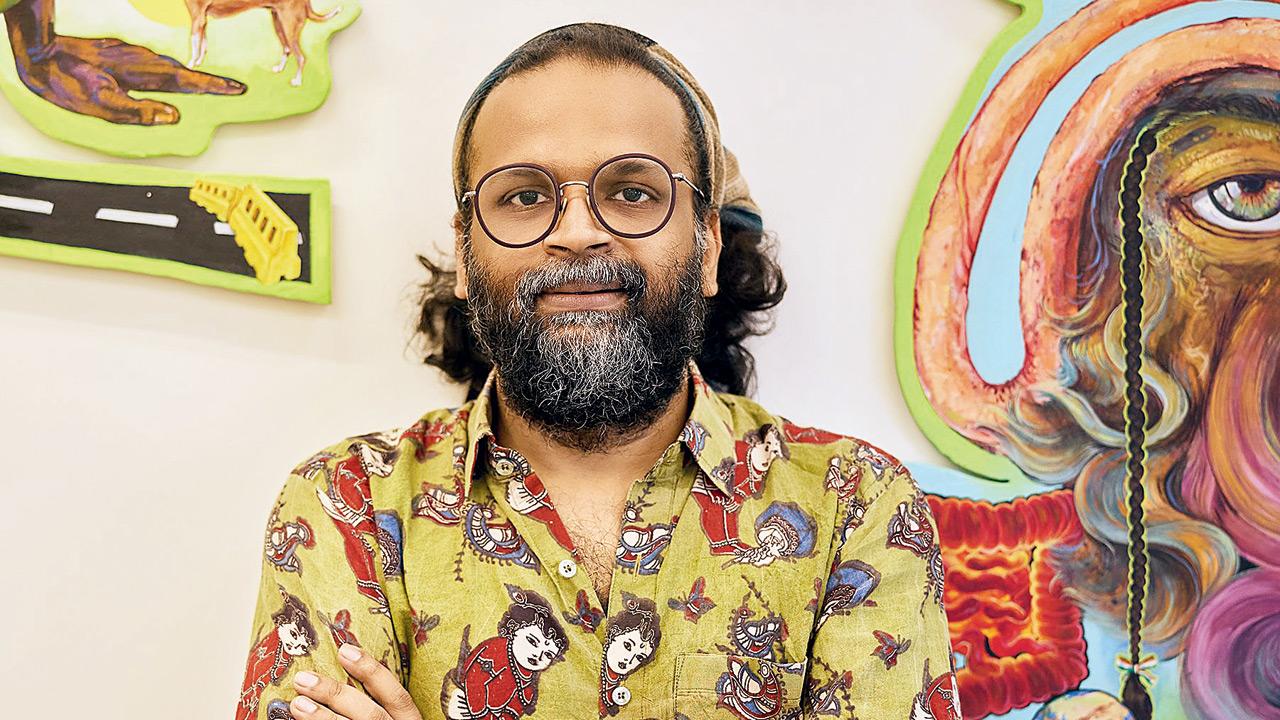
Bharathesh GD
The tradition itself is slowly fading out. Bharathesh says that the art of hand-painted cutouts have been replaced by computerised banners and flexes, even in South India. “Today, everyone is in the art of image making. Anyone with a camera can create an image, and call themselves an artist. The images, aesthetics and the form of the cutout itself has changed,” he points out. Does that reflect in an absence of the personal touch of artists on the large canvas. “You only miss it if you remember the cutout, and its effect on you as a public. Today, you are bombarded with images on the phone, and across mediums. Few remember it, and therefore, do not miss it,” he shares.

A view of the installation, Too Much Democracy
But the artist pushes to explore this visual canvas further through the tactile form of the signages that are part of the tableau, Too Much Democracy. Cast relief objects, logos, signages of JCBs, police barricades, dental casts are displayed in kirana store-style plastic pouches — a memory of family-run stores in many small towns across India.

A view of the exhibits, including the video installation
Also among the works is a short video dating back to 2008 titled GOD Conditions Apply. Featuring snippets of news excerpts that examine the acceptance of bodily belief on the basis of its conformity to the powers that be. “I could have used the familiar medium of the canvas, but it lacks the layered, tactile impact that these offer. With them, the idea emerges as a whole, rather than as an image,” the artist explains. And as every urban citizen in this country knows, nothing speaks louder than a poster on the street.

Amshu Chukki
Till September 27; 10.30 am to 7 pm
AT Fulcrum Gallery, 23 Great Western Buildings, Chamber of Commerce Street, Kala Ghoda.
 Subscribe today by clicking the link and stay updated with the latest news!" Click here!