


Runners Academy, a Borivli-based running school, defines how consistency and endurance in your 40s is built steadily and not rushed

A snippet of the Endurance run at Dream Park, Kandivli. Pics/Atul Kamble
Looking back in time, running definitely adds quality to life and it is truly never too late to start,” says Kaushik Panchal, founder of Runners Academy. At the age of 54, with more than 22 years of distance running behind him, Panchal speaks from experience, both as a runner and as a coach. As they age, people experience a sudden shift in the pace of life. Fatigue and stress become a part of their daily routine.
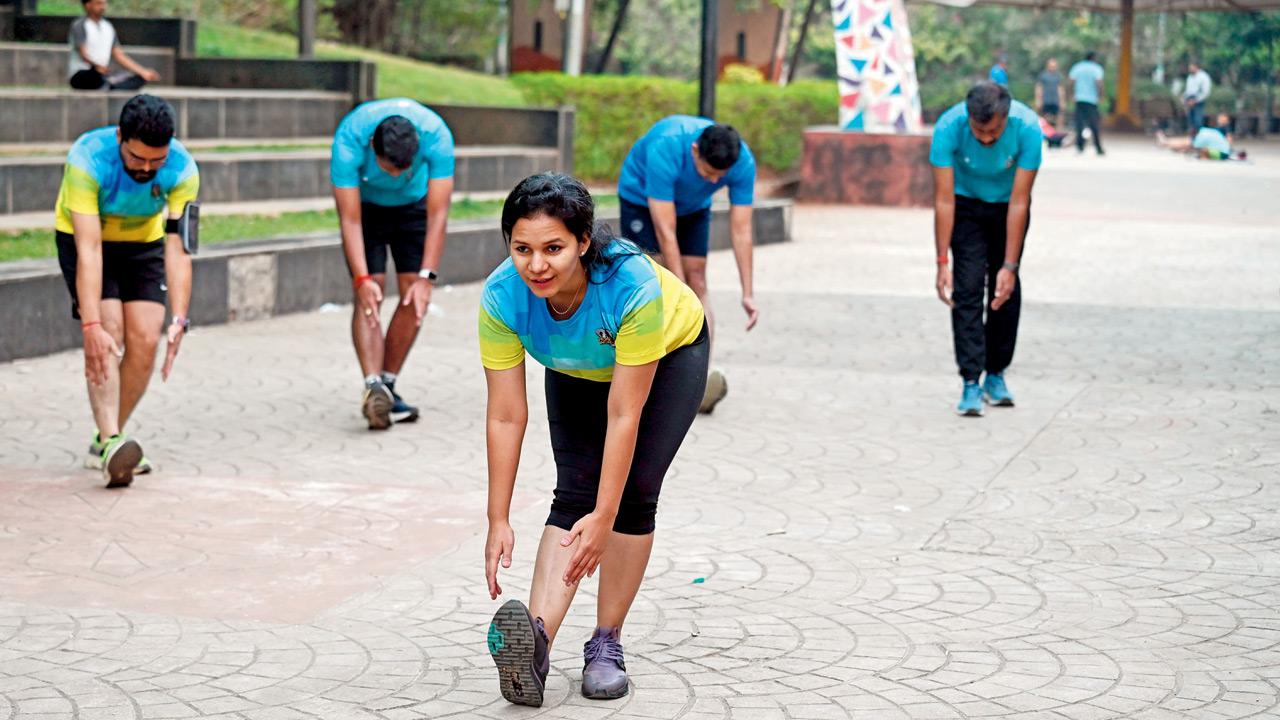
Ruby Kanchgar leads the group in stretching exercises
At the age of 33, Panchal was hit by the realisation that this was not a practical way to go about life. It was also compounded by the fact that he suffered from perpetual back ache, accompanied with issues of obesity and severe acidity. That is when, the businessman decided to change, one step at a time, no pun intended. Founded in 2015, Runners Academy in Borivli, now trains runners across five centres in Mumbai, many of them over 40 and senior citizens.
The discipline of endurance
Panchal insists, “Consistency in training is the most important aspect.” New runners at the academy train four to five days a week for two to three months, allowing endurance and strength to build gradually. The training plans are customised — considering factors such as age, fitness levels, previous injuries, and more importantly, the profession of the individuals.

The group performs hip rotation exercises to ensure better mobility
Sunday long runs form the core of the group’s marathon preparation. The community often changes locations to break routine and maintain motivation. “Warm-ups are treated as the holy grail, these include a head-to-toe warm up, giving your body a wake-up call,” reveals Panchal.

Pre-run drills help avoid sudden jerks during the run
The running coach insists on dynamic movements before each run, including foot gymnastics and running ABC drills. The latter are a set of fundamental running exercises — A-Skips, B-Skips/bounding, and C-Skips/butt kicks — designed to improve running form, efficiency, coordination, and speed by focusing on high knees, powerful leg drives, and quick foot turnover, making runners faster and reducing injury risk. These are paired with a slow jog or walk to ease the body into motion.
Injury is avoidable
Addressing the inevitable question, Panchal highlights, “Injuries are often the result of avoidable mistakes. Common problems such as stress fractures, plantar fasciitis (a common cause of heel pain, resulting from irritation and inflammation), and knee pain usually come from worn-out shoes, running on hard surfaces, skipping warm-ups, or increasing mileage too quickly. Lack of strength training and vitamin deficiencies also play a role.” His solution is simple: Structured training, gradual progression, and fewer back-to-back races.

Runners at the Autism Awareness Marathon at Kandivli East in 2019
Strength training, yoga, and cross-training are built into the academy’s weekly schedules. “Running should never be an everyday activity, as you need the same amount of days to recover,” says Panchal. Three to four running days are balanced with strength work and flexibility training.
Community is central to the academy. “Group training helps runners to stay motivated during plateaus and missed sessions. We travel together for races across India, including events such as the Pondicherry and Ladakh marathons.”

A group of runners participate in a yoga session before warm-up
A regular with the group, Dr Harshita Satam Ingole, 39, shares, “Running marathons was not something I thought I would enjoy. Regular long-distance training has improved my cardiovascular capacity and overall muscular resilience. The Sunday endurance run is something I especially look forward to.”
Nutrition, hydration, and mindset
Contrary to popular perception, Panchal suggests managing nutrition is easy. “It is equally important to focus on pre and post-run nutrition. For pre-running, keep it simple. Fruits like bananas, oranges, dates, and dry fruits, nothing too heavy. After a run, it is essential to have a protein-rich meal, within two hours.” This includes hydration, too. Drinking plenty of fluids with electrolytes a day before the run will do wonders.

Kaushik Panchal
After long runs, runners are advised to walk to bring their heart rate down gradually and stretch. A quick nap and an ice-cold shower also help, as does foam rolling. Panchal concludes by saying, “With the right training regimen, and consistent discipline, running almost feels like a high. It becomes a habit you love.”
At L-101, Dattapada Road, Food Corporation of India Warehouse, Borivli East.
Log on to@runners_academy
Call 9821026416
Do’s and Don’ts
Do’s
1. Consult a physician before taking up running
2. Do your warm-ups. Spend 10-15 minutes before every run.
3. Start slowly with walk-jog
Don’ts
1. Do not run everyday
2. Do not skip sleep and recovery
3. Don’t skip 3:1 ratio (3 portions of protein and one of carbohydrates pre and post-meal respectively)
 Subscribe today by clicking the link and stay updated with the latest news!" Click here!