
A senior IIT Bombay professor is quitting his prestigious job to set out on a climate change awareness yatra across the globe, which he will kickstart within India from October 23

Chetan Solanki inside the bus, where all appliances are solar-powered
All our life, we’ve seen people do whatever it takes to get into IIT Bombay. Last week, we met someone eager to get out. After a 21-year-long association with the premier institute, professor Chetan Solanki is down to his final weeks when we visit him in his office in the Energy Science building in the sprawling Powai campus. Within minutes, the conversation turns heated — a promising sign for the environment. Solanki’s cabin is the only one without air conditioning. It’s one of the many luxuries the professor, who teaches Solar Energy at the insititute, has given up as part of his pledge to conserve energy.

The customised bus will travel across India next month
With his team, Solanki is charting plans for his ‘Finite Earth Movement Yatra’ that begins after October 23, his last day on campus. “The idea was born in 2020, when I felt the need to reach more people beyond the confines of a classroom,” Solanki reveals. His message is simple and urgent — we face a climate emergency, and reducing consumption is the easiest step. “From the moment you wake up and brush your teeth, to making breakfast and commuting to work, every action leaves a carbon footprint pushing us closer to disaster,” he informs. A man of his word, Solanki hasn’t touched soap in three years, relying only on water to scrub himself clean.

His shirt features a timely message. PICS/SATEJ SHINDE
“It’s neither the government, nor technology that will save us,” he says; a striking claim to make on a campus where students are busy devising the next big innovation. What about new technologies like electric vehicles and solar-powered homes? Doesn’t that give him hope? “But where do you think solar cells come from? We mine silicon, copper, and iron to make every single one,” he counters. “I knew a family in Gujarat that owned one air conditioner. After the government subsidised solar batteries, they installed three, one in each room. Can you imagine the carbon emissions?” he rues.

The bus houses a mini library, a work desk, and a seating area
The solution, he says, is best illustrated in his bus, parked just a few blocks from the office. Built over a period of 22 days using his own funds and CSR funding from corporate firms, a team of four volunteers, including a driver and a cleaner will soon make the bus their home. On the way to the vehicle, we pass groups of engineering students hurrying to their lecture halls, many of whom, he assures, will carry his message forward. Inside the modified bus that will serve as Solanki’s home during the Yatra, we meet TUPEE, a character he has created to help him spread the word.

The professor explains the route of his upcoming yatra; (right) the kitchen space inside the bus
T: Travel less, U: Use items wisely, P: Purchase cautiously, E: Eat carefully, E: Eliminate electricity waste, TUPEE reminds us. On a wall facing this illustration hangs a large map of India. “We will chart a southward journey traversing Pune, Solapur, Goa, Kochi, Chennai and Coimbatore. Next year, I’m hoping to go global, starting with a trip to South Asia,” he reveals. We learn that a new music album for the cause is in the works. “We’re trying to rope in some familiar faces, including Sunidhi Chauhan, to bring it to life,” he reveals.
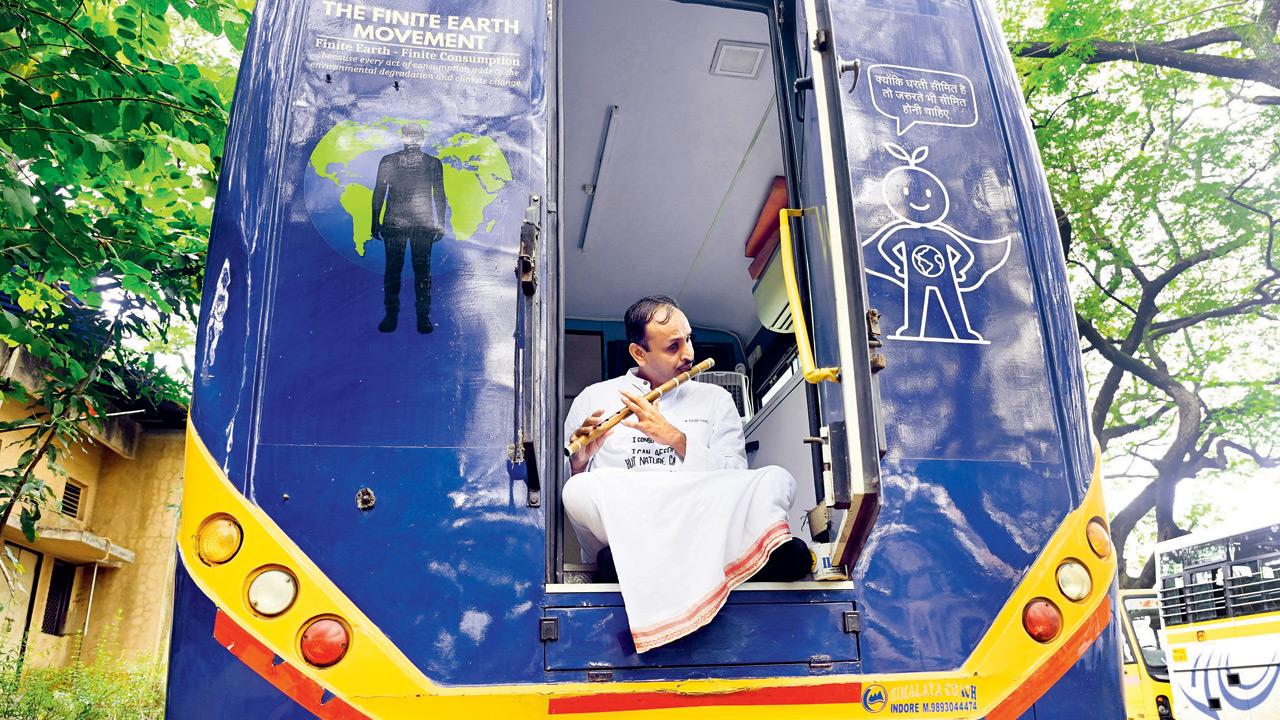
Seated at his favourite spot, Solanki plays a tune on his flute
Between taking mental notes, we’re admittedly a tad distracted by Solanki’s modifications inside the bus. It hosts a study desk, a mini library, a washroom, solar-powered lights, and a bedroom. At the heart of it, lies what we feared the most — a diesel engine. “People are quick to point out the contradiction. What about the air conditioners that run non-stop in malls? In the same world where I’m questioned for using diesel to spread awareness, you’re allowed to operate a cinema hall for three hours for a handful of viewers,” he counters.
Among test tubes repurposed into planters and to-do lists scribbled on whiteboards, a corner is reserved for photo frames of Solanki’s memories from his home in Madhya Pradesh. In 2020, the 51-year-old left behind his parents and wife to set out on the Energy Swaraj Yatra, the predecessor to his new movement. “It was hard for them, but they grew used to it. They don’t crave my presence anymore,” he shares. The Finite Earth Movement will add a few more years to his ongoing exile. “I will finally go home in 2031. It’s going to be emotional,” he adds.
As we step out of the bus, back into the lush green campus, we wonder how one could possibly be looking forward to leaving it behind, pre-retirement, at that. “I’ll miss it. The campus, the students, the prestige the job brought with it. But in simple words, we’re in a climate emergency. Mumbai’s monsoon arrived prematurely this year, and is already overstaying its welcome. We’re stretching our luck thin here. When we talk about human extinction, you need to understand that it’s not a few thousand years away. It could happen as soon as 70 to 150 years from today,” he remarks.
We bid the professor adieu to sit with that thought. But will we see him again in these lanes, someday in 2031, perhaps? “If IIT wants me back, it will be me who will set the selection criteria this time. The planet is running out of time and unless it’s an engagement that will drive real impact, I try my best to avoid lectures and talks for a few seconds of applause,” he signs off.
Log on to: energyswaraj.org (to follow the journey)
Live smart, for the planet
Adopt these easy hacks suggested by Professor Solanki, to play your part in curbing climate change
>> Carry a steel drinking tumbler when you visit cafés and restaurants
>> Avoid using paper tissues, and opt for washable cloth napkins
>> Eat seasonal food and buy from local markets to discourage packaging and food transportation
>> Wear lightweight clothes that can be washed easily. If you’re serious about change, opt for an all-white wardrobe. The dyeing industry is a big contributor to water wastage.
>> Curb the overuse and overdependence on quick commerce apps, and step out to shop
>> Travel in carpools whenever possible
>> Repair, don’t replace. Your shoes, bag, gadgets, have a longer lifespan than you think
 Subscribe today by clicking the link and stay updated with the latest news!" Click here!