


In a new book about the legendary Asha Bhosle, author Ramya Sarma dwells deep into the struggle that the singer defied to keep living, singing, and cooking
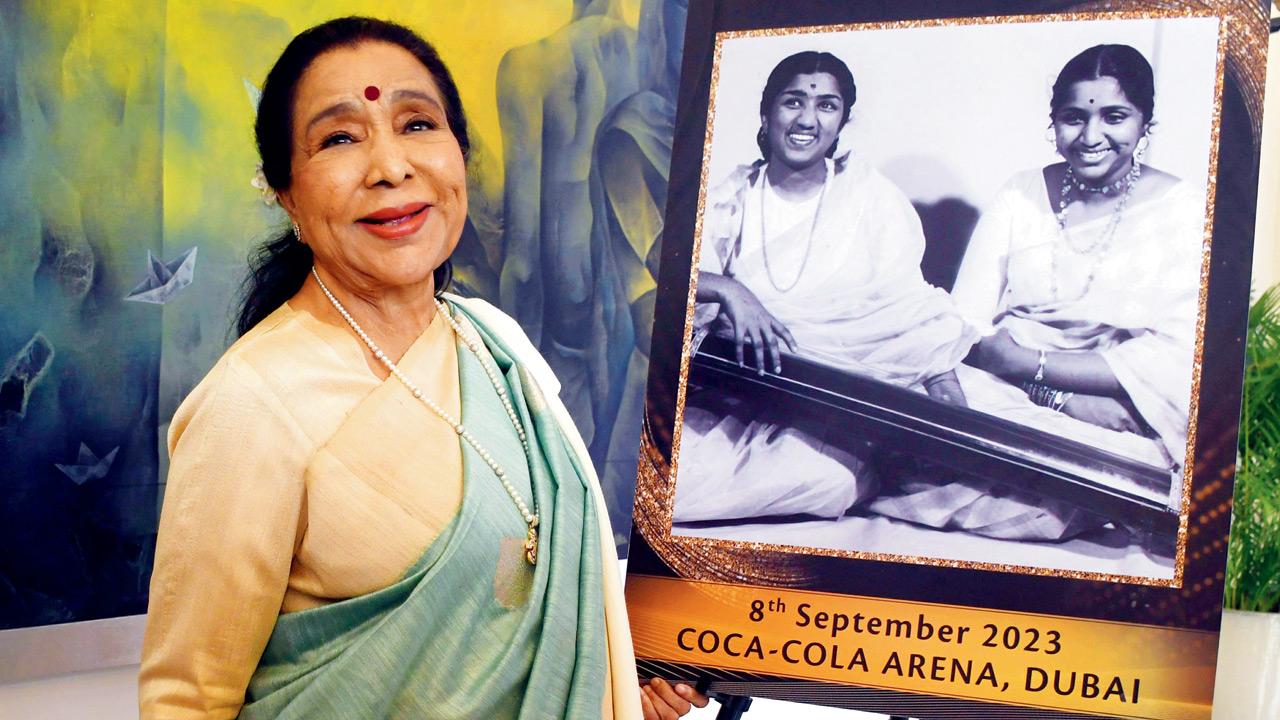
Pic/Ashish Raje
In 1949, Asha, at about sixteen years of age, eloped with Ganpatrao Bhosle, a man who was twenty years older than she was. For her, it was all about love, a romance that, unfortunately, went painfully sour very quickly.
But with her perhaps hasty, perhaps exciting, perhaps fated, runaway marriage she lost something far more valuable and meaningful than just her singlehood. She lost her eldest sister. “It was a love marriage, and Lata didi did not speak to me for a long time. She disapproved of the alliance.”* Was this because Bhosle had been Lata’s personal secretary? Did the elder sister feel guilty for having allowed her younger sibling to meet a man so unsuitable for her? That might never be spoken of, but the elopement caused a rift that lasted for many years.

Asha with her son Anand. She was pregnant with him when she had attempted to end her life. Pic/Getty Images
The marriage was a painful one for Asha, but it instilled steel into her spine and made her a strong, resilient woman. It would logically have put emotion into her voice too, adding pathos, sorrow, depth and empathy to her music. Rumour has it that Ganpatrao was a drunkard who beat his wife even when she was pregnant, very often resulting in her needing hospitalisation. Asha explains, “The family was very conservative and they could not handle a singing star for a daughter-in-law. My husband was short-tempered. Maybe he liked to inflict pain, maybe he was a sadist. But no one would hear about it outside. I gave him respect, never questioned what he did. I just did my duty as per Hindu dharma.”
There was continuous abuse and ill-treatment and finally Asha was asked to leave, “when I was expecting my youngest son, my third child, Anand. I went back to my mother, sisters and brother.” There were thoughts of ending the torment for good. “On one occasion I felt I should kill myself. I was ill. I was four months pregnant and found myself in hospital where the conditions were so bad that I thought I had landed in hell. I was in mental agony. So I swallowed a bottle of sleeping tablets. But the love I had for my unborn child was so strong that I did not die. I was dragged back to life, to living.”

The Mangeshkar sisters (from left to right): Lata, Meena, Asha and Usha. Pics courtesy/Amaryllis, Manjul Publishing House
Rumour has it that the sisters [Lata Mangeshkar and Asha Bhosle] monopolised the world they ruled, not allowing anyone else who could match them to last beyond a song or two, even deliberately sabotaging the competition. Is there any truth in this? Asha has said, “Neither didi nor I had the time to go to a music director and ask them not to take any other singer, new or not. So I am puzzled why we were accused of monopolising the music scene. Our life experience added to our work, and every music director wants a playback singer they can vibe with on a professional level.”
Singer Alka Yagnik, who slid into the space that Asha was eased out of as age and contemporary music started ruling in the early 1980s, and then stayed there for over thirty years, had this to say to the Times of India when asked if it was difficult being pitted against the Mangeshkars: “When a new artiste comes in, people want to find out if they can outdo the seniors. Everybody has their own place. Nobody can take Lataji’s and Ashaji’s place. When I started, people used to say that it is difficult for a newcomer to break through because the two sisters were ruling the industry with their voices. But whenever I met them, they were nice and affectionate. People say that they resented it when someone new came, but honestly, I never felt it.”
Speaking to singer Sonu Nigam for a special interview for Stardust magazine, Asha said, “Rumours were being spread that the Mangeshkar sisters have monopoly in the music industry. They were spread by a music director who then introduced new singers in the industry, but nobody could become, or was even a close competitor to, Lata Mangeshkar then. And nobody can be Lata Mangeshkar even today. I never liked anybody speaking against us.” “When these rumours were doing the rounds, all I said was, ‘Hum hatt jaate hain, aap gaaiye’ [We will step aside, you sing]...”
Gaana aur khaana
Asha confesses that if she had not found success as a singer, she would have become a cook. “I’d have cooked in four houses and made money,” she once said in an interview. Ask any of the celebrities from the film world who have worked with her and they will all talk about at least one culinary favourite she has cooked for them, apart from a song that they can never forget. Her forte is Indian cuisine and it is said that the Kapoor family still requests Asha to make her famous paya (trotters) curry, Goan fish curry and dal for them. The kadhai gosht and biryani have a huge fan club too.
Asha’s Nasheeli Raan
Ingredients
Leg of lamb 4 × 850g
Kashmiri chilli powder 200g
Shahi jeera 50g
Malt vinegar 1-2 litres
Ginger garlic paste 100g
Green cardamom powder 30g
Mace powder 30g
Salt 70g
Cinnamon sticks 20g
Bay leaf 20g
Method
Trim and marinate the lamb in all the ingredients, cook up to about 95 per cent on a slow fire. Let it cool in same stock. Put the lamb in the tandoor at 270°C.
When the meat acquires a colour, take it out, cut it into pieces and baste with butter. Add lemon juice and chaat masala. Serve with mint chutney.
*Asha Bhosle is quoted as saying in an interview.
Excerpted with permission from Asha Bhosle: A Life in Music by Ramya Sarma, published by Amaryllis, Manjul Publishing House
 Subscribe today by clicking the link and stay updated with the latest news!" Click here!