











As the world debates the Taj Mahal necklace, we spoke to Saumya Sengupta, who is making a documentary on last Mughal descendant, who lives on a pension of Rs 6000
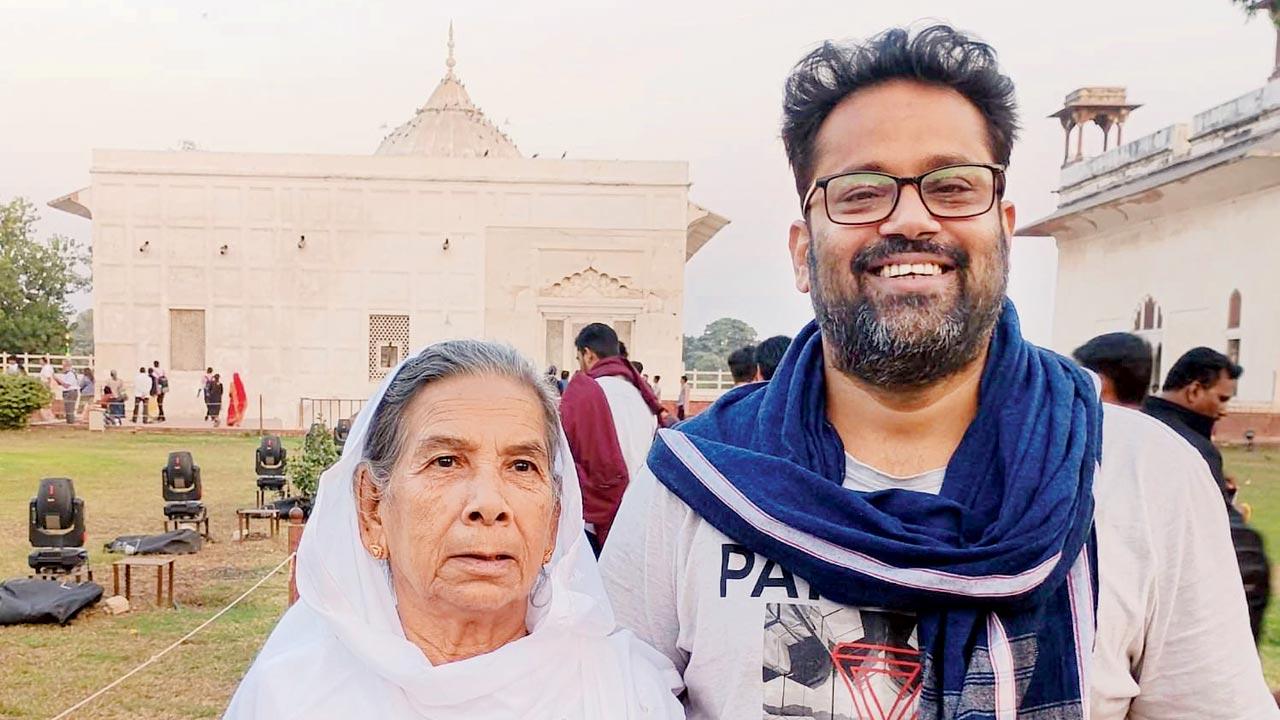
Filmmaker Saumya Sengupta, and Sultana Begum, the great-granddaughter-in-law of Bahadur Shah Zafar, the last Mughal emperor of India who died in exile in Rangoon
When Margot Robbie appeared on a red carpet of the premiere of her new film Wuthering Heights wearing a historic necklace associated in popular lore with Mughal royalty, the outrage was instant and global. Commentators debated colonial loot. Was it Elizabeth Taylor’s? Was it Noor Jahan’s? Should it be in Hollywood or returned to India? The necklace glittered beneath flash photography as Robbie gushed over the famous Taj Mahal necklace that Richard Burton bought for his beloved Elizabeth Taylor. Experts then wondered if Robbie knew anything about the Mughal Dynasty...
While the world argued over a diamond, the last Mughal emperor’s descendant was worrying about her next electricity bill. In a narrow lane in Kolkata’s Howrah district, history does not glitter. Sultana Begum, the great-granddaughter-in-law of Bahadur Shah Zafar, the last Mughal emperor of India who died in exile in Rangoon, lives in a small hut and survives on a meagre pension of R6,000 per month. The Union Home Ministry recognises her lineage but that recognition has not lifted her out of poverty.
 Margot Robbie appeared on a red carpet of the première of her new film Wuthering Heights wearing the historic Taj Mahal necklace, that is said to belong to Nur Jahan. Pic/Getty Images
Her life is the subject of The Lost Queen, a documentary by Bengal-based filmmaker Saumya Sengupta, who first encountered her almost by accident. He heard, one day, in a village near Howrah that a Mughal descendant lived nearby. “Someone told me there is a Mughal ancestor here. Naturally, I was very interested. The word ‘Mughal’ evokes royalty, grandeur, power. But when I went to her address, what I found was the complete opposite. She lives in a very remote, very modest place. That contrast stayed with me. You could say ‘it haunted me’...”
He began researching immediately. He elaborates, “In the 1980s, during a Lok Sabha question-and-answer session, her husband raised their condition before Parliament. There is documentation. There is no doubt that Sultana Begum is from the Mughal lineage. The Home Ministry knows this, and that is why she receives a pension from the central government.” That pension amount is a measly R6,000 that hasn’t seen an increase in the past decade.
The documentary’s research began at the end of 2024 and went into production in 2025. Sengupta and his team filmed in Delhi at Humayun’s Tomb, at the site where Bahadur Shah Zafar was arrested by the British officer Hudson, in spaces that still carry the residue of Mughal dynasty.
Sengupta explains, “When Independence came, everything that was royal became government property. Bahadur Shah’s property, what remained of it, had already been taken by the British. After Independence, it became public property.”
Sultana Begum challenged that transformation in court. She has repeatedly petitioned Indian courts seeking recognition that the Red Fort, the iconic seat of Mughal power in Delhi, should legally be returned to her as a descendant of Bahadur Shah Zafar, arguing it was taken from her family after the 1857 revolt and made government property. Her plea was dismissed by the Supreme Court, which labelled it “misconceived” . Sengupta is careful not to frame his film as legal advocacy. He says, “I did not make this documentary to support her court case. I just wanted to share her life journey. It is an unbiased documentary. The law will decide what is right. I just want her to live a good life.”
He pauses when describing her home. “She lives in a small hut, you know those small huts that barely protect you during heavy rain? That is her shelter. She sits there quietly. She has no ego. She is a very good person. There is a khatiya (bed) in her house, where she sits. She jokes it’s her raj-gaddi. Despite her condition, she is helpful to others.”
Then, just weeks after his film began circulating in festivals, came the global furore over the Noor Jahan necklace. Sengupta says, “People began saying it is a Mughal artefact, and that it was taken from India as colonial loot, that it belongs to her lineage. Whether that is legally correct is another debate. But attention has come.” In her own words, the Begum says, “I am not asking for diamonds. I am asking to live with dignity in my old age.”
 Subscribe today by clicking the link and stay updated with the latest news!" Click here!


