
Tempted to book an affordable hostel for your next trip, but worried about the horror stories you’ve heard about safety? Here’s how hostels in India are evolving into safe, community-driven havens for travellers
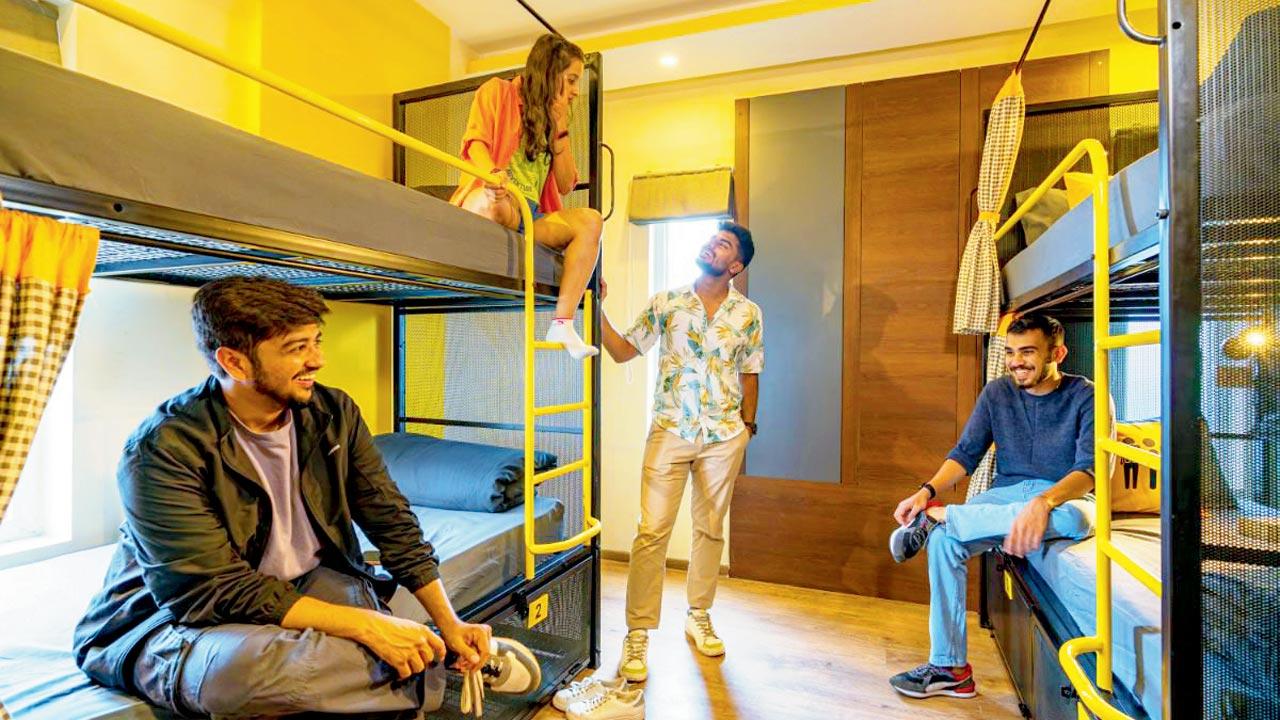
Backpacking hostels across India, such as this Hosteller property in Bengaluru, offer both mixed and female-only dorms. Pic Courtesy/Hosteller
In peak travel season, Sanjana S (name changed) set out to backpack through Mussoorie, expecting quiet trails and like-minded travellers. She checked into a hostel near Kempty Falls, hoping for the basics: clean sheets and a sense of safety. But by the second night, groups of drunk men kept the campus loud until dawn, and catcalls rang out.
Uncomfortable, she raised concerns with the property manager. “They haven’t done anything to you yet, right? They can drink around the property,” was the response she received. “Was she waiting for something to happen before making me feel safe?” Sanjana asks.
That night, Sanjana latched the dorm door. The following evening, while hanging out with a couple she had befriended, they were catcalled. “They were leaving the next day, so I cut my stay short too. This place just didn’t feel safe alone,” she says.
 Amit Damani and Pankaj Parwanda
Increasingly, twenty-somethings and even those in their early 30s are opting to backpack and stay at hostels we have seen crop up across the country. It’s a sought-after option for youngsters who enjoy the affordability and a chance to make friends through travel. But incidents like the one Sanjana faced raise the question: Are they safe?
Several reviews on the Internet reveal incidents that are worrying. At a hostel in Port Blair, a solo female traveller felt unsafe around a promoter loitering around campus, asking women for sexual favours. Another traveller was pursued by a male guest who stole her contact number, address and other data from the registration book at a hostel in Mumbai.
If this sounds like a problem for niche travellers, it’s not. The tourist hostel industry is on the cusp of a giant boom. As per Virtue Market Research, the global hostels market was valued at $6 billion in 2023 and is expected to reach $11.69 billion by 2030. The Indian hostel market was estimated to be worth $4.6 billion in 2023, which is expected to reach $12.1 billion by 2033.
 As the idea behind hostels is to drive community, they usually offer activities in common areas to help guests socialise in a safe space. Pic courtesy/GOSTOPS
As per previous interviews, Zostel aims to add 1000 beds in the US and Southeast Asia within the next two years. By December 2025, it’s aiming to add 15,000 beds in Tier II, III, and IV cities in India.
Meanwhile, the Hosteller is expanding to Nepal, Sri Lanka, and three Southeast Asian countries by the end of 2025. Closer home in India, it is adding 125-130 new properties across India, to grow to 200 properties in the next 24 months.
But safety is not the only complaint Indian travellers have when it comes to hostels. Mumbaikar Silvester Fernandes, who has stayed at hostels in India and abroad, recalls his experience at Indian properties as “annoying”. “The staff was quite indifferent to guests’ comfort. It took them over 45 minutes to fix haphazard parking around the premises, in order to make slots available for guests.”
He compares his experience to a YMCA hostel in New Zealand where, despite the “you are on your own” attitude that hostels generally have, the staff were friendly, efficient, and had a helpful attitude.
“The alcohol policy at [Indian] hostels is vague too. The website could say that alcohol is not allowed on the property, but you get there and see people drinking,” he says.
As competition picks up pace in the domestic market, there’s some concern that hostels may be more focused on curating experiences for guests rather than ensuring basic amenities. Akanksha Rai, who was with Sanjana during the catcalling incident in Mussoorie, recalls: “The experience at Indian hostels is great in some ways. There’s a campfire, music, and the location is beautiful. But at times, they are so secluded, it can feel unsafe. This particular one had no generator back-up, so we lost Wi-Fi connection in an already low-network area. The property is also very big, and there were no lights,” she says. She adds that another hostel she stayed at was strict about decorum. “Some properties have rules, and the staff ensure they’re followed. You can’t drink or smoke anywhere, or disturb others.”
Pankaj Parwanda, co-founder of goSTOPS, a popular brand of hostels, explains some of the measures they take to ensure safety. The most common one is female-only dorms, which are popular among solo travellers. “Even in the case of groups, if a woman has a booking in a mixed dorm and it happens to be dominated by men who are not part of the group, we move them into another with more women or to a female-only dorm at the time of checking in,” he says.
Parwanda adds that safety measures are constantly evolving as the brand learns about a guest’s needs. The hostel brand has switched to smart locks for dorms, which can be accessed only through a PIN shared on the app with the dorm’s residents. Guests can also file complaints via the app, which are responded to in real time. The brand is now working on adding a feature which will allow women to see the gender of other guests while booking a bed in a mixed dorm.
Check-in procedures, too, are increasingly being switched to app-only so that female travellers don’t need to interact with the staff in a male-dominated industry.
At NomadGao, a co-living and co-working community with a property in Goa and another in Himachal, a lot of the community managers are women. “We don’t have a formal grievance redressal system. But as soon as a guest books their stay, we reach out to them. They are informed about events, rules, and have an open line for feedback at any time,” says Anisa Dias, community lead at NomadGao.
Dias explains that as NomadGao sees a large number of foreign travellers, it’s important to give them a confirmation of safety. But their model also allows for better one-on-one interaction with guests and de-escalation of incidents. “Once we had a couple who were fighting loudly and disturbing other guests. We asked them to leave because that’s not the culture we maintain,” says Dias.
Undertrained staff is also a concern at some hostels, as is the practice of recruiting “volunteers” who are paid in kind with bed and breakfast. The result? They are often unprepared to handle guests who might misbehave.
Parwanda claims that goSTOPS has a mandatory 21-day training programme for staff, including sessions on harassment and body-shaming. “We have added modules as we evolve. This training is also for our blue-collar workers,” he says.
The hostel blacklists guests who continue to misbehave despite warnings. “If we know of guests who have misbehaved at other properties or hostels, they are automatically blacklisted,” says Parwanda.
The lack of regulation by any formal body for such budget stays is also one reason why such problems crop up. “Safety is not just being comfortable physically, but also mentally. Hostels need to take up a combination of measures. Simple things like collecting IDs on WhatsApp are concerns people have. It should happen on an app or web tool,” says Amit Damani, Co-founder at StayVista.
Parwanda agrees, “Collecting IDs is mandatory, but an e-KYC is not accepted. Regulations for hostels in India are poor, as the budget-stay market only began around 2014-15.”
But Damani opines that hostels abroad have poorer safety or grievance redressal amenities. “There, you are really on your own,” he says, adding that female-only dorms are not a feature abroad.
Damani believes that the industry does need regulation, but it can only happen when brands and experts come together. “Staff training is a big area of concern. It’s important for people to come together and protocols need to be defined,” he says.
$12.1 bn
Estimated value of Indian hostel industry by 2033

Check in, stay safe
1 Hostel rules vary, always read up before you book
2 Prefer a quieter stay? Choose properties that ban alcohol on campus
3 Download the hostel brand’s app for quicker support and grievance redressal
4 Solo women travellers can opt for female-only dorms
5 Lockers are available in dorms, but splurge on a private room if you want extra security
6 Research the locality of the hostel, especially in semi-urban or offbeat locations
 Subscribe today by clicking the link and stay updated with the latest news!" Click here!