
A new graphic novel, Our Rice Tastes of Spring, highlights how heirloom rice varieties are in danger of vanishing, as modified white grains take over farmlands

There are several heirloom varieties of rice that that the farmers grow in Jharkhand, such as Ranikajal, Goda-dhan, Chosaarh, and Kalamdaani. These may not always be as profitable to grow as the modified white rice varieties; but, as the author points out, livelihood is not just about making a profit, it’s about being one with the environment
For farmers, rice is not just food; it is tradition, and life itself. Over the course of her career reporting on the impact of social and food policies, Anumeha Yadav has witnessed first-hand how nutritious and hardy heirloom rice varieties are in danger of disappearing, even as the government and seed corporations push modified white grains that strip the soil of nutrients and cost farmers more and more to grow.
During her time living in a hamlet in Jharkhand, however, she noted how Adivasi farmers had stuck to indigenous rice varieties, preserving their food culture, as well as their nutrition and the soil quality. Based on her experience there, Yadav has released a new graphic novel, Our Rice Tastes of Spring, which takes this complex policy issue and presents it simply — through the eyes of Jinid, a little girl growing up in a fictitious farming village in Jharkhand. There, the villagers learn the value of heirloom grains the hard way, and eventually reject the “fortified” and modified grains pushed by the authorities.
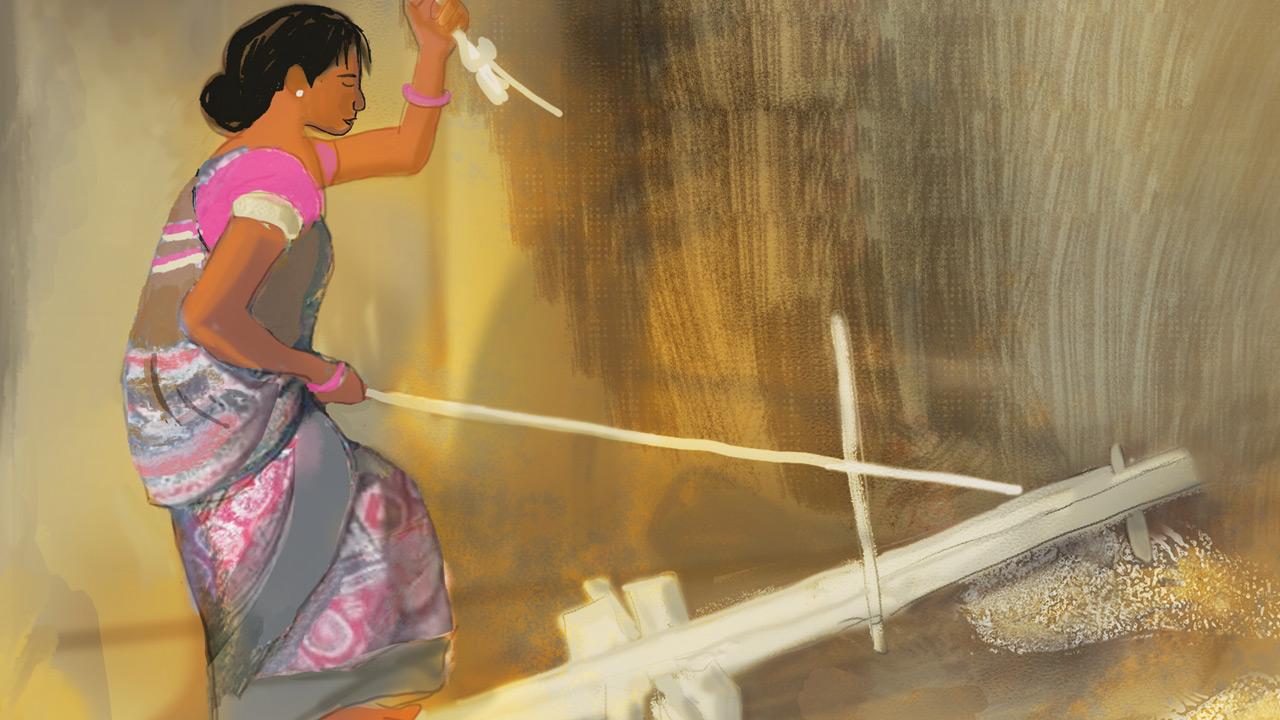
The book shows how the dheki, a wooden equipment,is used to pound the paddy into rice. Pounding the paddy, which is the whole grain, separates the outer husk from the kernel inside, that is then ready to cook and eat
“My colleagues, members of Bengaluru design collective Spitting Image, based the drawings on the photographs I had taken over six years in the Netarhat hamlet — its trees, shrubs, fields, cultural gatherings, the festivals, the village assembly, and most important, the village elders,” Yadav says, adding, “In describing the rice and the food, I drew upon not just on this actual hamlet, but from my conversations in other villages of Jharkhand, such as in East Singhbhum, and northern Odisha.
“In the particular village on the plateau that I lived in, the lesser well-off even among the Adivasi farmers had not switched to hybrid crops. They grew Ranikajal, Goda-dhan, Chosaarh, Kalamdaani rice. I ate porridge of Jeeraphool rice and desi makai corn ground in the dheki, a wooden pounder, and also several kinds of dried small fish that I don’t even know the names of sold at the weekly haat,” the author recalls.

The book shows how farmers who switched to modified grains then had to invest in fertilisers and insecticides, which ended up stripping the soil of nutrients and killed all the earthworms and other organisms that kept the soil healthy
This is made possible by mutual aid and support in the village. “For example, at the time of transplanting and work in the small farms, the Adivasi farmers sit together and decide how they will work in one person’s fields one day, and the next another and what they will pay each other, and it is the same even in building small houses. Besides cultivating, there are fishing, grazing, gathering activities. In every home, the Adivasi cultivators grow or forage diverse produce, drying it in the sun in their courtyards, on windowsills, to eat later — yam, gourds, berries, kulthi dal or horse gram lentils. I tried out ‘Chandbibi’, a small white insect my friend Anupa Baing had roasted for her toddler, a crunchy and tasty evening snack,” Yadav recounts.
Since the 1970s, India has lost more than a lakh varieties of traditional rice varieties that were consumed before the Green Revolution, she points out. “The government promoted a few high-yielding varieties that provided abundant grains on applying chemical fertilisers. But it led to monoculture that caused a massive loss of species and crop diversity. The indigenous rice species do not just have unique qualities in taste, nutrition, they are hardy and more suited to a changing climate in which droughts, floods occur more often. Ninety per cent of the traditional varieties are now estimated to be lost,” she rues.
Illustrations excerpted with permission from Our Rice Tastes of Spring, written by Anumeha Yadav and illustrated by Spitting Image; published by Red Panda, an imprint of Westland Books
 Subscribe today by clicking the link and stay updated with the latest news!" Click here!