
On the eve of the World Tourism Day, I find myself exploring the bylanes of Central Kerala with a fellow birder and nature enthusiast. While landing in Kochi, the plane emerged from the clouds to a sea-like expanse of coconut palms
 On the eve of the World Tourism Day, I find myself exploring the bylanes of Central Kerala with a fellow birder and nature enthusiast. While landing in Kochi, the plane emerged from the clouds to a sea-like expanse of coconut palms. This is in contrast to the forest-covered hills, mangroves or slums that welcome a visitor to Mumbai. But, when you drive through the city you realise that Mumbai does support a huge diversity of palms.

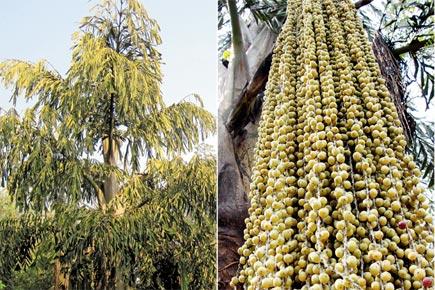
The leaves of the fishtail palm resemble the zigzag tail fins of a fish, acquiring the name
There are plenty of coconut palms in the coastal regions and sometimes, idiotically, even in the higher hilly reaches. With fibrous roots, these plants are best suited for sandy beaches and can withstand tidal currents and high wind speeds. But then, there are the fan-leaved Toddy or Palmyra palms with their cannonball-shaped fruits locally called tadgolas or ice-apples, which are the signature palms of coastal Mumbai. Their snake-like inflorescence is freaky looking and can scare kids unaware of its origins.
Your best chance of seeing these palms would be inside the Ismail Yusuf College or outside Nahur Railway station. If you step out towards Madh Island or Vasai, you are most likely to sight locals tap these palms for their sugar sap, releasing a mildly alcoholic drink called Neera by the morning and the more fermented taadi or toddy by noon. A decade ago, Neera selling counters lined our railway stations and the entire city. Sadly, there is little demand for this nutritious drink in today's fizzy cola-obsessed world.
If you step into some of the old wadis of Chembur or Mulund, you will be surprised by their density of green cover and will definitely encounter the tall and lean Areca or Supari palms. Although today they may not be in demand for providing beetlenuts to residents, they remain the habitats for Golden Orioles and Palmfly Butterflies. The cool shades of the Areca palm are a welcome sight in the over-concretising city.
However, the true representatives of the wild palms of Mumbai are the fish-tailed palms (Caryota urens). The leaves of the fishtail palm resemble the zigzag tail fins of a fish, and hence the name. Another relation the fishtail palm has with fish is that locals remove its leaves and use the stems as fishing rods. These palms are native to the Indian subcontinent and can grow up to 60 feet in height.
The Caryota urens is the only plant to have bipinnate (double row) leaves in the entire of the genus Caryota. The characteristic of this stately palm is its attractive unisexual flowers that hang drooping in clusters at the leaf nodes. Fruit development occurs from top to bottom and these are feeding sites for koels, hornbills, squirrels and even macaques. Once the last fruit of the inflorescence matures, the plant dies and such plants are referred to as monocarpic plants.
The species name of fishtail palms 'urens' means 'stinging' in Latin; refers to its fruits which cause irritation due to the presence of oxalic acid. Unfortunately, this property is exploited by gutka makers and causes a lot of harm to consumers.
Like many of its cousins, the fishtail palm too is categorised as sugar palm and yields far more sap than Palmyra and Coconut palms. This jaggery-like sweet sap is further fermented to make palm wine, locally called toddy or Kitbhul in Sri Lanka. The trunk of this palm is a rich source of starch and is used to make sagi, usually consumed during famines.
Mining, road-widening and replacement by exotic bottle palms spell doom for this amazingly elegant palm. But, what is more dangerous is our apathy and lack of association with our natural heritage.
Write to Anand at sproutsenvttrust@gmail.com
 Subscribe today by clicking the link and stay updated with the latest news!" Click here!