shot-button
E-paper E-paper
Home > Mumbai Guide News > Things To Do News > Article > With Maharashtras forts getting a UNESCO honour experts highlight how they can be preserved and help tourism

With Maharashtra's forts getting a UNESCO honour, experts highlight how they can be preserved, and help tourism

Updated on: 19 July,2025 08:11 AM IST  |  Mumbai
Fiona Fernandez | fiona.fernandez@mid-day.com

With UNESCO World Heritage Site status for the Maratha Military Landscape in Maharashtra, Fiona Fernandez reaches out to experts from conservation, architecture, public awareness and history to suggest action plans to safeguard these forts’ invaluable heritage, and catapult it to the global tourist map

With Maharashtra's forts getting a UNESCO honour, experts highlight how they can be preserved, and help tourism

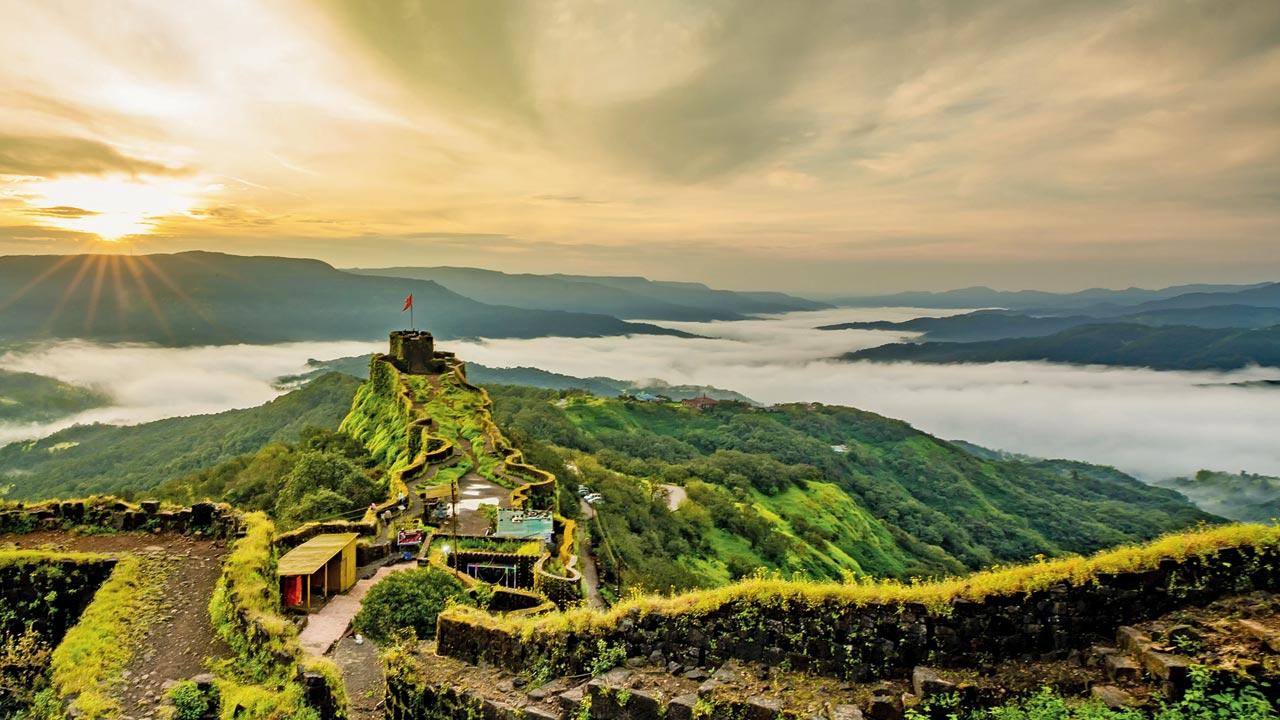
Pratapgad, built in 1656 on the orders of Chhatrapati Shivaji Maharaj, is situated at an altitude of 1080 metres. Pics Courtesy/Shivaji Desai, Wikimedia Commons

Seamless coordination

Shivneri FortShivneri Fort


In a significant move to safeguard and enhance the newly inscribed UNESCO World Heritage Site (WHS) of Shivneri Fort, a comprehensive action plan has been submitted, outlining immediate conservation priorities. The inclusion of Shivneri as part of the Maratha Military Landscape has brought with it a renewed focus on preserving its historical integrity and ensuring a world-class experience for visitors.


At the forefront of the proposed initiatives is the urgent establishment of an Interpretation Centre at Amberkhana. This dedicated facility is envisioned as a vital hub for visitors to delve deeper into the fort’s rich history and its pivotal role in the Maratha Empire. A complete signage programme will complement this and will be implemented across key attributes and pathways, to greatly enhance visitor navigation and historical appreciation.

Abha Narain LambahAbha Narain Lambah

Visitor safety and heritage protection are also central to this plan. The installation of a robust CCTV surveillance system is deemed crucial, alongside the development of a formal risk management and rescue plan, to be coordinated closely with local NGOs.

Structural conservation is critical. Top priority has been assigned to completing the restoration of the fallen fortification near Kulup Gate and the meticulous conservation of the walls around Kadelot Point. Urgent vegetation-clearing and desilting of water tanks are slated for expedited completion, to prevent further structural degradation caused by environmental factors.

The plan emphasises the systematic excavation and documentation of partially-exposed structures behind Badami Tank and the fort’s cave groups. This initiative is expected to significantly enhance historical interpretation and prevent potential erosion or vandalism.

To improve the visitor experience, the installation of additional water points is planned, along with the removal of the disused pump house at the fort’s summit. The construction of new toilet facilities near Amberkhana is to be fast-tracked.

The success of these ambitious plans to secure Shivneri Fort’s legacy for generations to come, hinges on immediate and seamless coordination and collaboration between the Archaeological Survey of India (ASI), the District Administration, and the Forest Department.

Abha Narain Lambah, conservation architect (ANL Associates had prepared the Site Management Plan for Shivneri Fort, birthplace of Chhatrapati Shivaji Maharaj, and part of the UNESCO WHS)

Executable action plan

Vikas DilawariVikas Dilawari

Having earned the prestigious World Heritage Site (WHS) status, the real work starts. This includes, having a robust management plan, which needs to be implemented, keeping with international practices and guidelines, and by respecting the authenticity and natural setting. Many, rather most, of our monuments are under threat of tremendous pressures of development around it in its buffer zone. Hence, it is an opportunity and challenge to safeguard, maintain and encourage sensitive tourism and development as is the practice in most Western nations. Scientific conservation and minimum interventions are the key factors to be kept in mind, which often tend to get neglected during implementation.

Necessary stakeholder and monitoring committees should be formed, where an implementable action plan is viewed as a commitment to obtaining this coveted status, and should be followed so that this legacy can be passed on to future generations. The WHS status encourages tourism, which is a double-edged sword; it should be well-balanced, keeping the cultural significance of the property in mind.

Vikas Dilawari, conservation architect

Retain originality

Louiza RodriguesLouiza Rodrigues

Communication between fort historians and conservationist architects is key to retaining their originality and historicity, before restoration efforts are undertaken by the latter. The debacle at Worli Fort should not be repeated, where the façades were cemented over, without retaining its original essence. Forts played an important role in India’s maritime history, for defence and security purposes; their original structures tell stories. If a fort is given heritage status, it is important that the first contact with the materials of the fort for preservation is by an architectural design expert. Many forts in Mumbai are in a dilapidated state and are grappling with encroachments and legal issues. Hence, we must address these forts with sensitivity and historic knowledge.

Professor (Dr) Louiza Rodrigues, Head of Department-History (retired), Ramnarain Ruia College

Buffer zones are critical

Raigad Fort was the capital during Chhatrapati Shivaji Maharaj’s reignRaigad Fort was the capital during Chhatrapati Shivaji Maharaj’s reign

For any UNESCO listed site, protocols for preservation and maintaining a pristine environment fall in place. What has to be appreciated is that all these sites are fundamentally fragile in nature, not because of their current state and material composition, but because of the context of their location, in space and in time. Preserving a monument is only half the effort. The other half, even more important, is preserving (even intervening in) the surroundings so that the monuments do not get overpowered or decontextualised. You can easily destroy a monument by destroying its neighbourhood.

Most conservation protocols call for the defining and maintenance of a buffer-zone around the monument. This buffer zone becomes, in effect, a no-development (or a very filtered development) zone so that the context of the nominated monument is protected. This includes the preservation of the vista, the prospect and the scale of everything around it.

Mustansir DalviMustansir Dalvi

Historically, even with our wonderful record of getting monuments listed, we have, at least in Mumbai, been singularly deficient with keeping a viable buffer zone for our nominated structure. The area around CSMT and current developments in Flora Fountain and Marine Drive are only two examples of this neglect. One hopes that the non-metropolitan monuments like Chhatrapati Shivaji Maharaj’s Forts receive better attention when it comes to surroundings.

Professor Mustansir Dalvi, architect, Professor of Architecture (retired), Sir JJ College of Architecture

Commitment is key

Vijaydurg FortVijaydurg Fort

With six World Heritage sites in the State and three of them in Mumbai itself, I hope the State Government will implement a robust system to preserve the outstanding universal value of each property. These are big wins for Maharashtra, and for India. We must demonstrate a commitment to looking after them as mandated by UNESCO.

Atul KumarAtul Kumar

Atul Kumar, founder, Art Deco Mumbai

Eco-conscious route

A section of the Teen Darwaza gateway inside Panhala FortA section of the Teen Darwaza gateway inside Panhala Fort

Firstly, these sites should deploy advanced security systems to avoid vandalism. Conservation efforts must be undertaken only under expert supervision and through conservation consultants, and not by untrained individuals, who could actually cause more damage. It’s extremely important that the local population be sensitised about the recognition, and be made aware of its historic significance. An organisation comprising of local youth can be created who should be trained to be the keepers of these valuable assets, and organise guided tours and conduct trails or treks to acquaint people with Chhatrapati Shivaji Maharaj’s warfare techniques and tactics, which led to the creation of these marvels of military engineering, strategic geographic adaptations and indigenous construction.

Campsites can be developed for an immersive experience, replicating the old style dak bungalow and khansama model to let people experience the local flavour, which I had experienced at Panhala Fort as a teenager. Infrastructure such as clean washrooms is essential. If access to the forts is difficult, alternate access modes should be created without disturbing the existing ecosystem.

Anita YewaleAnita Yewale

Light and sound shows are an incredible, immersive medium to showcase history to visitors. This should be managed through a single point of contact. Online presence is also necessary in today’s day and age, similar to how visitor numbers are tracked at Kaas Plateau, to control footfalls to safeguard the site from wear and tear. Above all, a self-sustainable, eco-conscious plan must be implemented in sync with the local community.

Anita Yewale, co-convenor, INTACH Greater Mumbai Chapter

LOG ON TO whc.unesco.org (to read more about the inscription)

"Exciting news! Mid-day is now on WhatsApp Channels Subscribe today by clicking the link and stay updated with the latest news!" Click here!

Did you find this article helpful?

Yes
No

Help us improve further by providing more detailed feedback and stand a chance to win a 3-month e-paper subscription! Click Here

Note: Winners will be selected via a lucky draw.

Help us improve further by providing more detailed feedback and stand a chance to win a 3-month e-paper subscription! Click Here

Note: Winners will be selected via a lucky draw.

maharashtra unesco culture news Lifestyle news mumbai things to do in mumbai

Mid-Day Web Stories

Mid-Day Web Stories

This website uses cookie or similar technologies, to enhance your browsing experience and provide personalised recommendations. By continuing to use our website, you agree to our Privacy Policy and Cookie Policy. OK