Workshops in Mulshi trace a rare Arabica bean’s journey from African origins to a Western Ghats forest farm, celebrating a century-old family legacy in coffee cultivation. The unlikely connection dates back to 1923, when Paranjpe’s great-grandfather Haribhau brought home Kenyan-origin seeds sourced from his travels

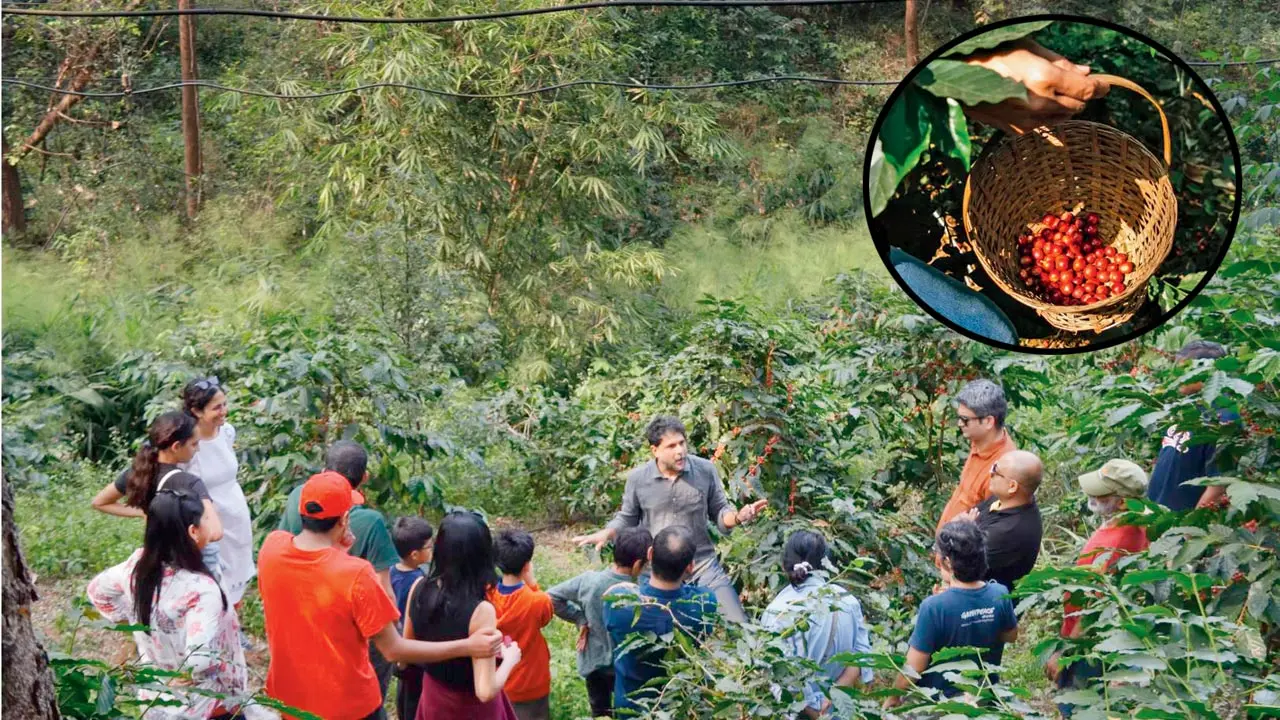
Ashwin Paranjpe (centre, in black) guides visitors through the forest farm in Mulshi; (inset) a close up of freshly harvested coffee berries. Pics Courtesy/Ashwin Paranjpe
Coffee's on us if you can name a thing or two about Lake Kivu in Rwanda. We’ll start you off: A species of wild Arabica that traces its roots to the lake has come to harvest in a forest farm in Mulshi. Organic farmer Ashwin Paranjpe, who helms Gorus Forest Farm in the Western Ghats is keen to show you around the estate at two workshops this month. Organised by Kalyan-based Snickerdoodle Coffeeworks and Homemade Barista on consecutive weekends, the tours will give coffee enthusiasts a full hands-on experience of the crop-to-cup journey of the drink.
The unlikely connection dates back to 1923, when Paranjpe’s great-grandfather Haribhau brought home Kenyan-origin seeds sourced from his travels. As a horticulture officer with the Bombay Presidency, he was stationed in Mesopotamia from 1919 to 1923. Upon his return to India, he also wrote the book Falzadancha Baug, documenting his experiences.
Participants brew coffee outdoors.
“In 2007, I returned to Mulshi after my Master’s degree in Horticulture from Florida. I was introduced to a vast hilly land that my parents had purchased in 2002. It was a wild, native forest. We had no idea what to do with it,” Paranjpe reveals. Never a bad time for coffee; the organic farmer planted seedlings in the hilly farms in 2010.
While Arabica can grow in temperatures ranging from 15 to 24°C, it was the elevation that proved to be a concern, Paranjpe reveals. “Our farm stands at an elevation of 580m to 700m, whereas the ideal elevation for Arabica is around 1600m,” he admits, adding that experts were equally surprised when the beans thrived in the farm. A few measures like micro-sprinklers help emulate suitable humidity in summers. After consulting World Coffee Research and French genetic scientist Christophe Montagnon, the Paranjpes named this hardy variant Haribhau EL 1923.
There might be some natural forces working in the farm’s favour, we believe. For one, the owners never levelled the forests or cut down any native trees. “The canopy of native trees like Sirish, interspersed with spices and fruits, provide essential shade. On the other hand, native birds are our finest quality checkers. They propagate only the choicest seeds through their droppings,” Paranjpe laughs. This earned the coffee variant its brand name, Wof Zerash, which translates to ‘sown by birds’ in the Kafi Noonoo language spoken by the Kaffa people of southwestern Ethiopia.
At the weekend stay, participants will learn about the origin of the plant, growth stages, flavour profiles, and will participate in a tasting session. The adventurous ones will be encouraged to step in the forests and help harvest a new batch of coffee cherries in bloom this season. Helped by eight local families, the farm also oversees the full process of readying the coffee to be served. From 150 plants in 2010, we learn that the number in the farm has grown to 4000 today.
PS: If not for the coffee, we recommend you make the trek for the AQI. “The air is pristine. I feel healthier and happier every day. Don’t ask me about my bank balance — growing coffee isn’t a rich pursuit, but I do feel like a king here,” he signs off.
ON January 11 and January 17
AT Gorus Forest Farm, House 178, Nanegaon village, Taluka Mulshi.
LOG ON TO @gorusforestfarm
ENTRY Revealed on request
Crop to cup
Here’s how the Haribhau EL 1923 coffee bean travels from the Mulshi plantation to your cup

1 A coffee flower comes to bloom

2 The fruit forms with the bean (seed) inside it

3 Beans are harvested carefully and left to dry

4 Beans are hulled by the local staff

5 After roasting in a terracotta pot, the beans are sent ahead for grinding

6 With calculated measurements, a cup is finally brewed
Subscribe today by clicking the link and stay updated with the latest news!" Click here!