A new imprint offers a fresh, insightful lens on India’s eclectic literary landscape. It opens with the celebrated poet’s undiscovered gem, Soliloquies, a lost piece of poetry in print for the first time, accompanied by a revelatory interview with poet-novelist, and curator of this imprint, Jeet Thayil

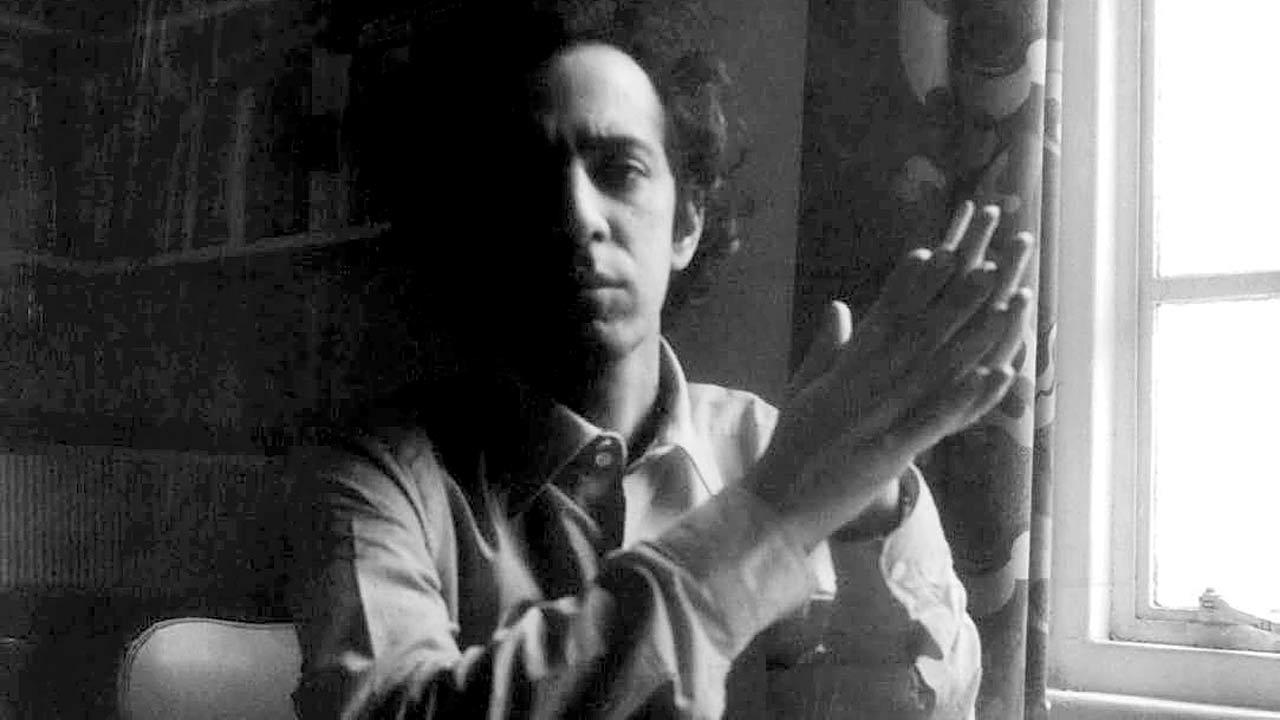
Selfie, circa 1965. PIC COURTESY/ ADIL JUSSAWALLA
There’s a certain enchantment that comes with reading an interview where a celebrated modern-day author-poet is in conversation with a literary legend. It’s intimate, magical and insightful, all at the same time. Soliloquies by Adil Jussawalla is the first title in a series under Thayil Editions (HarperCollins India), a new imprint that is an attempt to consume and discover (or rediscover) the body of work of handpicked talent across India’s literary landscape. Jeet Thayil’s brainchild, the first in the series, kicks off in fine style with a tribute to Mumbai’s literary icon. It includes a rare selection of poems that Jussawalla wrote as part of a play, Jian, when he was barely 18-years-old. The palm-sized book contains his poetry, and a freewheeling interview by Thayil, packaged in pop art-meets-psychedelic design. There are delightful insights into Jussawalla’s childhood, his trysts and conflicts with his academic decisions, his personal life, and his return to the city of his birth.

Adil and Katia in London, 1968/69. PIC COURTESY/VERONIK JUSSAWALLA
The interaction reads less like an interview and more like a conversation. “I was struck by how frank and unpretentious Adil’s replies were to my questions. Some of the topics were personal, topics he has never addressed on record. It’s the viewpoint of a poet looking back on a life well-lived in literature, a poet with nothing to lose and nothing to prove. Throughout the interview, a wicked and self-deprecating sense of humour is in evidence,” reveals Thayil, adding, “For me, for all these reasons, the interview is as valuable as the poetry. It is an overview of a remarkable life, in which history is a constant, and cultural history, a bonus. For Indian poets, of whichever age and language, it holds an important lesson — not in the writing of poetry (which can’t be taught), but in how one can live as a poet.”

View from Veronik’s bed-sit on Campden Hill Road, London W8, April 1968; AA School of Architecture, London, 1957. PICS COURTESY/ ADIL JUSSAWALLA
Jussawalla also recalls a vibrant poet community in 1970s and ’80s Bombay. “Our conversation about this particularity hasn’t changed much over the decades. Bombay’s literary scene has stayed much the same since the seventies and eighties, at least in the important ways. While there are more avenues to publication than ever before — for example, independent presses like Poetrywala, Copper Coin and Red River, not to mention Instagram and Facebook, where you can publish if you are so inclined. While there are more publishers, it doesn’t make poetry any less precarious as a vocation.”

The cover art by Bonita Vaz Shimray, HarperCollins India’s art director keeps the writer front and centre while bold and cutting-edge in appeal. Over five years, the imprint will publish 20 titles that marry text with photographs, sketches, and visual interventions
Citing Jussawalla’s challenges, Thayil offers a reality check about a poet’s existence. “There is no literary culture, where books are reviewed in a meaningful way. There are no prizes for emerging poets. Poets are rarely offered life-saving teaching gigs. The road is as long and winding as it ever was. Of course, in a way this is as it should be. The lack of money and accolades for poetry is a way of separating chaff from grain. You need a will of iron and a very thick skin to continue into a poetic middle and old age. And even when you make it to old age, the rewards are uncertain, often non-existent. It is nothing short of a national shame that Adil was often unsure as to who would publish his next book, and that he has lived with that uncertainty for much of his life.”

The book is smartly priced keeping in mind younger readers and writers. “They are the ones who may be most interested in the question of whether it’s possible to live a life in poetry,” feels Jeet Thayil. PIC COURTESY/NINAN JOSEPH
Dharini Bhaskar, associate publisher, Literary, HarperCollins India, who has collaborated with Thayil for this imprint, is excited about this series, “This curation is fearless, experimental, privileges the written word, and also celebrates the book as an artifact. It is an important contribution to the world of literature; the kind that would survive the test of time. He was clear about the format and the writers he wished to approach. We had to begin with Adil Jussawalla, one of India’s most significant writers; the piece he wrote sets the tone for much that is to follow.” Second on the list is Buku Sarkar, who presents poems and spectacular images; next is Kamal Trilok Singh, whose raw and visceral short fiction demands to be read aloud, and finally, Karthika Nair, with her poems that include an entire ecosystem.
Bhaskar believes that discerning readers, possibly familiar with writings by some of these names, are in for a treat. “What makes a writer a writer is that s/he surprises. We believe we know what we can expect from Jussawalla or Nair — but do we really? Jussawalla’s Soliloquies, for example, was written when he was barely 18; when he was grasping for the numinous. It is unlike anything else in his body of work, and until it was published as part of Thayil Editions, it remained an undiscovered gem. So, too, with the other writers who have offered something that startles, defies expectations, and reminds the reader that this is what art is all about — breaking the rules.”

Dharini Bhaskar
Thayil reminds us that Jussawalla wrote Soliloquies as part of a play called Jian, and was his first-ever long-form writing. “It was rejected by the writers and publishers he sent it to. Luckily for us, he didn’t throw away the manuscript. The fact that parts of the play are now available to the general reader is a life lesson. Keep the faith. Believe in your work. At some point, the world will catch up: an invaluable insight for all readers and writers,” he signs off.
Log on to: harpercollins.co.in
Cost: Rs 399
In his own words
Face the fact: “My first nickname, when my father’s mother saw me with that distorted face, was Quasimodo, which didn’t go down well with my mother. Eventually, the top of my head flattened out, but I can’t help the long face.”
School canvas: “Later, my writings in the compositions we were assigned at Cathedral School began to be noticed by some teachers. I used to get good marks, but I never felt I would write as a career or vocation. It was just that I liked shaping things with paints and pencils and crayons, and I liked shaping things with words.”
Nissim and Adil: “While I was in Bombay, I’d meet Nissim Ezekiel. He lived in a paying guest apartment nearby, at Warden Road. I showed him the manuscript of poems I’d written. He said he’d just been published by P Lal, and would send the manuscript to him. Lal accepted it and that’s how Land’s End, published by Lal’s Writers Workshop, came about.”
Subscribe today by clicking the link and stay updated with the latest news!" Click here!