








Chirodeep Chaudhuri’s black-and-white photographs for The Only City organically synergise with the plots in this eclectic curation of urban storytelling by 18 authors. Excerpts from an interview

Chirodeep Chaudhuri; (right) Chaudhuri calls the photo for Jeet Thayil’s story his most satisfying frame
Tell us about the rigour that went into the selection.
The brief from the editor, Anindita Ghose was fairly detailed. The photos in The Only City (HarperCollins India) had to avoid poverty porn and anything that is patronising of the subaltern; it had to have contemporary relevance, and the selection had to be mindful that more stories feature characters closer to the reading audience i.e. educated, at least, middle-class.
It was a challenge because I had never done photographs to accompany fiction. I began by reading the stories, even those that were still works-in-progress. It offered broad contours and a general sense of the ideas that might work from my photo archives, and what would require fresh shoots. I remember most of the photographs I’ve shot through the year. This trait proved useful while working on this project. Though the contexts for which they were originally shot may have been different, for the book, it was about finding newer ways of making them relevant in a different context.
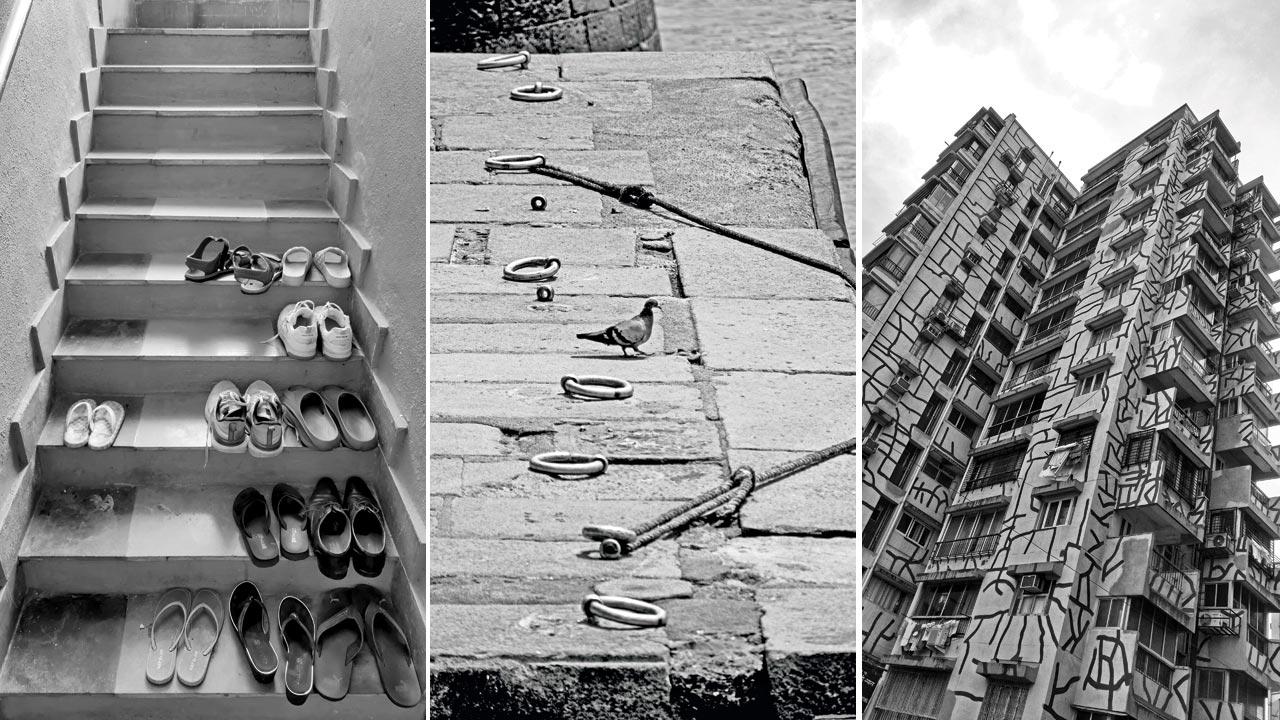 In The Storyteller’s Tale by Shanta Gokhale, set in Shivaji Park, which the author identifies with, having lived there all her life, she pays rich tribute to the lower middle-class Marathi woman who she considers a force; For Raghu Karnad’s Speedboat, Chaudhuri captured the shiny steel rings that are seen on the jetty at the Gateway of India, where a part of the story plays out; Kersi Khambatta’s story, The Hon. Secy looks at the layered ecosystem of the archetypal housing society in the city and its complexities. Pics Courtesy/Chirodeep Chaudhuri; HarperCollins India
Early in the process it was decided that we would go with black-and-white [photographs], though the first selection shared with the team included both. It was largely an aesthetic choice. This meant that many colour images that were part of this first selection had to be dropped. I was choosing vertical images, mostly. I wasn’t throwing out horizontals but trying, as much as possible, to be mindful that important portions may go into the binding when used across the spread. Also, one was now looking at horizontal images that could be cropped vertically, if necessary, and not compromise.
Sooni Taraporevala refers to your work as ‘quiet photographs’ against the hectic pace of the city; how did each story fuse with the selected images?
I don’t think I have ever done “loud” pictures of the city. I had become aware of the tone of voice to use while working on my book, A Village In Bengal about my ancestral village and our two century-plus old Durga Pujo in my family. The silence of the village was an important character in that story and the images were made keeping that in mind. I always felt my home city required a different tone of voice from that of my ancestral village. But, I have also come to realise that my view of the city is that of an insider, a resident and therefore much of what I see is routine or not eventful enough as opposed to explosions of surprise. It’s like the insider’s view versus that of a tourist. And, so my observations of Mumbai are often quiet observations.
We also decided to do photographs without people. Again, this was an aesthetic choice. I began to look for situations which had a sense of life and people instead of showing them directly. For example, I remembered a building named Homecoming in Bandra’s Waroda Road, which I felt might be an apt image to start the book, an entry into the city and the book. For Raghu’s [Karnad] story, I decided to check out the shiny steel rings on the jetty at the Gateway of India, where a part of the story plays out. I hadn’t thought of those rings till I spotted them by chance in a photograph I had shot of the durbeenwallahs, who stand there with their telescopes and binoculars. The idea wasn’t to illustrate the stories but to find broader themes in those visuals, which might obliquely hint at the stories. For Kersi’s [Khambatta] story about a housing society in Mumbai, I had a few choices, one was a photograph of three of my pet cats at home; the other option was the one published. It’s almost like a unifying aspect of all the buildings in this city — seepage during monsoons, though that is not mentioned in the story.
What is your most challenging/satisfying frame in the book?
It would have to be the one of the crow clasping a chicken feet that is at the beginning of Jeet’s [Thayil’s] story. Your Meat in My Hands is also my favourite among the 18 stories. It’s an odd story because photographic ways of depicting the ideas can also be very clichéd ones. I had photographed this frame a few months before the book started occupying my mind. I had shot it then because it looked like an interesting subject but it took on a different meaning in the context of this story.
 Subscribe today by clicking the link and stay updated with the latest news!" Click here!