







A Naga husband-wife duo bring the harmony and natural beauty of traditional woodwork using inspired, contemporary form to a unique exhibition in Kala Ghoda
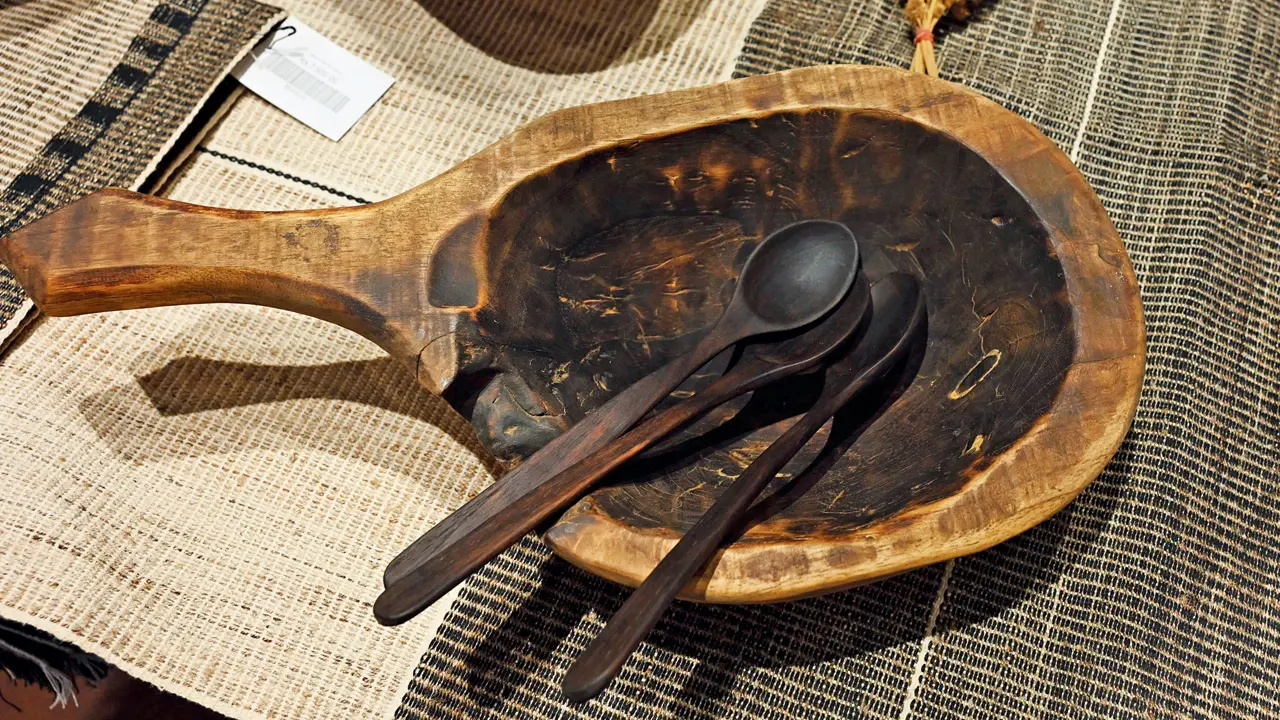
A wooden serving plate and spoons at the exhibition
Do you have roots in Chennai?” Ajung Yaden asks this writer, perhaps our surname leading to the query. Having spent seven years in the South Indian metropolis, the artist is understandably curious. And just like that, a conversation about artistic traditions digresses into food. “Ajung makes the best sambhar in Dimapur, in case you want to drop by,” laughs Atem Longkumer, wife and co-partner in Yaden’s project. But South Indian delicacies are not the focus of our conversation. Rather, it is their first exhibition in the city of Mumbai. The exhibition, Tribolt: Furniture Designer Makers of Nagaland, is an homage and a creative evolution of the Naga tradition of woodworking.

Atem Longkumer and Ajung Yaden amidst their works at the gallery. Pics/Atul Kamble
The art was a part of life when growing up, Yaden says. “I grew up watching my father, who was an inspector. But he had a passion for woodworking. I created my first furniture when I was 13 or 14 years old,” Yaden, a Madras Christian College alum, adds. Longkumer remembers walking into her grandmother’s home in Changki village in Mokokchung for breakfast to find the material used in different ways. “She [my grandmother] had bowls, ladles, wooden plates and spoons. Even the floor of the kitchen, often the largest room of the house, was wood,” she adds.

A wooden board with signature rough texturing and natural flaws
It is this inherited love for the craft that drew the duo back to it, despite having pursued different careers. Longkumer had a successful career as a fashion stylist in Delhi, while Yaden was on his way up as a bureaucrat. To put the government job on hold to establish their Dimapur art studio and workshop in Eralibill in 2019 was a risky move.

A pair of traditional tools
Their Mumbai exhibition is a product of the work they put in. The works on display range from ladles, boards to chairs and lamps and artworks. While the primary inspiration is the traditional art, the works also exhibit an acceptance of nature with all its flaws. Longkumer explains, “If you look at Naga woodwork, it shows a lot of surface texturing and undefined shapes that give the furniture a distinct identity.” Not very dissimilar to the Japanese art of Wabi Sabi, Yaden adds, that aims to accept the beauty of imperfections.

Handcrafted wooden icons
Understandably, there is no polish, no artificial finish to the works. The duo work with traditional tools; the dao, a kind of machete, axe and chisels. “The key is to use the dao along the grain of the wood,” says Yaden, adding that the idea is to use the natural shape of the wood to direct their ideas. “For instance, some of the lamps we designed have cracks, utilised to a natural advantage,” he elaborates. The process was not an easy one. Radhi Parekh, gallerist, explains that though the transit took careful managing. “It took us almost 10 days to ship the works from Dimapur to Mumbai. Then, came the task of arranging. Since most of the pieces retain their natural weight, they can be heavy work,” she adds. At the gallery, the works complement the table cloths and mats from woven stinging nettle, a part of the Leshemi project that also traces its roots to the eponymous village in Nagaland.
 Bowls shaped in their natural form
The woodworking tradition might have a few takers in the modern world, but the couple is not dissuaded. “We have two very young children, a son and a daughter, who are so curious to see us work, and want to be part of it,” Yaden reveals. Like every proud mother, Longkumer adds, “My daughter can already spot teak and mango wood, and tell them apart.”
Till: June 1; 11 am to 7 pm
At: Artisans’ Centre, VB Gandhi Marg, Kala Ghoda, Fort.
 Subscribe today by clicking the link and stay updated with the latest news!" Click here!