








Grassroots leaders from six states highlighted village-led climate solutions at Mumbai Climate Week. From Maharashtra’s first net-zero Panchayat to Kerala’s Solar Gramam model, the session showcased renewable energy, land restoration
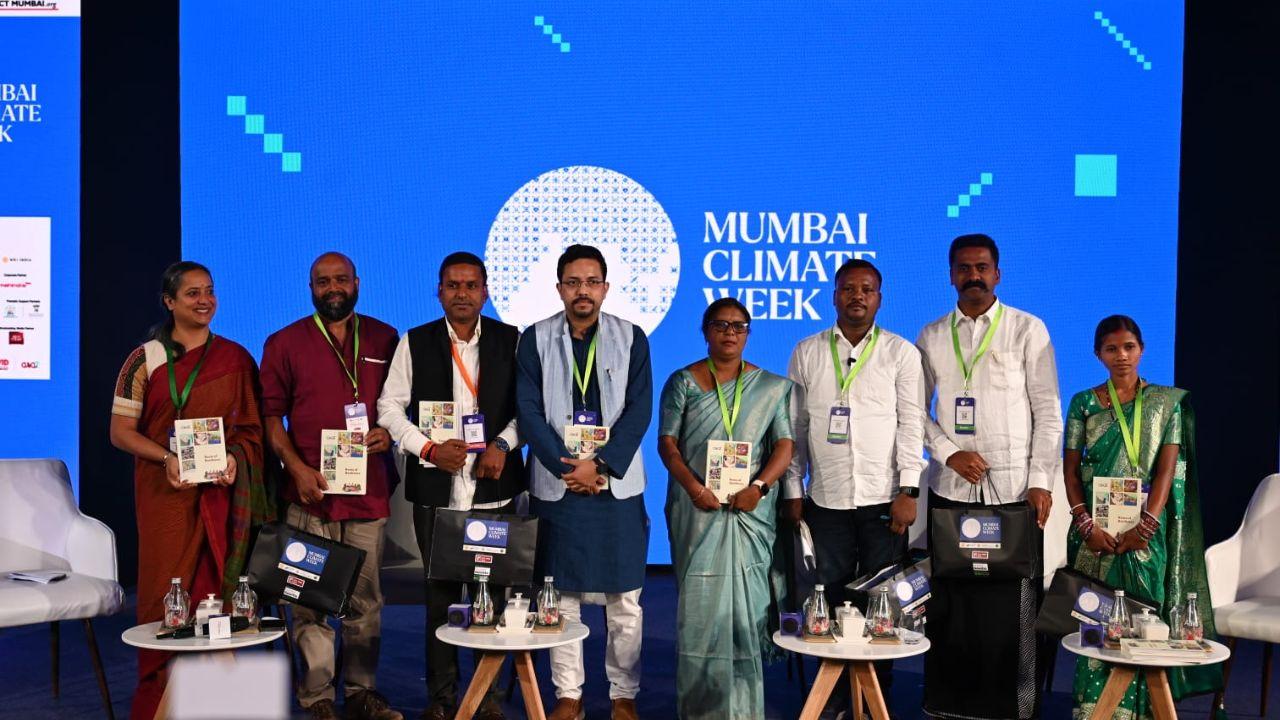
Panchayat leaders in Mumbai Climate Week.
Grassroots leaders from six states in Mumbai on February 19 showcased how India’s most impactful climate solutions are emerging from village councils. during a special ‘Panchayat’ session titled “Panchayats Leading India’s Climate Charge” at the Jio World Convention Centre as part of Mumbai Climate Week.
The session demonstrated some of India’s most effective climate solutions emerging from village councils, not conference rooms.
Built on the Conference of Panchayats (CoP) initiative led by Asar Social Impact Advisors and Policy and Development Advisory Group (PDAG), it focused on strengthening local self-government institutions to tackle climate risks.
Sharada Gaydhane, Sarpanch of Bela Gram in Maharashtra’s Bhandara district, shared how her village became India’s first net-zero Panchayat.
She asserted, “Climate change can be felt in the water we fetch, the food we grow, and the air we breathe. It affects our health, and it is my responsibility to do what’s best for my village. For us, climate action begins at home. When the Panchayat takes responsibility and people participate, change becomes real.”
Under her leadership, nearly 90,000 trees were planted, solar panels were installed on Anganwadis and Panchayat offices, LPG adoption replaced traditional chulas, waste segregation was implemented at the doorstep level, and single-use plastics were rejected.
“Every village festival, wedding, and birth of a child was marked by planting a tree and taking care of it. Over time, we planted almost 90,000 trees. We made concrete efforts to move away from chulas to LPG. We used panchayat funds for solar panels over Anganwadis and panchayat offices. While waste began to be segregated at every doorstep, we took a vow to reject single-use plastics,” she further added.
Bela Gram won Carbon Neutral Vishesh Panchayat Puraskar in 2024
Leaders from Jharkhand, Kerala, Karnataka, Bihar and Odisha also presented community-driven initiatives. Ramvriksh Murmu from Siyari village in Bokaro highlighted solar lighting and pumping solutions to tackle power shortages. Sachith K K from Perinjanam in Kerala described the transformation into a ‘Solar Gramam', with 850 households adopting rooftop solar systems. Jayanti Nayak from Koraput, Odisha, detailed how indigenous women restored over 10 hectares of unused common land.
Community-led Solutions in Focus: Shift to renewable energy, restoring ignored lands
From Jharkhand, Ramvriksh Murmu, Mukhiya of Siyari village in Bokaro district, described how Gram Panchayat Help Desks strengthened local governance and enabled the adoption of solar lighting and pumping to address frequent power cuts.
Sachith K K, former Panchayat President of Perinjanam in Kerala’s Thrissur district, spoke about the village’s transition to ‘Solar Gramam’, with 850 households becoming rooftop solar prosumers.
Representatives from Karnataka and Bihar also highlighted efforts to integrate sustainable livelihoods, strengthen village governance systems and advance rural development, collectively demonstrating that effective climate action is being shaped at the level of local self-government institutions across the country.
Jayanti Nayak, an elected representative from Koraput, Odisha, described how a collective of indigenous women documented land use and identified over 10 hectares of unused common land for restoration.
The power of Panchayats in climate action
Keynote speaker Jagadananda, co-founder & mentor, Centre for Youth and Social Development, speaking about the power of Panchayats and frontline leaders in shaping climate action, said, “The future of climate resilience lies in climate-smart Panchayats, where land, water, livelihoods and people converge at the local level. A climate-smart India begins at the Panchayat, closest to the risks, resources and resilience. Our collective future depends on investing in and strengthening these institutions, where people, ecosystems and democracy come together.”
Building on this vision of climate-smart Panchayats, Arindam Banerjee, co-founder and partner, PDAG, outlined how the Conference of Panchayats was conceived to strengthen local governance systems where climate impacts are felt most directly.
Arindam Banerjee, co-founder and partner at PDAG, said, “The Conference of Panchayats was designed to explore ways to enhance the capacity of local self-government institutions and actors to address emerging climate risks. It focuses on developing local, evidence-based solutions and implementing long-term climate initiatives, anchored within the local socio-economic and climate realities. We hope that this CoP will help drive a uniform nationwide local climate action platform by 2028 with the proposed global CoP33 to be held in India."
Echoing the vision of locally anchored climate governance, Vinuta Gopal, CEO, Asar, said, “From the farthest corners of six states, gram panchayat leaders took the stage to show that climate action is already being built on the ground – through every tree that is planted, solar panel installed, and village action plan formally adopted. Rooted in the institutions of local self-government, these efforts are protecting lives and livelihoods as climate pressures intensify. Such grounded models for scalable climate action offer hope that the most lasting and credible solutions are those that begin within communities and grow outward.”
The Mumbai Climate Week marked India’s first platform dedicated to accelerating climate action, empowering Mumbai, India, and the Global South. The initiative reimagined critical climate solutions as interconnected, scalable innovations rooted in the complex dynamics of the region and its economies.
 Subscribe today by clicking the link and stay updated with the latest news!" Click here!