








The city - sliced, diced and served with a dash of sauce
PIC/SHADAB KHAN
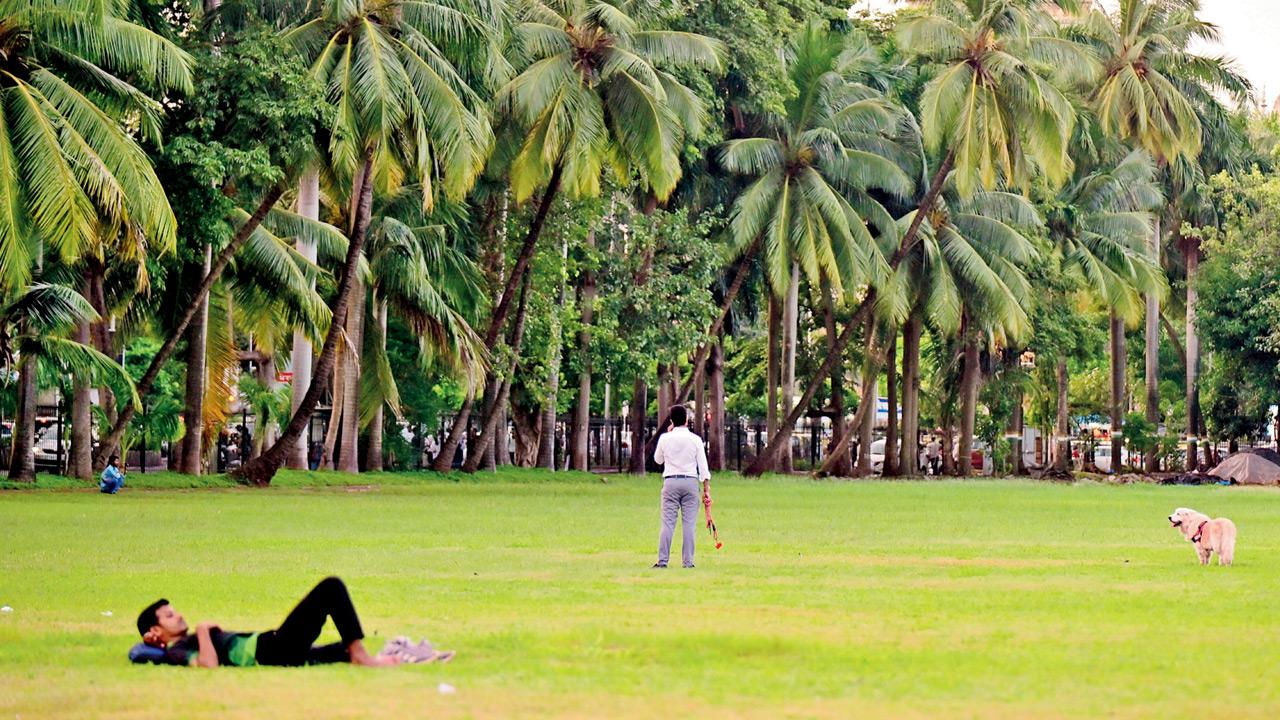
Paws and relax
A man catches a nap while a pet dog enjoys play time with its owners at Oval Maidan in Churchgate
Running notes from Berlin
 (From left) Priyanca Walanju and Deepak Oberoi at the Berlin Marathon. PICS COURTESY/BOMBAY RUNNING, Berlin Marathon
We’re blaming British pop icon Harry Styles’s (below) infamous disguised run at the Berlin Marathon for outshining Mumbai’s own moment of glory. Marking their first World Marathon Major participation, fourteen members of the Bombay Running club ran alongside 55,000 international marathoners in the capital city earlier this week. “While our run was expectedly memorable, we’re bringing back management learnings from the Germans. Throughout our run, citizens came out in large numbers to cheer us on, sing for us, and help us stay hydrated. We were pleasantly surprised to see sustainable bottles instead of the usual PET water bottles. Hopefully, Mumbai will adopt similar measures at the upcoming Mumbai Marathon,” founders Priyanca Walanju and Deepak Oberoi, shared over a call from Berlin. The contingent will now fly to Frankfurt to experience a different German challenge — Oktoberfest.
Viva la vada in Chembur

Guacamole Vada Pav (right) owners Kalpana and Nandu at the stall. PICS COURTESY/Gracias Granny
Two unlikely forces are joining hands in Chembur to give the vada pav a Mexican makeover. Neighbourhood Mexican café Gracias Granny (GG) has roped in Nandu Vada Pav, better known as Aunty Vadapav among local residents, to create the audacious ‘Guacamole Vada Pav’. “The idea was born out of the need to highlight local eateries and their contribution to shaping food culture. These are places that you won’t see on your curated Instagram feeds,” shared GG co-founder Rashmit Arora (below), a longtime patron of the vada pav stall. “When we approached the owners, who identify themselves as Kalpana Aunty and Nandu Uncle, to their customers, they were clearly not too keen on taking us up on it. Perhaps, they had seen how netizens react to such experiments with their beloved snack. It took them some convincing before they finally agreed,” Arora revealed to us.

The 40-year-old family-run vada pav stall finally came around and brainstormed the off-beat dish that features the humble potato’s fancier South American counterpart, avocado. “The dish is flying off the shelves. Mumbaikars love a good gastronomic experiment,” an elated Arora said. The limited edition vada pav will stay on the cafe’s menu before making way for another hyperlocal collaboration. “We plan to sustain this concept in Chembur, and in Santacruz where we’re soon opening doors to a new space,” he added. Those brave enough to bite into the creation can head to the café between 4 pm and 9 pm. Purists can pull over at the legacy stall, just a few blocks away.
Rooted in mystery

The tree with unusual root growth in Vile Parle. PIC COURTESY/DR CS LATTOO
A coconut tree in the Saraswati Sadan housing complex in Vile Parle East has left the city’s best minds puzzled. First spotted by a resident, the trunk of the tree seems to be growing thick roots six feet above the ground. When we reached out to veteran botanist Dr CS Lattoo (right), he explained, “In cases of waterlogging, these trees may develop additional roots just above the soil surface. The palm in question, however, presents a rare deviation. The fact that the trunk above these roots has a significantly thicker girth compared to the lower portion is unusual. The exact trigger for such growth, especially at that height, remains unclear. It is nature’s way of showing us that learning is truly a lifelong journey.”
Look! A giant caterpillar on campus

The Hungry Caterpillar by Apoorva Shroff. PIC COURTESY/APOORVA SHROFF
Ashoka University now has its own ecological mascot in the form of a large caterpillar made entirely of bamboo. Designed by Mumbai-based architect Apoorva Shroff (below), the structure, named The Hungry Caterpillar, was unveiled on Thursday at their campus in Sonipat. Construction spanned roughly six months, but the idea sparked well over a year ago.

“It’s located in an area where students typically spend their leisure time, called Dhaba Street. The structure reimagines a food street as an ecosystem,” Shroff told this diarist. “It’s geometrically unique; the canopies resemble folding leaves, and form shells. The bamboo is woven at a 45-degree angle for shade. Mainly, the kitchen in the structure is 3D printed in concrete, which is sustainable, unlike traditional construction. Even the chairs provided underneath are made of recycled plastic waste.”
 Subscribe today by clicking the link and stay updated with the latest news!" Click here!