









Civic official says goal is to increase ‘satisfactory’ and ‘good’ days; expert sceptical, questions data; effectively, this means Mumbai has seen better air quality year on year, going by civic body data

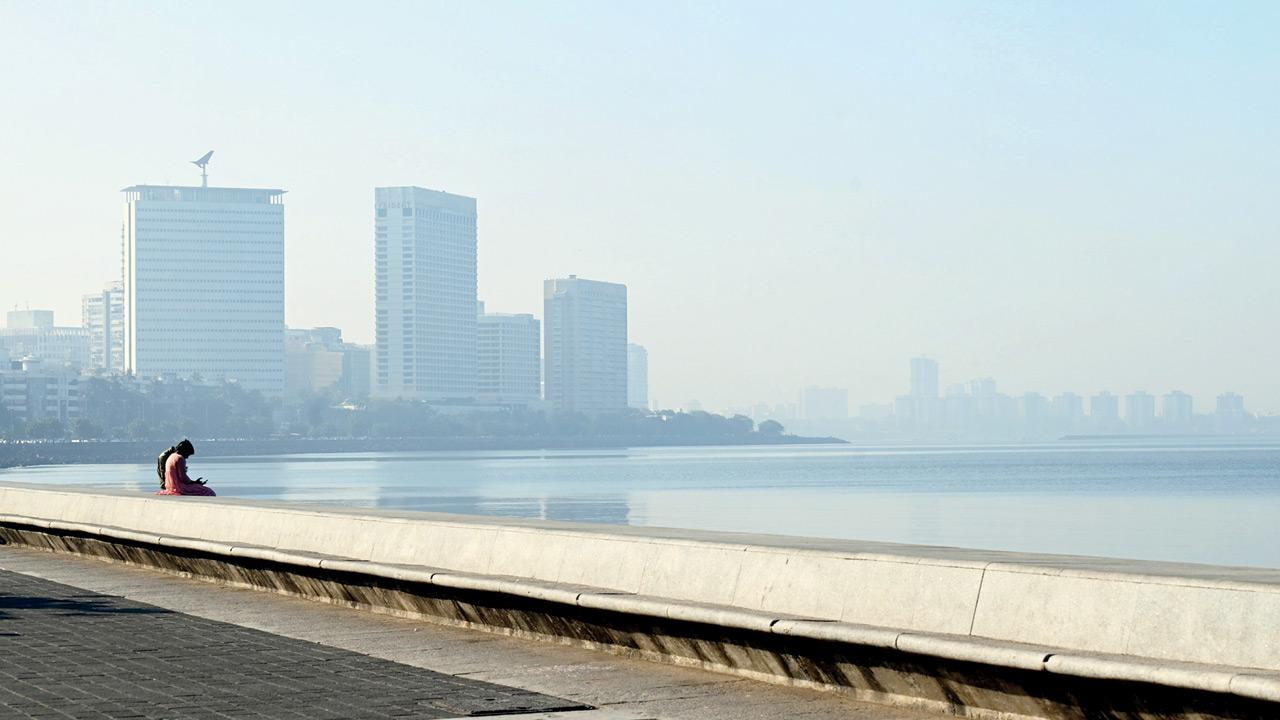
Marine Drive is veiled in smog on Monday. PICS/SATEJ SHINDE
Mumbai has seen a 95 per cent decrease in the number of ‘severe’ Air Quality Index (AQI) days in the past four years, from 40 in 2022 to only one in 2025, according to information from Brihanmumbai Municipal Corporation (BMC). In contrast, the city has seen a 21 per cent increase in ‘good’ and ‘satisfactory’ air quality days, from 21 days in the ‘good’ category in 2022, to 55 in 2025; and 153 days in the ‘satisfactory’ category in 2022, to 162 in 2025.
 Sumaira Abdulali, Awaaz Foundation
Effectively, this means Mumbai has seen better air quality year on year, going by civic body data. Referring to how air quality determines the quality of life, driving growth and investments, a senior civic official told mid-day, “It is a priority to maintain and improve air quality in Mumbai. We must also see that the city is a crucial business centre. Bad AQI can have a direct impact on growth.”
Recent percentages
Mumbai faced a near-severe crisis of bad AQI as it emerged from the coronavirus pandemic after 2022. That year, Mumbai saw 40 ‘severe’ days — in the red category in lay terms, and 150 ‘moderate’ days. In 2023, there were 35 ‘severe’ days and 145 ‘moderate’ days. In contrast, this year, Mumbai has recorded 112 days in the ‘moderate’ category.
A senior civic official said, “We aim to reduce the number of ‘moderate’ days further, and increase the number of ‘satisfactory’ and ‘good’ days for Mumbai.” In 2023, BMC released 27 guidelines to curb air pollution in the city. A year later, it added yet another point. This 28-point agenda is meant to control dust arising from construction in the city, regulate road dust from vehicles emerging from construction sites, and curb on-road pollution through regular washing and cleaning. The BMC has subsequently cracked down on bakeries across Mumbai to control pollution from cooking fuel.
Citizens speak
Shishir Joshi, CEO and founder of Project Mumbai, said, “While there are multiple climatic reasons which result in air quality improving or worsening, a critical aspect that cannot be ignored is citizens’ awareness and the role of civil society in enhancing that. In the past few months, very few acronyms have gained as much traction as AQI. It has been a conversation starter, a visible indicator through growing appearances of masks and not thus, ensuring the state (in this case, the BMC) is far more alert than otherwise is — compelling accountability. While data always is a great indicator, what needs to grow is not just awareness, but informed conversation surrounding AQI and what we as citizens should be doing to hold the authorities accountable.”
Project Mumbai is bringing the global climate conversation to India and the city to host the Mumbai Climate Week in February. Sumaira Abdulali of the Awaaz Foundation said, “It is distressing to see the government constantly saying that AQI has improved, when we are all clearly experiencing the health side effects of bad air quality. Data that shows improved air quality in Mumbai should account for the experiences of people. Each country uses different formulas and methodologies for calculating this index, and there is nothing wrong with that. However, when an average is taken of major pollutants, including PM2.5 and PM10, it is easy to get several good and satisfactory days. The Central Pollution Control Board has changed the formula for calculating AQI. We don’t look at PM2.5 concentrations in the air alone anymore. Yet, PM2.5 is what we actually breathe. It’s why we continue to experience bad air, even though the data shows an improvement.”

 Subscribe today by clicking the link and stay updated with the latest news!" Click here!