












Wondering about that sore throat that just won’t go? It is because of consistently high levels of PM2.5, a pollutant that lodges in lungs, causing respiratory issues, say experts
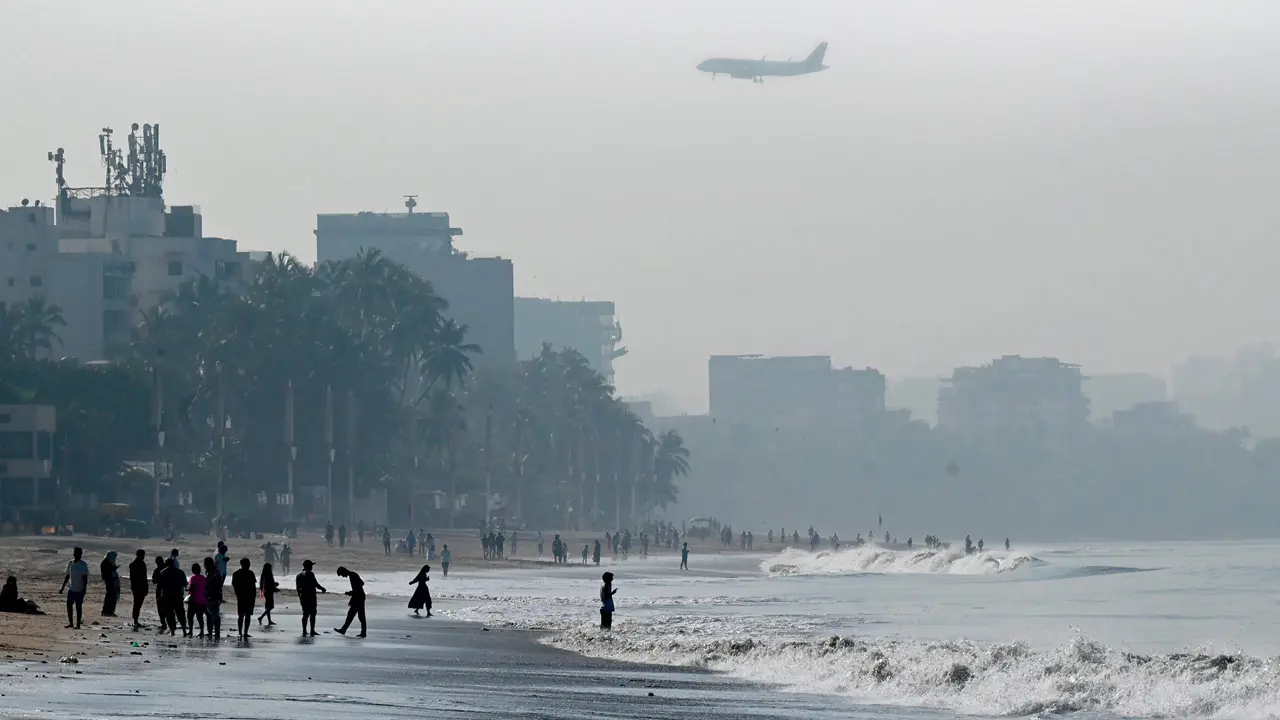
A veil of smog envelopes people and buildings at Juhu beach. PIC/SATEJ SHINDE
This December, Mumbai has consistently recorded concentrations of PM2.5 — considered the worst pollutant —higher than India’s National Ambient Air Quality Standards (NAAQS), especially in Bandra Kurla Complex (BKC), Byculla and Mazagaon, Chakala in Andheri East, Deonar, Ghatkopar, Kherwadi in Bandra East, Khindipada in Bhandup, and Malad, according to data available from continuous ambient air quality monitoring stations (CAAQMS), registered with the Central Pollution Control Board.
mid-day assessed data for PM2.5 concentrations in Mumbai's air for the first two weeks of December. Every day, the average concentration of PM2.5 was higher than 60 µg/m³ (micrograms per cubic metre), ranging to an average of over 100µg/m³. Hotspots such as BKC, Kherwadi, and Byculla have recorded maximum PM2.5 levels exceeding 200µg/m³
Why is it important
While the overall Air Quality Index (AQI) of Mumbai is noted to have improved this winter in comparison to 2023 and 2022, Mumbaikars have continued to experience the adverse impacts of bad air quality, leading to respiratory problems ranging from sore throat to respiratory infections, increased asthmatic symptoms, and fatigue.

Dadar railway station is engulfed in smog on December 17. PIC/SAYYED SAMEER ABEDI
PM2.5 is considered the worst pollutant. These are tiny particles that human beings can inhale. They settle deep in lungs. They can enter the bloodstream, causing long-term heart problems and even stroke. In contrast, PM10 is not a pollutant that can immediately be inhaled, and leads to other problems such as irritation to the eyes, damaging skin and hair.
While according to NAAQS, levels up to 60 µg/m³ are acceptable, according to the World Health Organisation (WHO), acceptable levels of PM2.5 are at an annual average of 5 µg/m³ and a 24-hour average of 15 µg/m.
Health impacts
Manoj Kumar, analyst from Centre for Research on Energy and Clean Air (CREA), said, “There is a huge amount of evidence to show that PM2.5 is the most harmful pollutant for humans. In fact, to date, researchers have not been able to find a threshold for safe ‘consumption’ of it. This is to say, no value has been determined where PM2.5 is safe to breathe.”
According to health experts, PM2.5 is considered so bad that it can give non-smokers an illness associated with smokers. Harish Chafle, a senior pulmonologist and critical care specialist, said that, according to a study by the Chest Research Foundation, Chronic Obstructive Pulmonary Disease (COPD) is more common among non-smokers than among smokers in India.
Chafle said, “If we consider AQI and lung health, PM2.5 is a crucial component. If PM2.5 is high, lung health is going to be bad, even if the AQI is great. This can cause long-term problems. If you see the larger picture of air pollutants causing health problems, it will be helpful to take PM2.5 as an important subset of AQI. It is not just about AQI. In addition to causing lung problems, causes other larger health problems such as heart diseases and stroke, including COPD, which in layman’s terms is called smoker’s lungs. Non-smokers have it these days, due to breathing ambient air.”
Brief history of methodology
India’s AQI was launched in October 2014, giving it its number (formula) and colour description. It was done to enable the common man to judge the AQI in their vicinity through a layman’s lens. According to a statement made by Ministry of Environment, Forest and Climate Change at the time, an effort had been made to include a comprehensive set of parameters. While the earlier measuring index was limited to three indicators, the current measurement index has been made quite comprehensive by the addition of five additional parameters. In 2019, the National Clean Air Programme sought to revise the threshold for PM2.5 concentrations to keep up with present-day requirements, but it is yet to be implemented.
How does India calculate AQI?
Eight major pollutants are taken into account: particulate matter (PM 10 and PM 2.5), carbon monoxide (CO), ozone (O3), nitrogen dioxide (NO2), sulfur dioxide (SO2), ammonia (NH3), and lead (Pb). To calculate AQI, data for a minimum of three pollutants must be present, of which one should be either PM10 or PM2.5.
Green day
Mumbai recorded its first green AQI day of December on Sunday, with an AQI of 90, in the ‘satisfactory’ category. From December 1 to 20 (Saturday), Mumbai recorded AQI numbers in the yellow of the ‘moderate’ category, with December 4 and 18 recording the highest reading, 138. On none of these days was PM2.5 the primary pollutant despite heavy concentrations of the same in the air. Ozone and NO2 were the worst pollutants on all days.
Top areas with high concentrations of PM2.5
>> Bandra Kurla Complex
>> Byculla and Mazagaon
>> Chakala in Andheri
>> Deonar >> Ghatkopar
>> Kherwadi in Bandra
>> Khindipada in Bhandup
Areas with low concentrations of PM2.5
>> Powai
>> Sewri
>> Sion
90
AQI of Mumbai on Sunday
 Subscribe today by clicking the link and stay updated with the latest news!" Click here!