








Civic officials say they have redistributed oxygen to clinics in need and have kept a buffer of 500 litres in city’s seven zones
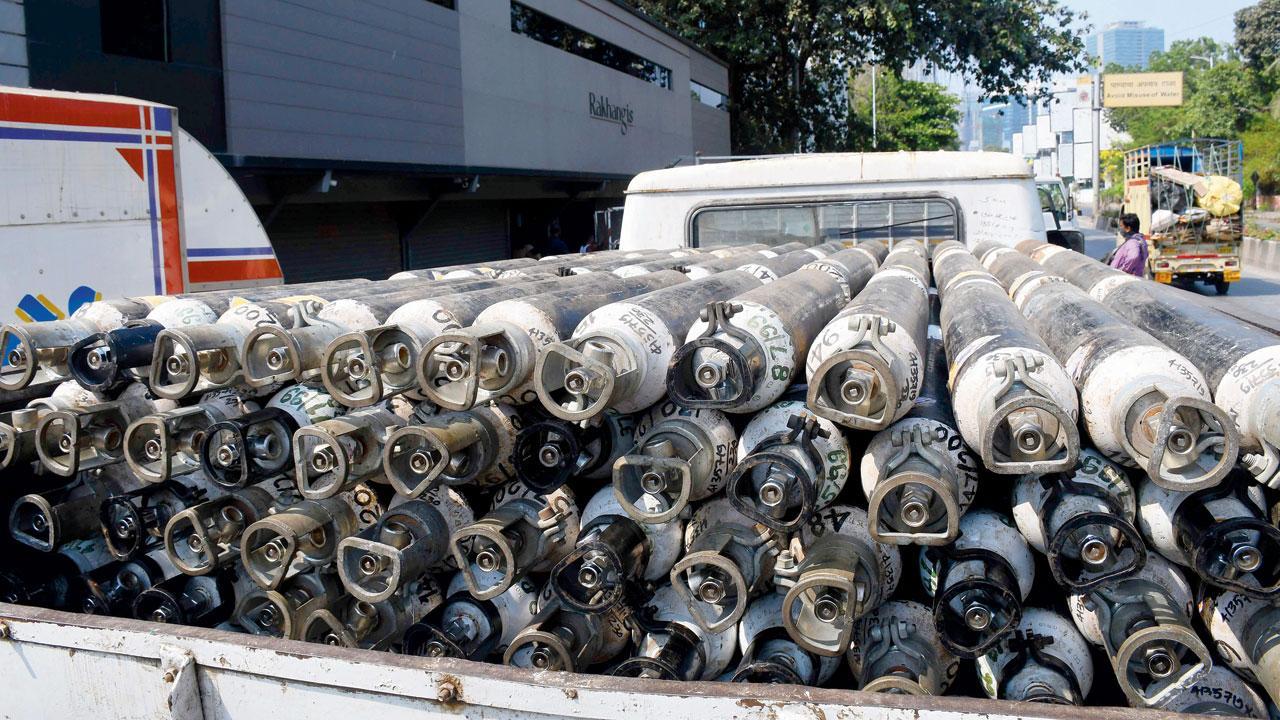
The state’s total oxygen requirement is 1,500 MT currently. Pic/Ashish Raje
As the city’s oxygen supply slowly stabilises, civic officials have been busy at coordination efforts to ensure no hospital faces a shortage. With smaller private nursing homes and hospitals particularly needing help, civic coordinators at every ward are routing oxygen from big hospitals to such needy ones. Senior officials, on the other hand, have assured that the city would get its daily demand of 235 MT liquid oxygen. An issue could arise only if there are technical problems on the supply side.

Hospital staff get oxygen cylinders refilled at a shop in Mahalaxmi. Pic/Ashish Raje
During a review meeting on Monday, Municipal Commissioner Iqbal Singh Chahal said that the city is in a much better position in terms of oxygen availability. Around 300 metric tonnes (MT) oxygen is expected to arrive from Visakhapatnam, Jamnagar and Raigad. Experts, on the other hand, said that the State’s response has been delayed and that experts should be allowed to take the lead in the mitigation of COVID-19’s second wave.
After the BMC shifted around 168 patients from six civic hospitals to Jumbo COVID centres and other oxygen-rich hospitals on Friday and Saturday, a crisis was averted at least temporarily.
The city receives around 235 MT oxygen daily. In the review meeting, civic officials met oxygen suppliers and manufacturers, Food and Drug Administration’s (FDA) Mumbai commissioner and other officials.

A man refills an oxygen cylinder at a private gas refilling shop in Mahalaxmi on Saturday. Pic/Ashish Raje
Chahal instructed that civic teams will monitor the transportation of oxygen from the production site and its distribution. The teams will update the quantity of oxygen received on a shared Google Drive daily for effective monitoring. This was agreed upon by the FDA commissioner too, who promised to assist the civic body.
It was also learnt during the meeting that oxygen producers and suppliers are not getting raw material for production. Chahal instructed hospitals, especially the private ones, to use available oxygen properly and sparingly.
“About 300 MT more oxygen is expected from Visakhapatnam, Jamnagar and Raigad soon, giving relief to everyone. Until then, however, oxygen producers and suppliers, along with the administrative machinery, should also work on ‘mission mode’ with civic officers appointed to ensure timely supply,” Chahal said.
‘State’s response delayed’
The state requires 1,500 MT of oxygen daily. Dr Deepak Baid, former president of the Association of Medical Consultants, Mumbai, said the government’s response to the oxygen shortage was delayed. “Manufacturing should have been increased or supply should have been diverted to medical oxygen much before this. We are losing lives amid the delay,” he said.

Iqbal Singh Chahal, civic chief
Dr Baid said on Saturday that the BMC has asked private hospitals to register daily before 5 pm the next day’s oxygen requirement. “The local ward officer (assistant commissioner) is our contact person in case of any trouble,” he said, adding that the approximate in-house caseload ratio of state-managed and private-managed cases in Mumbai could be 60:40.
Local pool
Some six hospitals (COVID, non-COVID) in Ghatkopar, including Dr Baid’s own hospital, have formed a group. “We know the situation is beyond the government’s control. We inform each other about supply and consumption. If there is shortage, we send cylinders to the needy hospital. We prevent shifting of patients,” he said.
Dr Baid added that many hospitals in Mumbai have started buying oxygen concentrators for R45,000-R50,000 per piece. “Oxygen shortage will lead to shortage of beds because hospitals may hesitate from operating at total bed strength. Almost all admitted patients need oxygen. Why would they get admitted if they don’t need it?” he asked.
“The charges for jumbo and other cylinders have been capped, but suppliers are recovering losses by charging more for transport and deposit,” Dr Baid said.
Let experts manage it
National Secretary of the Indian Medical Association’s (IMA) Hospital Board, Dr Mangesh Pate, said the COVID-19 mitigation should be in the hands of experts, not politicians.
“They (government experts and political leaders) say 80-85 per cent active cases don’t need oxygen, but what should we do with the remaining people who are put on oxygen? We don’t know about the arrival of refill/replacement,” he said.
According to Dr Pate, the cost of procurement has increased two-three times and the requirement has increased by 50-100 per cent. “A patient needs 15-25 litres of oxygen per minute, sometimes even 30 litres. On a ventilator, a patient can consume 45-90 litres per minute,” Dr Pate said.
According to IMA, till Sunday, the state’s mortality rate is 1.61 per cent, which is lower than the world average of 2.51 per cent, but it is more than the Indian average of 1.21 per cent.
Govt on war footing
On Monday, Deputy Chief Minister Ajit Pawar told officials to get as much oxygen from paper factories, steel, fertiliser and petroleum refinery plants. He asked for defunct oxygen plants to be repaired in factories as soon as possible.
Health Minister Rajesh Tope said, “The state is consuming the entire procurement of 1,500 MT. In a couple of days, we will have a supply of 1,800 MT daily, but it may not suffice if the caseload continues to increase,” he said.
Transport Minister Anil Parab said his department will create a green corridor to facilitate faster movement of vehicles loaded with cylinders and tankers carrying liquid oxygen by road from other states, offloading points and refilling sites within Maharashtra.
Mumbai’s oxygen supply stable, says Kakani
Additional Municipal Commissioner (public health) Suresh Kakani told mid-day that the city has nothing to worry about as the required oxygen is stable and a problem can arise only in case of technical issues.

Suresh Kakani, additional municipal commissioner
Amid the pandemic, the state regulates the oxygen quota, Kakani said. Mumbai has been allotted a supply of 235 MT daily. One-third of the city’s requirement is of private hospitals.
“The oxygen demand isn’t much higher than last year’s spike. It’s 10-20 per cent more and can be managed unless there is a technical problem in production or last point delivery,” he said, adding that the civic body has its dedicated suppliers.
When the civic body shifted patients from a peripheral hospital to some others, it was due to a shortage created by a technical problem on the supply side.
Kakani said the decision was taken after it was learnt that the manufacturing facility wouldn’t operate for at least 12 hours because of a technical snag. “In that case, hospitals, where refills are required, would have faced hard times to manage patients. So, we analysed requirements for the next 12 hours depending on the stock available in that particular hospital,” Kakani said.
45-90L
Oxygen required per minute by a patient on a ventilator
15-25L
Oxygen required per minute by a patient
 Subscribe today by clicking the link and stay updated with the latest news!" Click here!