










Mumbai woke up to a dense layer of smog as the city’s AQI climbed to 185, marking one of the highest pollution levels this year. With stagnant temperatures, rising humidity, and low wind speed, visibility dropped sharply, raising concerns over worsening air quality.
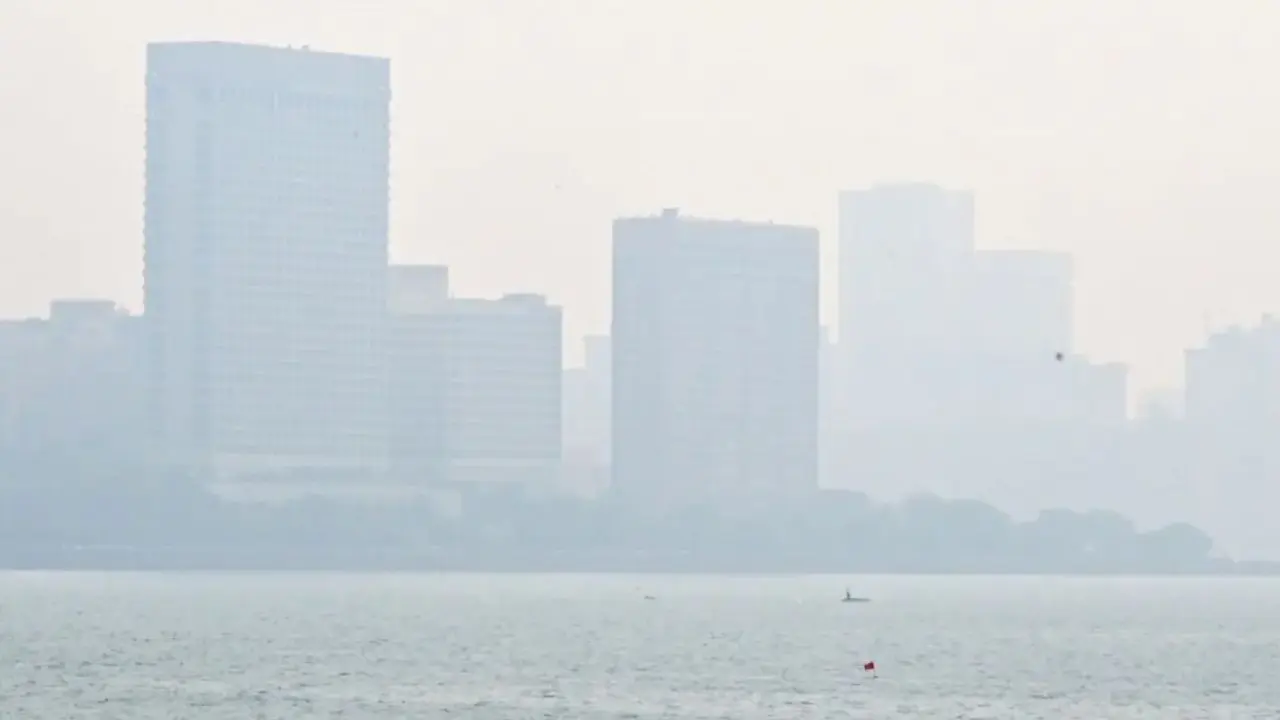
Thick layer of smog across Mumbai. Filepic
Mumbai’s air quality observed a sharp decline as the city on Wednesday woke up to extremely hazy conditions with poor visibility. The thick layer of smog was clearly a sight that made every Mumbaikar concerned about the rising level of pollution.
Along with the deteriorating air quality, the temperature, which usually goes down during this time of the year, has been at a standstill since the last few days. As per the Indian Meteorological Department, the weather around the city and suburbs will experience clear skies along with the maximum and minimum temperatures ranging from 33 degrees Celsius to 23 degrees Celsius.
While the last week in Mumbai felt quite chill, the temperature across the city and suburbs in the last 3-4 days has been on a warmer side, making the conditions a lot more hot and humid.
As per the IMD, the island city on Wednesday recorded humidity of 82 per cent and a slight drop of 1.2 degrees Celsius from yesterday. During the night over the past three days, the wind speed in Mumbai has been as low as 1 kmph.
Air quality ‘moderate’
While the city did experience one of the haziest mornings of 2025, the AQI justified the worsening air pollution situation. Mumbai on Wednesday morning recorded an AQI of 185 (moderate category). This level of pollution is by far one of the highest which Mumbai has recorded this year. With conditions expected to get even worse in the coming few days, it can be a major reason for adverse health effects, especially for sensitive groups.
Considering the fact the volcanic ash blowing towards India might just be the reason for these hazy conditions, leaving rising levels of pollution is something that cannot be left unanswered.
The volcanic ash
The volcanic ash cloud impacted northern states, including Delhi, Rajasthan, and Haryana, more. While the IMD experts on Tuesday also confirmed that Mumbai’s AQI is not related to the volcanic ash, the atmospheric condition still remains concerning.
According to the CPCB, an AQI between 0 and 50 is considered ‘good’, 51 and 100 ‘satisfactory’, 101 and 200 ‘moderate’, 201 and 300 ‘poor’, 301 and 400 ‘very poor’, and 401 and 500 ‘severe’. The areas worst affected by pollution continue to be BKC, Deonar/Govandi, Kurla, and Wadala, with smog reported during dawn.
 Subscribe today by clicking the link and stay updated with the latest news!" Click here!