Moksha after 20 years
Updated On: 20 January, 2019 05:42 AM IST | Mumbai | Sumedha Raikar-Mhatre
Her pursuit of the Brahmasutras began in Kashi in 1998. She is currently studying the Nyaya Sutras. Meet Dr Shailaja Bapat, the Bhasha Samman awardee of the Sahitya Akademi, who will travel anywhere in search of handwritten manuscripts





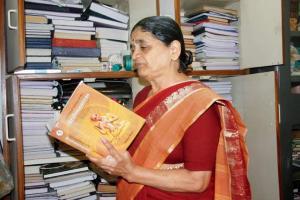
Dr Bapat, who lives with her sister, is thankful for a family that exempts her from pressures of socialisation. Pic/Mandar Tannu
 If you get robbed in Varanasi, Lord Shiva offers you salvation and lasting peace. Pune-based Sanskrit scholar-author Dr Shailaja Bapat had no patience for such popular beliefs when she was deprived of cash, reference notes and a key treatise on Vedant philosophy while aboard the Varanasi-bound Gyan Ganga Express sometime in 1998. As she got off at the Manduadih railway terminus, she was busy borrowing money and resources to conduct her intended research on Brahmasutras (the foundational text which decode the Upanishads, which are the spiritual core of Hinduism) in Varanasi's libraries. While she was left with only tears, and a story about two pickpockets who jumped off the decelerating train, the Kashi dwellers did not fail to tell her to see the silver lining in her state of loss. They reminded her of the possibility of moksha, each time she recounted her saga, in and out of the city's libraries.
Twenty years later, as Dr Bapat receives Sahitya Akademi's Bhasha Samman for her contribution to Classical and Medieval Literature, she sees her 1,800-paged Critical Edition of the Brahmasutras (divided in three volumes, published by New Bharatiya Book Corporation, Delhi) as the highlight of her scholarship. The award makes a special mention of her painstaking deconstruction of the Brahmasutras (555 aphoristic verses supposedly written by philosopher Badarayan roughly between 450 BCE and 200 CE; though multiple authors not ruled out) and pays tribute to the rigour manifest in a scholar's exploration. A sizeable glossary of 800 Sanskrit terms annotates the critical edition, which undoubtedly makes it a heavy read; it presupposes an insider reader (Sanskrit or theology student) who not just values the record 10 years devoted to unlocking the variant commentaries on the original Brahmasutras, but also imbibes research methodologies while negotiating three hefty tomes weighing nearly three kilos.
Trending Stories
Latest Photos
Latest Videos
Latest Web Stories
ADVERTISEMENT

Ganeshotsav 2026

ADVERTISEMENT