
Both ruling Mahayuti and Opposition seem to have strategies in place for local body polls, but one miscalculation could cost each side dearly and completely reshape Maharashtra’s political landscape
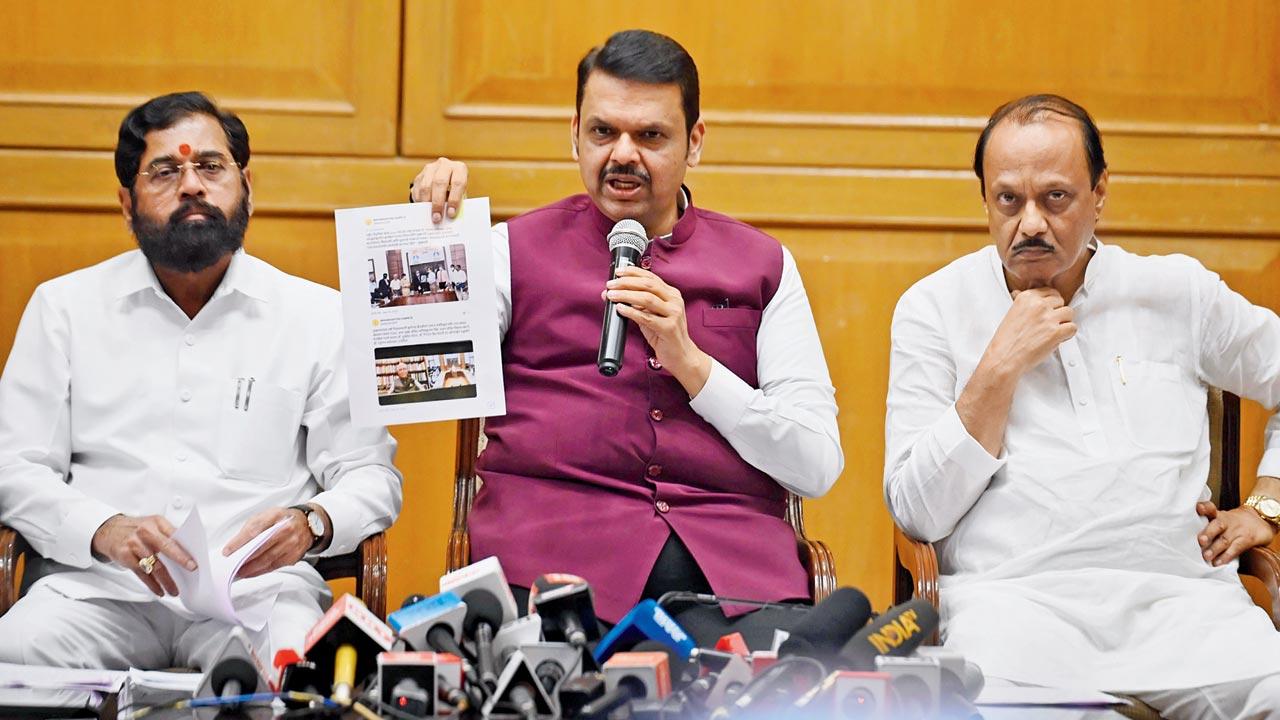
(From left) Mahayuti alliance leaders Eknath Shinde, Devendra Fadnavis, and Ajit Pawar. File pic/Ashish Raje
 The ruling Mahayuti and the Opposition are taking risks with the strategies they are planning for the upcoming local body elections. One misstep could prove costly for either side.
On paper, the Mahayuti strategy for the upcoming local body elections looks like a smart and well-timed move in comparison to the Maha Vikas Aghadi (MVA) game plan.
But, in politics, even small mistakes can quickly backfire. There is already an invisible unease within the alliance partners — the BJP, Eknath Shinde’s Shiv Sena and Ajit Pawar-headed Nationalist Congress Party (NCP). One wrong move in the local elections could easily upset the ruling alliance equations and further widen the crack at the state government level.
In Mumbai, where the Opposition is relatively strong, the Mahayuti (BJP, Eknath Shinde’s Shiv Sena and Ajit Pawar’s Nationalist Congress Party) have chosen unity out of necessity. The Thackeray cousins, Uddhav and Raj, are expected to campaign aggressively to capture the Marathi vote. Any split in the ruling alliance could make the task easy for Shiv Sena (UBT) and Maharashtra Navnirman Sena (MNS).
For two decades, the Thackeray cousins fought each other, never caring that their rivalry was splitting the Marathi vote and weakening the very community they claimed to represent. Now, with their political relevance on the decline, the estranged cousins buried their differences and united under the banner of Marathi pride. It is less about rediscovering brotherhood and more about survival in a changing Mumbai, where emotional appeals may be their last strong card.
But beyond Mumbai and Thane, the story is different as local ambition outweighs coalition dharma for both ruling as well as Opposition parties. These polls, often called “mini Assembly elections” will be held across 29 municipal corporations and hundreds of local body elections that will shape Maharashtra’s political future well beyond the civic level.
The Mahayuti strategy is to stay united where competition is strong and go solo where rivals are weak. Chief Minister Devendra Fadnavis has explained that places where ruling partners are already in first or second place, the Mahayuti will fight independently to avoid giving the Opposition any extra advantage. It sounds like a clever plan, but if the local maths doesn’t work out, the Opposition will get an opportunity to bounce back.
Solo contests will help parties understand their individual strength at ground level. But, a bad result in major civic bodies in the Mumbai Metropolitan Region (MMR) and smaller municipalities in the rest of Maharashtra could spell trouble for the so-called “triple engine Sarkar.”
For the BJP which leads both the central and state government, the local body polls are an opportunity to expand its base in Maharashtra’s urban and rural belt. But, for Eknath and Ajit, the same elections are a test of survival and legitimacy.
Shinde needs to prove that his breakaway faction still commands public support, while Ajit Pawar must demonstrate that his gamble of joining hands with the BJP has not alienated his traditional voters.
All three ruling alliance partners will try to put their best foot forward and show command over the electorate. But that’s precisely where the danger lies. The real threat to the Mahayuti comes from each other. The growing race among alliances to out power each other may actually end up weakening the ruling alliance.
During the on-ground campaigning, contestants and party speakers from the ruling alliance could end up attacking each other, highlighting faults and flaws within their camps.
This competitive spirit will turn the local body elections into a full-blown battlefield of rivalries. The message of unity will go for a toss and become a headache for those Mahayuti ministers and leaders sitting in Mantralaya.
But it is not only the ruling regime that faces a risk in the strategy they are working on. The Opposition is navigating tricky terrain with its strategy to keep BJP at bay. Shiv Sena (UBT) is pushing the Congress to join the Opposition alliance for local body polls to avoid a vote split. UBT Sena is in touch with senior Congress leaders in Delhi, as the state Congress is keen on contesting alone.
The Sena (UBT) knows it can manage Mumbai, to some extent, Thane and Nashik on its own strength (including the MNS alliance), but in the rest of Maharashtra, a divided Opposition would only help the ruling Mahayuti.
Other than Congress, Samajwadi Party (SP) leaders too feel that local body polls should not be contested in alliance with the Thackeray cousins. This concern stems from the fear that any association with Raj Thackeray’s Maharashtra Navnirman Sena (MNS) could impact their parties at the national level. MNS’s aggression towards non-Marathi speakers has drawn criticism in several states.
The Mahayuti leadership may assume people will support them because of promises of development, coalition deals and power politics. The Opposition may believe that playing the emotional Marathi card and highlighting misrule will win hearts.
But, voters on the ground can easily sense when parties are fighting for power and not for people. In such case, voters can punish political parties at the ballot box, complicating calculations and making life difficult for both camps.
That’s why these local body elections are more than just a popularity contest. They test how smartly parties manage their alliance, read the ground and plan ahead. And, since these polls are often treated as mini Assembly elections, the results will set the stage for Maharashtra’s politics for the next few years and set the tone for the 2029 parliamentary and Assembly elections in the state.
Sanjeev Shivadekar is political editor, mid-day. He tweets @SanjeevShivadek
Send your feedback to mailbag@mid-day.com
The views expressed in this column are the individual’s and don’t represent those of the paper
 Subscribe today by clicking the link and stay updated with the latest news!" Click here!