










India and the UK signed a landmark free trade agreement on Thursday, eliminating duties on key sectors. The deal significantly benefits Indian exports of generic medicines and medical devices like X-ray machines and surgical tools, boosting their competitiveness in the UK market.
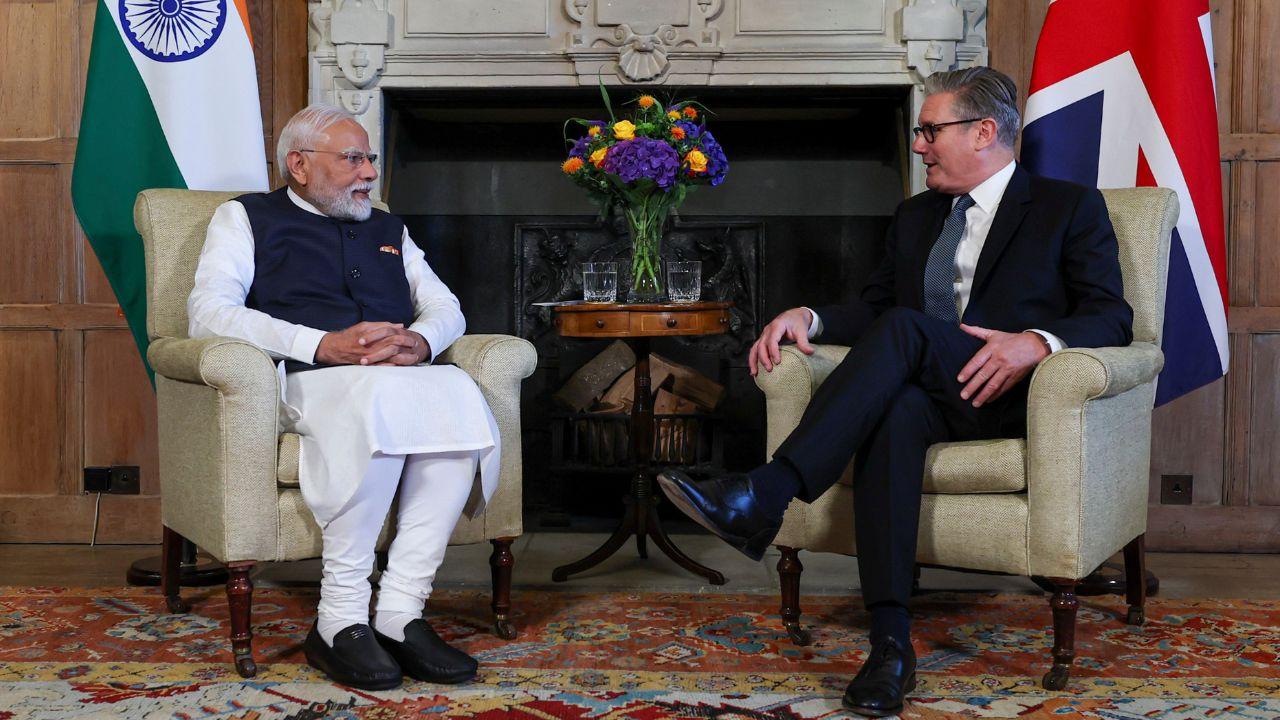
Prime Minister Narendra Modi with his British counterpart Keir Starmer during a meeting at Chequers Estate, in UK. Pic/PTI
On Thursday, India and the UK signed a Free Trade Agreement (FTA), which is expected to give a major boost to trade between the two countries. As reported by news agency PTI, India's exports of generic medicines and medical devices, such as X-ray systems and surgical instruments, will receive a major boost with Britain agreeing on zero duty under the Free Trade Agreement.
Along with several parts of the India-UK trade agreement, this section of the FTA, inked between the UK and India on Thursday, was agreed in the presence of Prime Minister Narendra Modi and UK Premier Keir Starmer.
One of the officials from the Commerce Ministry stated that "a significant share of medical devices like surgical instruments, diagnostic equipment, ECG machines, and X-ray systems will not attract any duty," as cited by news agency PTI.
The Commerce Ministry official further added, “This will reduce costs for Indian med-tech companies and make their products more competitive in the UK market. Given the UK's shift away from reliance on Chinese imports post-Brexit and COVID-19, Indian manufacturers are poised to emerge as a favoured, cost-effective alternative, especially with zero-duty pricing for medical devices,” as cited by news agency PTI.
The Ministry further indicated that the zero-tariff provisions under the FTA are expected to significantly enhance the competitiveness of Indian generics in the UK market. The generic pharmaceutical business remains India's largest pharmaceutical export destination in Europe.
India exports approximately USD 23.31 billion globally, and the UK imports nearly USD 30 billion, but Indian pharma accounts for under USD 1 billion, indicating significant headroom for growth.
It was indicated in the document that the pharmaceutical sector has 56 tariff lines, which account for only 0.6% of the total.
It has also been pointed out that the pharmaceutical sector, despite its relatively modest representation in terms of tariff lines, is generally of high value and strategic importance, particularly in global trade.
The Indian pharmaceutical industry is the world's third largest by volume and 14th largest in terms of value.
In the fiscal year 2024–25, Indian pharmaceutical exports increased by 10% year-on-year to reach USD 30.5 billion.
As reported by PTI, over the last 30 years, the industry has become a leader in the manufacture of high-quality generic drugs at competitive prices.
Considering that India is already the largest supplier of generic medicines, with a 20 percent share in the global supply by manufacturing 60,000 different generic brands across 60 therapeutic categories, the pharmaceutical industry is set to boom significantly after the FTA between India and the United Kingdom on Thursday.
The current market size of the medical devices sector in India is estimated to be USD 11 billion and is expected to reach USD 50 billion by 2030.
(With inputs from PTI)
 Subscribe today by clicking the link and stay updated with the latest news!" Click here!