Australia, France, UK — the world seems full of anti-Indian rallies right now. Indians abroad tell us they are sticking around because of the salaries, standard of life, and their will to beat the odds

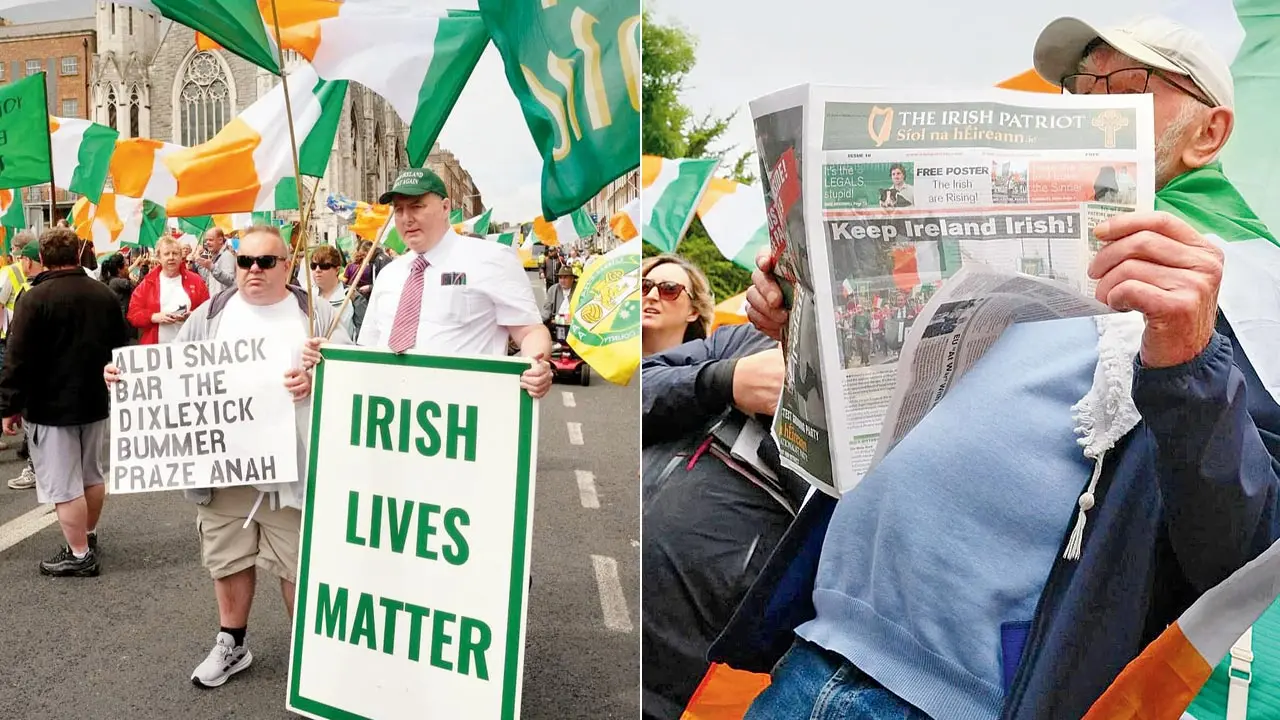
In April 2025, over 10,000 people joined an anti-immigration march in Dublin led by far-right activists. Pics/Instagram@vin_lincs.photo
On a quiet afternoon in the UK recently, a Sikh woman walking home was sexually assaulted and told, “You don’t belong in this country.” Thousands of miles away in Dallas, Texas, an Indian man was brutally beheaded in a hate-driven attack. These are just few of the attacks against Indians across UK, US, Canada, and Australia that have sparked outrage not only within the Indian diaspora, but across communities where their identities mark them as outsiders.
On Saturday, the Trump administration significantly increased H-1B visa fees, which is a temporary US work visa that allows companies to hire foreign professionals. It now requires a whopping Rs 88 lakh payment per application, effective from September 21, 2025. This latest move is seen as an attempt to crack down on immigration issues in America.
Aman Srivastava and Farhana Bodi
Sharmistha Seth [name changed], who studied in the UK, recalls being asked in all seriousness by her British classmates how many elephants her family owned. The question was framed innocently, yet it carried the weight of seeing Indians as primitive and otherworldly. Racism often arrived unprovoked. “My hijabi friend and I were waiting for a bus in UK,” she says, “and the driver simply ignored us while picking up others.” She currently resides in Sydney where the discrimination continues. Teenage boys once hurled abuses at her when she was enjoying a late evening walk. “These boys simply shouted — You stink you stupid brown f*cking Indian. I couldn’t even respond to them except for flipping at them as they drove past me.”
Today, stereotypes thrive online. Derogatory reels mock India as dirty or unhygienic, fuelling real-world hostility. It’s combined with extremist forums where anti-Asian slurs doubled to 46,000 posts in the US in January, according to Reuters.
The “Unite the Kingdom” rally in London swelled to nearly 1,50,000 protesters where 26 police officers were injured. Pics/Instagram@walesonline
Dev Patel [name changed] has seen how memes reduce Indians to curry, call centres, or comical accents when he was doing his PhD in Lithuania. “They [white people] will form an opinion about you through selective reels on India and come tell you that you eat food unhygienically. You try explaining to them but soon realise it’s futile to do so.” Old prejudices now spread at algorithmic speed, fuelling a modern cycle of ridicule and racism.
For Anmol Saxena, a 22-year-old living in Melbourne, racism was normalised in classrooms. Classmates called him “curry muncher” and “brown fella.” He recalls: “When I was in high school, a friend of mine gifted a deodorant to me for my birthday and told me to put it on to mask the ‘Indian smell’.” Saxena notes a shift in college, where diversity brought more tolerance. But, the slurs still linger as reminders of a childhood where ridicule was routine. Living in Australia for a decade with his family now, he mentions that the culture and work wages are the biggest encouragements to stay in the country. “Even as a part-time worker, the salary is better than what freshers get in India. I have settled into their culture now. I cannot go back to India and start afresh.”
An anti-immigration rally in Australia in August. Pic/Instagram@skubesnaps
Meanwhile, Aman Srivastava, who spent two years in France for his Masters, highlights how colourism intersects with racism. His lighter skin spared him some of the worst taunts compared to his darker-skinned friends. Job rejections were framed as “language issues,” even when he spoke better French than white peers. “I don’t know if that was bias or outright racism,” he says. “Sometimes you can’t discern underlying discrimination because you want to give them the benefit of doubt.”
While doing his PhD research in French territory, Patel found racism cloaked in denial. A white technical director called him “P@ki”, a derogatory racial slur for Pakistanis. This was said behind Patel’s back, but some of his teammates understood the slur and informed him about it. Together, they confronted the technical director, who refused to acknowledge it. “He apologised for everything except the slur,” Patel recalls. “It’s a bit disturbing that he was openly doing that with his friends.” As a researcher, the only thing that motivates him to continue working abroad are the opportunities that are provided to him. “If, as a PhD researcher, India gave me the funding and stipend that I get overseas, I would come back.” He also mentioned that most of his teams have been diverse and inclusive. Only a fraction of people are intolerant. “It doesn’t happen every day, but it exists.”
The comments under Sara Singh Tak’s business account on Instagram for Humans of Australia
Founder and CEO of media channel Humans of Australia, Sara Singh Tak has witnessed prejudice in boardrooms. She recalls her friend’s company laying off people of colour, including Indians, in the first round of redundancies. “You sometimes hear junkies on trams yelling at people of colour to ‘Go back to your country’,” she says. But online abuse is harder to dismiss. Her business account is filled with slurs like “p@jeet”, another ethnic slur directed towards Indians, or mocked for an “Appu accent”. Tak founded Humans of Australia to humanise immigrants through storytelling and to challenge what she calls the “white supremacy syndrome”. “It’s not just news, we humanise and give visibility to people, brands and businesses of Australia from all diverse backgrounds and communities,” she explains.
While Tak reshapes immigrant narratives, others like Farhana Bodi have fought to redefine visibility in industries long resistant to brown women. A beauty entrepreneur, content creator, and Dubai Bling cast member, Bodi describes her move to Dubai as persistence. “My move to Dubai was driven by a vision to build my brand at the heart of the Middle East’s cosmopolitan and fast-growing market,” she says.
Sara Singh Tak, Supriya Singh and Punam Rane
While she didn’t face overt discrimination, she noticed “some international beauty brands prioritised working based on their nationality. It wasn’t a personal rejection, but a clear pattern in brand priorities at the time.” Her coping mechanism was simple but powerful. “My hard work and talent. I knew that the quality of my content would speak louder than any industry preference.” Over the years, Bodi’s determination helped her “become one of the brown-skinned girls to really make it in the Arab world,” proving that merit can outshine bias.
If racist taunts feel personal, the past year’s protests show prejudice mobilised on a mass scale. In Australia, the March for Australia rallies on August 31 drew an estimated 54,000 people across major cities. Linked to far-right nationalist groups, the protests featured arrests and chants accusing immigrants of stealing jobs and causing the housing crisis. In the UK, anger over asylum-seeker hotels has escalated into a nationwide movement. The “Unite the Kingdom” rally in London swelled to nearly 1,50,000 protesters under the banner of Operation Raise the Colours. Twenty-six police officers were injured and 24 people arrested, underscoring how quickly anti-immigrant sentiment can turn violent. Ireland presents a chilling counterpoint. Recent weeks have seen targeted, violent attacks on Indian individuals in Dublin suburbs like Tallaght, Clondalkin, and Ballymun. These incidents include assaults and threats. In one case, a six-year-old girl was punched and told to “go back to India”.
Meanwhile, in April, over 10,000 people joined an anti-immigration march in Dublin led by far-right activists, with endorsements from public figures promoting
narrow nationalism.
Across these geographies, the pattern is clear: resentment is less about migration numbers and more about political scapegoating.
Leaders in the UK and Australia divert to immigration, investing in border crackdowns rather than tackling housing or inequality. As Tak puts it, “I think there are always people who are anti-something, but the real issues are the incorrect policies which immigrants are often blamed for.”
As Farhana Bodi reflects, “I didn’t see the bias as a barrier, but as a challenge to outwork and innovate.” Her words carry a larger promise: that true belonging emerges when difference is not just tolerated, but celebrated.

Same place, contrasting sentiments
For Dublin City Councillor Supriya Singh, racism in Ireland is a reality but not a defining one. Singh, who moved from the UK in 2016, recalls anti-India protests and the shock of attacks such as Tallaght. Yet, she insists these moments are outweighed by solidarity. “What truly defined my journey was the overwhelming encouragement from my neighbours and community, who placed their trust in me and elected me as their councillor,” she says. Singh expresses clearly that negativity exists, but the spirit of inclusion runs stronger.
Fellow councillor Punam Rane, by contrast, views the current moment with sharper unease. On a recent trip to India, she was struck by how Irish racism had become front-page news. “Almost every conversation I had circled back to the same topic — the safety of Indians in Ireland,” she says. Rane has no doubt that Indian professionals can rise to prominence in Ireland’s economy. She believes Ireland to be a neutral country with its environment welcoming of all communities.
Subscribe today by clicking the link and stay updated with the latest news!" Click here!