shot-button
BMC Elections 2026 BMC Elections 2026
Home > Sunday Mid Day News > Their god is not your fancy dress

Their god is not your fancy dress

Updated on: 16 November,2025 08:50 AM IST  |  Mumbai
Arpika Bhosale | smdmail@mid-day.com

How can one person’s god be someone else’s cosplay? It’s a question the indigenous tribes of Tulu Nadu are asking, on seeing their centuries-old tradition being aped by Kantara fans in costumes

Their god is not your fancy dress

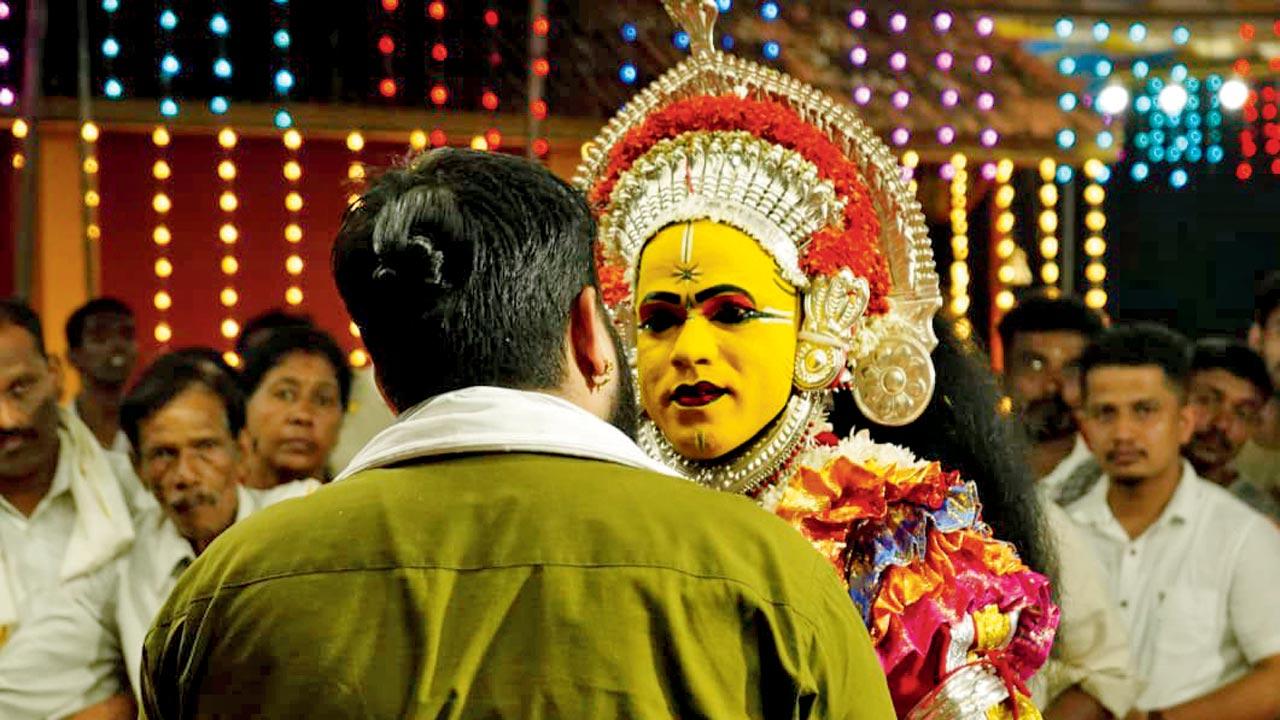
Shashank Nilitare during the calling of the Daiva spirit ceremony

Every Halloween brings the “appropriation” discussion to the fore again, with debates on what costumes pay homage and which are just culturally insensitive. The discourse is all the more pointed amid the Kantara fever this year, with instances of fans cosplaying the ancient Boota Kola ritual outside movie theatres. After all, is it really paying homage if you style a Halloween costume or cosplay as a 500-year-old demigod of an indigenous people? 

In Tulu Nadu, along the western coast of Karnataka, there are over 1200 demigods known as Daiva/Boota, and they hold deep, sacred meaning for the people of this region. For them, the success of Kantara is a double-edged sword, bringing public awareness to their centuries-old culture, but also exposing it to insensitive mimicry in the form of “cosplay”. This outrage is widely reported in regional news media from Tamil Nadu and Karnataka. 


Daiva speaking to Shashank NilitareDaiva speaking to Shashank Nilitare


Their worship includes the ancient practice of Boota Kola, when the demigod merges with the member of a chosen family. This merged demigod-in-human-form then communicates with the villagers through a mediator — a member of a different clan chosen for this role.

Shashank Nillitare is the 16th-generation mediator from his village, Balnadu, in Puttur Taluk of western coastal Karnataka. “My family summons the spirit of Daiva. In this generation, I am the one who has been chosen to do so,” Nillitare tells Sunday mid-day over a phone call.

The recent cosplay of the demigods outside theatres showing Kantara has been a point of contention between apprporiation and paying homageThe recent cosplay of the demigods outside theatres showing Kantara has been a point of contention between appropriation and paying homage

Since Diwali, Nillitare, an engineer by day, has been working through the night as the Daiva season has begun. “It starts every year on the day of Deepavali and ends on April 26. It is during this period that the Daiva tells us what we need to improve the harvest,” he says.

Nillitare invokes the spirit of Ullalthi Amma, his village’s demigoddess. Legend has it that she, along with her brother, came to Puttur (western Karnataka) during the reign of a cruel king. Tired of injustice, the divine duo killed the king, freeing their people from the tyrant.

Shashank Nilitare and Sadhana ThippanakajeShashank Nilitare and Sadhana Thippanakaje

Balnadu was then gifted to the demigod siblings by Lord Mahalingeshwara. “Each of the 16 villages here has a demigod and more sub-demigods that are rooted in our culture. Just like I am chosen from a long line of mediators in my family, the Daiva presents itself in the body of someone from another family that was chosen over 500 years ago, when the demigods first graced us with their presence,” adds Nillitare.

The birthright is considered sacred, and no matter what their day job, the man/woman chosen will rarely reject the duty. They give up alcohol, meat, and leads in the harvest season. Once the season ends, too, they are expected to lead a pious life. 

Nillitare has mixed feelings about Kantara. “The movie was good in a way; many people have learned of our traditions, but thousands have gotten access to a sacred thing. It’s meant only for those who understand the importance of Daiva in our lives. It hurts when we see people outside theatres, and even in the movie, enacting it [Boota Kola] for entertainment,” he says.

In some villages, he reveals, the ritual is so closely guarded that it cannot be witnessed by even those from the neighbouring village. Many Daivas tend to refuse counsel to outsiders, says Nillitare. “The demigods are believed to know the lineage of every person in the village, but they cannot see an outsider’s ancestors when she/he asks for help,” he explains.

The Daiva plays the role of a counsellor or a therapist in the village, imparting counsel on a range of subjects, from marital issues to business. “When the Daiva addresses you, the first thing they say is, “As a mother, I feed you and, as a father, I will guide you. That is what they are for us,” he says.

Visual anthropologist Aslam Saiyad, who has been researching the rituals of tribals, including those from the Aarey forest, for the last two years, says he couldn’t make it through Kantara. “I watched a bit and realised the depiction is quite exotic; it’s not like that,” he says. 

The Bollywoodisation of tribals, says Saiyad, is so ridiculous that past a point, it becomes amusing. “The ritual is a part of everyday life for tribals. We get so enamoured by it that it tends to be portrayed in a very unrealistic fashion. We like our tribals to wear leaves; we cannot look at them like regular people, which is why we enjoy movies like Kantara,” he adds.

Sadhana Thippanakaje is a food anthropologist and cultural documentarian of Karnataka and Maharashtra’s west coast and says that there are different versions of the Daiva along this coastline. “This tradition overlaps with the Maharashtra and Konkan region as well. Here, we might call it baapdev [father of gods], jaagewala [entity of this land] or raakhandar [protector of lands]. In Kantara, the demigod is Panjurli, who is a wild boar that protects the forest. Similarly, there are demigods who will protect paddy fields,” she says. 

The attire and makeup for the rituals are made from nature; the attire from banana stem, and the makeup from leaves and flowers. “The community largely comprises SC and ST members who live on the borders of the village. But during this season, the savarna too join to pay their respects,” she adds.

“If one does get a chance in their lifetime to witness a ceremony where the Daiva comes and express their divinity in dance, it is a wonderful blessing,” says Thippanakaje. As an observer, she lets us in on how the movie has led to an almost commercialisation of something so sacred, “Some people from the mountainous regions of Karnataka, like Mysuru, may not have known about this tradition, but after the movie, many have started dressing up, dancing, and screaming to copy the movie. They [Daivas] are not actors; they are chosen,” she says, disgust creeping into her voice.

Cosplay has to be respectful

True cosplayers will be quick to point out that a Halloween costume comes nowhere close to the effort put in by them to replicate their favourite characters — from Chewbacca to Captain America — from the toenail to the hair. But with Comic Con India returning to several cities for its second leg of 2025 this month (Hyderabad and Guwahati), and with Kantara capturing the audience’s imagination, we might just see some Buta Kola cosplay pop up on the internet. Lifelong cosplayers, though, warn that this would not be appropriate cosplay.

Medha Srivastava in cosplayMedha Srivastava in cosplay

“There’s a thin line between appreciation and appropriation,” says Medha Srivastava, illustrator and cosplayer, “and acknowledging it is what separates a respectful artist from a person who might be just imitating it carelessly. For example, Kali comes from our religion, and there are a lot of people in the West who cosplay as Kali on Halloween.   We get offended by that, right?”

“Before cosplaying a very culturally rooted character, we need to ask ourselves, ‘Do I understand the background and symbolism of this attire or this character? Am I representing it respectfully without mocking it? Or am I sexualising the character?”

Rivika Khanna in full cosplayRivika Khanna in full cosplay

“With historical characters, cosplay has to be depicted respectfully to avoid hurting people’s sentiments,” says Rivika Khanna, founder, Mumbai Anime Corps. “Cultural appropriation strips meaning from culture, treats it like a prop, and disrespects its origin. On the other hand, cultural appreciation is about honouring, researching, and crediting, wearing it with understanding, not entitlement.”.

"Exciting news! Mid-day is now on WhatsApp Channels Subscribe today by clicking the link and stay updated with the latest news!" Click here!

Did you find this article helpful?

Yes
No

Help us improve further by providing more detailed feedback and stand a chance to win a 3-month e-paper subscription! Click Here

Note: Winners will be selected via a lucky draw.

Help us improve further by providing more detailed feedback and stand a chance to win a 3-month e-paper subscription! Click Here

Note: Winners will be selected via a lucky draw.

Sunday Mid-Day Sunday Mid-Day update Sunday Mid-Day news update Sunday Mid-Day latest update Sunday Mid-Day latest news kantara karnataka

Mid-Day Web Stories

Mid-Day Web Stories

This website uses cookie or similar technologies, to enhance your browsing experience and provide personalised recommendations. By continuing to use our website, you agree to our Privacy Policy and Cookie Policy. OK