










Artemis II is hardly the first spacecraft with toilet troubles. Post its safe return on Saturday, journalist Gulu Ezekiel recalls a conversation with US astronaut Dr Mary L Cleave, who’d jettisoned waste water from the Atlantis shuttle, resulting in a streak that was dubbed ‘Cleave’s Comet’. Talk about trailblazers!

An autographed photo of Dr Mary L Cleave gifted to the writer in 1987
The launch of Artemis II onboard the Orion rocket on April 1 and its safe return on Saturday brought back memories of the golden age of space flight in the 1960s which fired up the imagination of youngsters around the world. This was the first crewed space flight to leave Earth’s orbit and enter the Moon’s orbit since the last of the manned Apollo missions (Apollo 17) in December 1972.
The glitches in Artemis’ on-board toilet also reminded me of my meeting with a Space Shuttle astronaut in Chennai (then Madras) in December 1987, when I was a reporter with a national daily.
The Apollo missions, which began with the tragedy of Apollo 1 in January 1967 (killing all three astronauts on the ground during testing), culminated two years later with the first humans to step onto an alien surface in July 1969. Commander Neil Armstrong had the signal honour, followed by his crewmate Lunar Module Pilot Buzz Aldrin. In all, there were six successful missions with 12 astronauts walking on the moon’s surface. The only one which was aborted was Apollo 13, which returned to Earth after circling the Moon but failing to land due to a catastrophic near-fatal explosion on board.
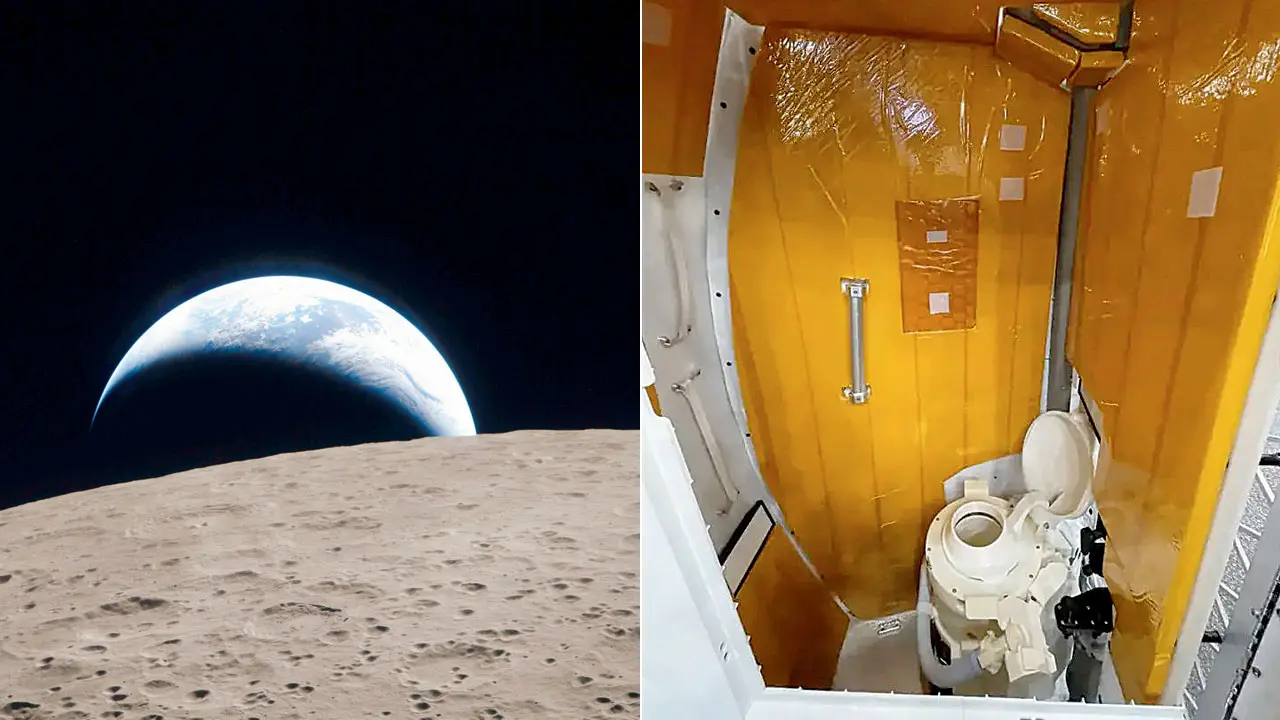 A glimpse of Earth through the Orion spacecraft window during the Artemis II crew flyby of the moon on April 6. Pic/Getty Images; (right) The Artemis II mission has twice had to grapple with a clogged toilet. Pic/Canadian Space Agency
As space fever swept the world, my elder brother Jawahar, 12, and I, 10, became lifelong space buffs. The three Apollo 11 astronauts, including Command Module pilot Michael Collins who stayed in the capsule circling the Moon, travelled the world on PR tours and received a rapturous welcome in Mumbai (then Bombay) where an estimated 1.5 million fans greeted them. This was part of a 38-day tour visiting 29 cities in 24 countries at the request of US President Richard Nixon. The Moon landing was one of those historic moments in time when one can recall exactly where one was when it occurred — in our case, at our neighbour’s home in Durgapur, West Bengal, listening to the live commentary over their short wave radio since ours was not working.
My brother had a hobby collecting newspaper front pages on historical events, including, of course, the Apollo missions. Imagine our excitement, then, when we had the honour of meeting Apollo 12’s Alan Bean, the fourth man on the Moon, during a visit to Calcutta (now Kolkata) in 1976. He gave a lecture where he spoke of the Space Shuttle programme which was launched in 1981. He was delighted to sign the newspaper page. In 2011 Jawahar’s elder son, Arjav, met Mr Bean in Washington, DC, and reminded him of that Calcutta meeting. That page is now framed and displayed in my brother’s “man cave” in his home in the US, along with his rock music memorabilia.
Which brings me back to the meeting in 1987 with Space Shuttle Mission Specialist Dr Mary L Cleave who had flown on Flight STS 61 on the Atlantis shuttle from November 23 to December 3, 1985. Two flights later, came the first of the two shuttle tragedies. The Challenger blew up on January 28, 1986, just 73 seconds from takeoff, killing all seven on board. This included school teacher Christa McAuliffe, who was to be the first civilian in space where she was to give lessons to her students. The entire shuttle mission had come to a grinding halt while NASA did a thorough check of the three remaining shuttles, Atlantis, Columbia, and Discovery.
The second tragedy occurred in 2003 when Columbia exploded as it came in to land in Texas on February 1, killing all seven on board, including Indian-born Kalpana Chawla. Ronald McNair, one of those onboard the doomed Challenger flight, had visited Madras in 1985, but I missed meeting him. Perhaps just as well.
The excitement over McAuliffe’s flight which was not to be brought back a memory from Alan Bean’s talk to the audience at the United States Information Service (USIS) centre in central Calcutta. My brother and I were rapt listeners as he spoke about the planning of the Space Shuttle. Bean told us that anyone of us in the audience could be an astronaut aboard the Space Shuttle as it was tailored to take civilians into space. This elicited a roar of laughter from the sceptical audience, though Jawahar and I were not laughing. We just gave knowing looks to each other.
I met Dr Cleave at the Indian Institute of Technology (IIT) auditorium at Guindy, Madras. It was a sensitive time for NASA, but she answered all my questions candidly and honestly. The headline for the interview dated December 12, 1987, said it all: ‘Quo Vadis, NASA?’ — the Latin term meaning “Where are you going?”
The shuttle programme did indeed resume in September 1988 and Dr Cleave made her second and final flight again on board Atlantis in May 1989. It finally ended in 2011. Inevitably the question arose: was it worth the cost in terms of money and lives to send humans into space when so much could be achieved by robotics? Dr Cleave was adamant that some tasks could only be undertaken by humans. I asked the same question to Rakesh Sharma, the first Indian in space, when I met him in Delhi not long after the Columbia disaster. He gave the same answer.
The issue of toilets on board rockets has always been a sensitive and tricky issue. The early manned flights, which were extremely basic and cramped, had no toilets at all — the job was done in bags, something the astronauts hated. But even on board the more spacious shuttles and the International Space Station (ISS), this has been a recurring problem. I asked Dr Cleave, “How is it NASA has been able to put 12 men on the moon but cannot construct a properly functioning toilet on board?” Her reply was a brief one, “We are working on it.”
With the Artemis II mission twice having to grapple with a clogged toilet, it appears this remains a work in progress. The first time the problem was solved by Mission Specialist Christina Koch, with NASA releasing a short video of a stream of bright liquid exiting the craft. Koch joked: “I’m proud to call myself the space plumber.” The second time the pipes were blocked by ice. The cost of the toilet: a cool $23 million.
There was an odd connection between Koch and Dr Cleave. The day before Atlantis landed, residents of Houston, Texas, were told to look out for it. Viewers witnessed a very bright and extremely long object streak out of the shuttle. This comet-like tail turned out to be ‘waste water’ which Dr Cleave had dumped, and which was promptly dubbed ‘Cleave’s Comet’!
Postscript: It was only when Artemis II took off that I was reminded of my interview with Dr Cleave and discovered she had died in 2023, aged 76. This article is my small tribute to the memory of a remarkable, intelligent, and highly capable person who had a distinguished career at NASA as a scientist and engineer after her flying days were over.
$23 m
Cost of the toilet on board Artemis II
The writer is a journalist and author based in New Delhi. He has written on a number of topics including space exploration, rock music and movies, apart from 20 sports books
 Subscribe today by clicking the link and stay updated with the latest news!" Click here!