


Tomorrow, the Lok Sabha might discuss the Trans Rights Amendment Bill — a policy change proposed without consulting the very community it threatens to strip of the most basic right of self-identification
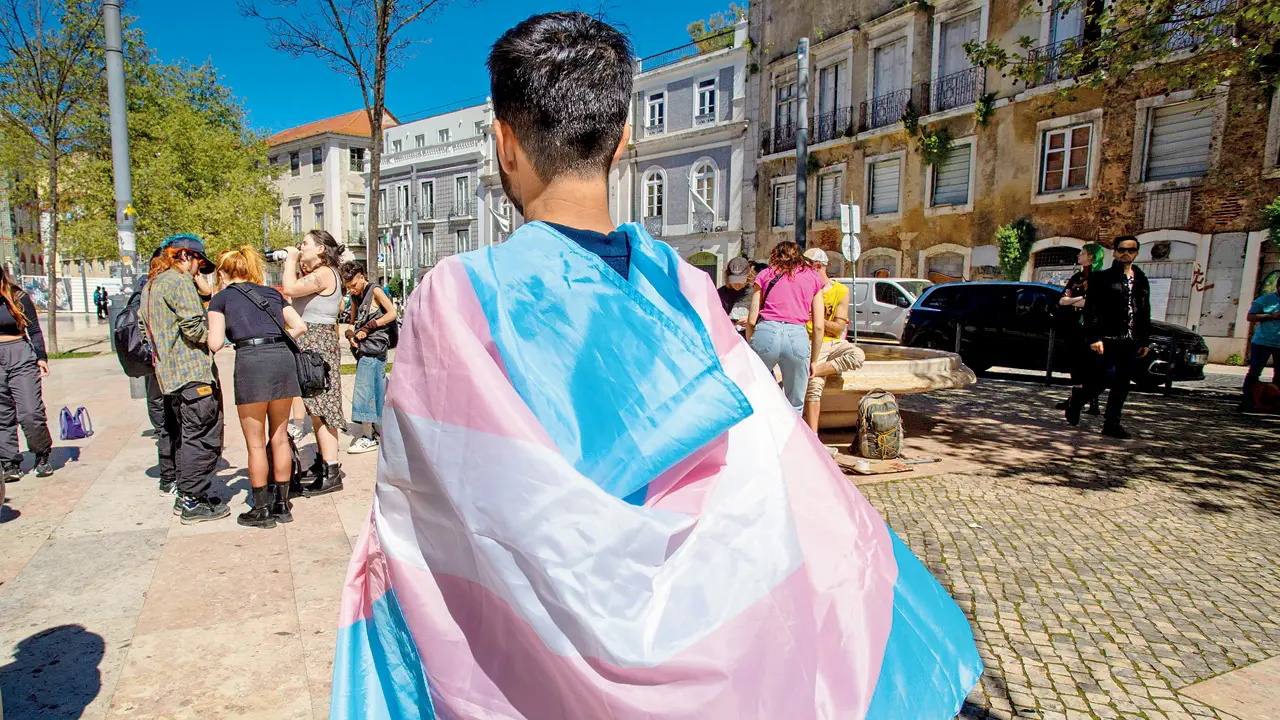
Pic/Getty Images
On April 15, 2014, the streets were painted pink, white, and blue. The Supreme Court had just delivered the NALSA judgment (National Legal Services Authority v Union of India), which made self-identification the cornerstone of being transgender. For a brief moment, the law caught up with lived reality.
Then in 2019, we got the Transgender Persons (Protection of Rights) Act, 2019, which set a three-step process for transgender certification. NALSA is going to turn 12 in a few weeks. It is at this hour that Dr Virendra Kumar, cabinet minister for the Ministry of Social Justice and Empowerment, presents us with, the Transgender Persons (Protection of Rights) Amendment Bill, 2026.
The Bill sets any and every progress made in the trans advocacy movement back by a century, violates every international standard, as well as our own country’s precedents. It claims to protect trans people, and yet, proposes to strip them of basic rights they’ve won after a decades-long fight.
Tomorrow, this Bill might be taken up for discussion in the Lok Sabha. This is not abstract policy; it will shape real lives, real bodies, real futures. So read it. Ask who it protects and who it leaves behind. And then demand answers. Call your representatives, write to them, question them. Because laws like these do not pass in a vacuum — they pass when people look the other way.
‘You cannot create welfare by excluding’
Kanmani R, Transgender lawyer
The trans community still doesn’t have economic protections of job reservations in India. The SMILE scheme, launched in 2022, provided free housing, gender-affirming medical care, and scholarships, but the programme is drowning in red tape. Instead of expanding the programme, the State’s response seems to be that self-identification leads to “misuse” of the scheme.

Kanmani R
Kanmani R, a Chennai-based advocate specialising in trans rights, says, “The Bill proposes that trans persons undergo an external medical process. Now, by virtue of the definition, the first step itself is to get medical procedure,” says Kanmani. But not all trans people feel the need, or can afford to transition surgically. Making this a prerequisite “is in direct violation of the NALSA judgment”, she adds.
The process for registration could become more complicated: evaluation by a State-appointed medical board, followed by its recommendation to the District Magistrate (DM), who can seek further expert review before issuing or withholding a certificate. “In India, a majority of trans people come from working-class, poor, and marginalised backgrounds. By introducing process after process, the State is putting a trans person through immense pressure — it’s a form of social violence. Welfare cannot be implicated by exclusion.”
Another major change is in Section 18, with the addition of clauses that criminalise forcing an adult or child to present as transgender through outward markers such as dress, voice, behaviour or “by making them undergo medical procedures such as castration”. “The National Crime Records Bureau has not provided any credible or publicly available data that clearly justifies the need for such specific offences,” Kanmani says, “The Bill seems to place trans persons within a framework of begging, kidnapping, and coercion, which is unsavoury.”

Members of the transgender community stage a protest against the new Bill at Jantar Mantar in New Delhi, on March 16. PIC/GETTY IMAGES
Another concern is “the requirement of medical institutions to furnish details of any person who has undergone gender-affirming surgery to the DM,” says Kanmani, “But surgery is supposed to be a very private matter. We are, quite literally, setting up a surveillance mechanism.” The lack of privacy coupled with outing allies are both equally upsetting, she explains.
“The name of the Act suggests it should protect trans people. But in this Bill, abuse against a trans person is punishable by six months to two years, whereas ‘forcing’ someone to become trans carries a punishment of 10 years to life.”
The National Council of Transgender Persons ought to have been consulted before formulating any policy changes, but Kanmani says, “Trans members have put out statements saying they were neither consulted nor informed.”
‘It is a double whammy’
Zainab Patel, Trans activist from hijra community
Zainab Patel, a trans rights advocate and petitioner in the 2014 NALSA case, says, “The hijra community stands in solidarity with the trans community. We realise that this is a model of medical and institutional gatekeeping. Sooner or later, everyone will get impacted by it,” she says.
With the Bill narrowing the definition of transgender identities, does that mean trans persons must align with socio-cultural groups for recognition? “The hijra community will continue to be a safe space for those who identify with this community,” Patel says, “At the same time we are not conducting membership drives to get more community members. We exist for those who identify as hijra and we have strived to be a safe haven for those identify as hijra.”

Zainab Patel
According to Patel, on the one hand the Bill wants to help “genuine oppressed” socio-cultural groups and on the other hand, “it doesn’t even include all the groups. What about Jogappas in Maharashtra and Karnataka; Shiv-Shakthis in Tamil Nadu and Andhra Pradesh; Sakhis in Odisha and Uttar Pradesh?”
Patel argues that this will lead to medical speculation even within the socio-cultural communities. “If I say I belong to the hijra community, how will they verify it? The only model that existed was in Tamil Nadu where initially the Transgender Welfare Board had senior gurus from the community who verified.” This model of community-based verification was phased out and eventually abolished after the 2019 Act came into place. “We don’t want such a model to come back. This is a very dangerous precedent and I fear that people will start going to quacks now to conceal their surgery history.”
Referring to the amendments proposed in Section 18, Patel says, “There’s an implication that the community is going and trafficking [people]. What the government is doing is a double whammy. It looks like it favours socio-cultural identities but the Bill also puts in so many checks and balances that ensure the community will automatically die out.”
‘Identity is not biological’
Aryan Somaiya, Trans-affirmative psychotherapist Founder of Guftagu Therapy
A study published in the National Library of Medicine finds 50 per cent of them have attempted suicide at least once before their 20th birthday.
Psychotherapist Aryan Somaiya says, “No one really understands you. It starts with your family, then you get bullied at school, then there’s discrimination when you’re getting hired, and it’s so much harder to find a partner.”

Aryan Somaiya
It seemed, briefly, like the government at least was starting to understand and support trans lives, but all that seems poised to go out the window now.
“Identity is not biological; gender is psychosocial,” says Somaiya, “Medical practitioners cannot verify gender. Their role comes in only as a service provider, when trans people need gender-affirming health care. So how can a medical professional validate my gender? This is not their subject-matter expertise.”
Proposed changes
Transgender lawyer Kanmani R explains:
>> One would no longer be able to self-identify as trans. Instead, the Bill proposes medical verification of trans folk
>> The Bill shrinks the definition of trans persons to these categories: socio-cultural identities (kinner, hijra, aravani, jogta), those with intersex variations, and those whose identity is “forced” through mutilation, castration, or hormonal changes
>> Previous 3-step process to get a trans ID now stretched into more complicated 5-step system
>> Criminalises “forceful” transgender identity by abducting, mutilating, harming, or forcing either a minor or adult to present as trans and engage in begging, servitude, or labour
>> Mandatory reporting of gender-affirming surgery to the District Magistrate and the designated “authority”
Is there a risk for doctors?
Dr Kanchan Pawar has 10 years of experience in providing gender-affirmative healthcare and is certified by the World Professional Association for Transgender Health.
She points to some ambiguities in the Bill, “If I provide hormone treatment to a client, it could be interpreted in the future as, ‘This doctor encouraged or caused someone to transition.’ This creates medical ambiguity for practitioners like me.”
Because of legal ambiguities, Dr Pawar is putting treatments on hold. “I’m telling my clients that I would prefer to hold off on starting hormone therapy until I have more clarity about what this amendment means for medical practitioners.”
An already broken system
It’s chaos!” says a trans friend. They feel safe enough to talk to us when we call to ask if they are doing okay. “To be honest, there is so much anger and distrust of the government, of the media; and all this for a scheme [the SMILE scheme for gender-affirming care] that most of us have not even been able to qualify for,” they say.
Our friend had been trying to get gender-affirming care for the last three years, but tells us that the documentation for this can take up to nine months. They say, “Documentation is the biggest hurdle. The website keeps crashing and you need to call someone and inform them; then they restart, we lose weeks and weeks in this process.”
We reach out to a few who have, despite the odds, availed of benefits, right from the transgender certificate to hormone replacement therapy to gender-affirming surgeries. But tensions are high, and they refuse to speak to us.
4,87,803
Population of transgender individuals in India
*Census data from 2011
8129
Number of people who’ve been rehabilitated in the SMILE scheme as of January
*Press Information Bereau
Inputs from Arpika Bhosale
 Subscribe today by clicking the link and stay updated with the latest news!" Click here!