shot-button
Union Budget Union Budget
Home > Sunday Mid Day News > As Heated Rivalry goes viral Mumbaikars dive into what makes it popular and why India needs to see more

As 'Heated Rivalry' goes viral, Mumbaikars dive into what makes it popular, and why India needs to see more

Updated on: 18 January,2026 08:39 AM IST  |  Mumbai
Debjani Paul | debjani.paul@mid-day.com

Why are Indians going gaga over a Canadian show about gay ice hockey players? Seeing queer joy and pleasure in the mainstream consciousness matters, says the city’s LGBTQIA+ community, while also asking: When will India get its own Heated Rivalry?

As 'Heated Rivalry' goes viral, Mumbaikars dive into what makes it popular, and why India needs to see more

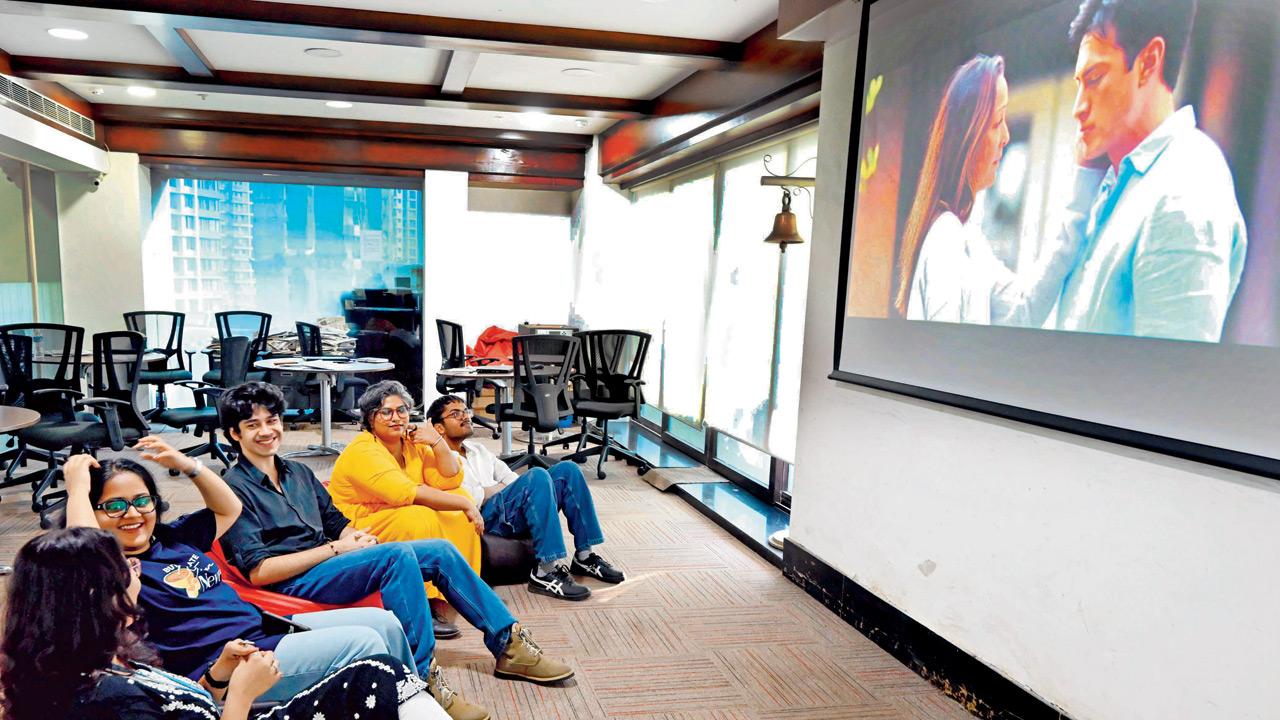
Queer community members are planning private screenings of Heated Rivalry for Pride celebrations, as well as Galentine’s Day. Pic/Nimesh Dave

Listen to this article
As 'Heated Rivalry' goes viral, Mumbaikars dive into what makes it popular, and why India needs to see more
x
00:00

This show has made so many queer people believe in love again,” Dan Rebello tells us. It’s been a long day at work for the primary school teacher, but their voice gets animated as we discuss the Heated Rivalry phenomenon that’s taken the world by storm. The Canadian show tells the story of two secretly gay ice hockey players, Shane and Ilya, who go from rivals to lovers.

Mulund-resident Dan first heard about the show around Christmas, when the last episode was about to air. The 33-year-old, who identifies as a trans-masc bisexual and is autistic, sees themself reflected in many ways on the show. They have since watched it eight times, and have also read the book (of the same name) by Rachel Reid that inspired it.


“It made me take a chance on love again,” they say shyly, “I liked somebody a year ago, but things didn’t go well. We reconnected over the show and then admitted how we miss each other. We decided to just take a chance and make it work.” There’s a lot of buzz around Heated Rivalry’s no-holds-barred depiction of gay sex as well as its emotional range: from the fear of being outed, to sportsmanship and competitiveness, to tender romance, and oh, so much yearning.


Heated Rivalry is a love story about two closeted gay ice hockey players

For the LGBTQIA+ community, it’s a powerful thing to see representation in stories that centre queer joy and pleasure, rather than trauma. “It’s a big statement for queer folk to say that the show has made us believe in love, because so many of us can’t imagine a future with somebody we love, or even just being our authentic selves,” Dan emphasises. 

There’s also been some criticism of how much sex the series features. Fans have defended it, pointing out that a lot of the character development happens in the sex scenes, as the male leads progress from furtive hotel room sex to coming to terms with their sexuality and accepting the deep love they hold for each other — all dangerous things in the hypermasculine world of ice hockey.

Garv Chaturvedi appreciates Heated Rivalry for representation of queer joy. Pic/Nimesh Dave
Garv Chaturvedi appreciates Heated Rivalry for representation of queer joy. Pic/Nimesh Dave 

For Thane-resident Garv Chaturvedi, a 20-year-old pursuing a Bachelor’s degree in Mass Media, the show is an example of how good storytelling can normalise queer love in the mainstream. “There’s this ‘sex sells’ narrative around the show’s popularity, but if you watch the show, you will see that the acting, the direction, the progression of the story, all do justice to the book. There have been other great shows recently like Heartstopper and Red, White and Royal Blue with happy endings. A well-made show that depicts queer individuals as we are — in pursuit of love and joy like any other person — appeals to everyone, and can do a lot to normalise the community,” he says.

Heated Rivalry features a lot of intimate scenes between Ilya (played by Connor Storrie) and Shane (Hudson Williams). Pics courtesy/Heated Rivalry

“Queer portrayal in India, on the other hand, is unfortunate. Media reflects how society thinks, and here, we have very few stories where queer folk are central characters; they are usually used as subplots. Or, their stories end in tragedy, [like Aligarh]” he adds. And there’s a reason for that. From film distributors to OTT executives and even viewers, there’s still a lot of resistance to depicting unapologetic queer love on Indian screens. 

Filmmaker Onir, who recently took his new film, Pine Cone, on the festival circuit, recalls a frustrating exchange with a viewer: “Pine Cone is all about queer desire, and it has a lot of intimacy. At a screening in India, a journalist came up to me and said, ‘It’s beautiful, but don’t you think there’s a little too much lovemaking?’ I told her that it was just four-and-half-minutes of lovemaking in a 90-minute film. People find that to be too much, but have no problem sitting through a three-hour film with two hours of violence. So is the problem you, or me?”

On OTT platforms, showrunners such as Rangita Pritish Nandy are pushing the envelope with queer arcs in series like Four More Shots Please!, The Royals, and Modern Love. Nandy is yet to watch Heated Rivalry and is sceptical of it ever launching in India. “I don’t think they’ll be able to release it here because it’s got a fair bit of intimacy. Not unless they chop it up,” she says.

Anahita Karthik first started writing queer romances as a way to embrace her bisexual identity. Pic/Ashish Raje

Among international movies and shows that have made it to Indian OTT platforms, Nandy is a fan of Red, White and Royal Blue, which is yet another romcom adapted from a book by Casey McQuiston. “I just loved the normalcy of it. But when I recommend it to people, they say, ‘We don’t watch all this. What is all this gay love?’” 

Representation matters and can change hearts one view at a time. Nandy recalls that a very senior investment banker called her one day after season two of Four More Shots Please! aired. He told her that the show had helped him relate to his daughter who is in a same-sex partnership. “He told me, ‘The normalcy with which you told the story [of the lesbian romance arc between Umang and Samara] made me feel that I can support my daughter. It made me feel like all the bias was in my head’,” says Nandy, adding, “That bias exists for even the most educated and privileged viewers. The onus is on us, as creators, to find a language for a two-way conversation with viewers, so we can champion causes without dumping too much information on them.”

Onir was questioned for his decision to feature four-and-half minutes of intimate scenes between the male leads in his film Pine Cone. Pic courtesy/Onir

Shows like Four More Shots..., Modern Love, and Made in Heaven have all successfully done this. It’s also a business decision for many platforms. “India largely has single-TV homes, where one family has one TV. People are not comfortable watching intimate scenes, especially not queer love, with their family. Younger ones might be watching it on their phones. There’s certainly curiosity among the audience, but perhaps no one wants to admit they’re watching it,” says Nandy.

This seems to be a global issue. Heated Rivalry showrunner Jacob Tierney reportedly had to fight to keep the intimate scenes in the show, when many studios wanted to axe even kiss scenes until the penultimate episode. 

Onir, too, faced a similar problem with his short film, We Are Faheem & Karun. The short, which explores the chemistry between a security guard from Kerala at a checkpoint and a Kashmiri college student, is inspired by the story of a real soldier.  Onir recently screened the movie in Srinagar. “It is the first ever queer film to have been screened in Kashmir, and it was a full house,” he says, “I would have thought there’d be producers or distributors reaching out. But there is some unspoken resistance; most people are only comfortable when queer stories are subtle  or invisible, seen from a heteronormative gaze.”

There’s also Sabar Bonda, 2025 film directed by Rohan Parashuram Kanawade. It went on to win the Grand Jury Prize at the Sundance Film Festival, but is yet to be seen on Indian OTT platforms. “There is a lack of will in Indian programming,” says Onir, “because there is very little representation from the queer community. It took years for women to demand and get more representation. And, they’re still fighting misogyny and unequal pay. It’ll take time for us too. Our stories need to be seen just as another beautiful story and not as a ‘queer story’.” 

It wasn’t always like this, says Prathyush Parasuraman, author and cultural critic. “We had erotically exciting queer cinema earlier; one of the pioneering films was Bomgay [1996] by Riyadh Wadia, which is very erotic and explicit. There’s a sex scene in the library and you can see Rahul Bose’s bu**,” he says, “There was Summer In My Veins [1999], a documentary by Nishit Saran, where we see him come out to his mother on camera. There was a lot of queer literature, from Hoshang Merchant’s poetry to R Raj Rao’s novel, The Boyfriend, which is very cruisy and erotic.”

A turn towards “respectability” came about in the 2000s, says Parasuraman, when “the queer movement was seen to be aligned with the legal fight”. “The movement became more about queer respectability than expression, and one way of garnering respectability in India is by erasing the erotic.”

Umang and Samara’s romance arc in Four More Shots Please! is one of the few desi representations of lesbian love. Pic courtesy/Four More Shots Please!

While cinema still saw some experimentation, queer literature took a greater hit. Outside of fanfiction sites like Archive Of Our Own (AO3) Wattpad, the closest thing we’ve seen to queer erotica in recent years is Parasuraman’s short story, Two Bi Two, in an anthology of Mumbai stories, The Only City (HarperCollins India, 2025). It’s a strikingly explicit account of a man who goes cruising in the infamous 2X2 local train compartment. 

“Cruising is such an integral part of so many people’s coming of age — pun intended,” he tells us, “There’s something very heated and immediate about the interaction between the characters in the story, but there’s also a tender gesture at the end, when the protagonist has to get off at the next station, and the other man zips up his pants and smooths the kurta for him.”

For many desi queer authors, writing is a way to express their gender identity and sexuality, and also tie their stories to the reality of Indian society. Vivek Mohan, an author based in Kochi, has written two gay romance novels, the second of which (Two Boys By The Pond, self-published in 2025) is partly based on his own love story with his partner.

Rangita Pritish Nandy and Onir

“South India has quite a few films with queer narratives, but not much in books. I had also watched a lot of queer movies and shows from abroad, but their experiences are not the same as ours. All the places I mention in the book are real, as are the societal pressures and customs; Indian readers will be able to relate to it.”

Similarly, Mumbaikar Anahita Karthik started writing queer lit as a way to embrace her bisexual identity.  “Eventually, though, it became more about wanting to write the representation that I’ve rarely had the chance to see,” she tells us. Her new book, Better Catch Up, Krishna Kumar (HarperCollins Publishing, January 2026), is a bi-for-bi romance set in Mumbai, but will be published in the US and UK. The protagonist is an Indian-American — a conscious choice because “it’s easier to normalise their coming out journey and make it more joyful”. “I feel like it wouldn’t be realistic for most people to have an easy coming out experience in India,” she explains.

Dan Rebello and Farhad Dadyburjor

Bengaluru-based Swati Hedge, too, made a similar choice to publish her new bi-pan romance novel, As Long As You Loathe Me (Penguin Random House, March 2026), in the US. While LGBTQIA+ romance is a booming genre internationally, “it’s a hard sell in India”. “Take my book cover; it has two girls looking at each other with flames and hearts around them. It explicitly shows a queer romance. How many people will be comfortable seen holding this book in India? If a parent sees their teen reading it, will they be okay with it?”

The 29-year-old author and freelance editor has several romcoms to her name, but hadn’t thought of writing a queer story until she came out as bisexual in 2022. “I wouldn’t have known what a queer person’s journey is like,” she says, “If someone outside the community writes a story, it takes away the opportunity to give a voice to someone from the community — whether that’s queer, black, or brown stories. When we tell someone else’s story, it’s also hard to separate that from titillation and fetishisation.”

There has been some criticism for the book series behind Heated Rivalry as well regarding this, with questions  about why a woman is writing novels about gay men. On the other hand, under Jacob Tierney, a gay male director, the show has been praised for its deep understanding of gay intimacy.

Swati Hegde and Vivek Mohan

Meanwhile, in the Indian publishing industry the tide finally seems to be turning. Westland Books last year became one of the first in the country to launch a brand new imprint for LGBTQIA+ stories, called Queer Directions (QD). It is being helmed by Sanghamitra Biswas, who is also the publisher at Westland’s other imprint, Tranquebar.  “There is space and a need for the more serious books and memoirs from the queer community, but we also want to publish books that are fun, quick to read, and speak to a larger audience,” she says, “I’m now looking for those out-and-out rom-coms and slice of life stories that are going to focus on the fun and exciting parts of being queer.”  

The Indian industry is more conservative than its international counterparts, she admits. Where LGBTQIA+ romances are churned out every couple of weeks in the US, it’s slow going here. But that’s also partly because submissions are low. Ambar Sahil Chatterjee, literary agent with A Suitable Agency, says he’s always on the lookout for queer manuscripts, “But we don’t see enough of them. Since the Supreme Court decriminalised Section 377, publishers have come alive to the fact that this is an untapped market. I don’t think any publisher here will be opposed to publishing in this space, but the challenge is to find well-written stories that resonate with readers.” 

Farhad Dadyburjor’s new book, Queerly Beloved (Penguin Random House India, February 2026), is the first desi gay romcom we’ve seen from a mainstream publication in a few years. Queerly Beloved is as masala as it gets, set around a big fat Indian gay wedding. “I can’t believe no one’s done that yet here,” he says. “Internationally, just December [2025] saw close to 200 LGBTQ-themed books released. Here, we don’t get to see many of those titles in our bookstores,” he says.

There is a lot of curiosity, though, from queer and cis-het folk alike. During a recent literature event organised by Read A Kitaab and Mumbai Queer Pride as part of Pride month, participants were keen to learn about queer literature, says Dadyburjor. Every show, movie and book will push the needle a little further, he hopes. “You’ll see, in five years, we’ll be having an entirely different conversation about this,” he foretells. Heated Rivalry fan, Dan, for one, is more than ready. “We’re done with trauma porn. Queer people want hope; give us joy, give us love.”

Why are straight women crazy about it?

All through December, every Saturday night, Saumya and her roommate had their own ritual: switch on their VPN service and stream the latest episode of Heated Rivalry.

“There is so much tenderness and yearning between Shane and Ilya [the main characters],” says Saumya, “It doesn’t hurt that the actors are easy on the eyes. But it wasn’t until I watched the show that I realised what I had been missing in my relationships with men. Women are so used to the heavy lifting when it comes to emotional labour, both in our lives and on screen, that it was a complete revelation to see two men being vulnerable with each other.”

She has since also read the book that inspired the show, and has gone on to discover other titles in the MM (male/male romance) genre, also known as Boys’ Love or Yaoi. In fact, cis-heterosexual women form one of the biggest fan bases for the genre. In a 2022 survey of readers on fanfiction portal AO3 (Archive Of Our Own), researchers from the University of Central Florida found that cis-het women form 53.7 per cent of the readers of queer romance or slash fiction (such as M/M or F/F).

A straight woman enjoying gay smut might seem counter-intuitive, but Saumya explains: “With cis-het erotica, I can’t help but see myself in the female character’s role. In gay romance, I can either take myself out of the equation entirely, or enjoy the fantasy from either character’s gaze. Also, with two men, we see an equality in the equation that sadly many women may never experience with a man.”

More LGBTQIA+ stories

Looking for sapphic, non-binary, and bisexual representation? Catch Jhumkewali, a play staged by Mumbai-based indie theatre group Haus of Bhaus. It’s a sweet, sapphic coming-of-age tale of two college students. There are also a couple of desi authors writing romcoms with Indian-American bisexual characters, such as Swati Hegde’s As Long As You Loathe Me (Penguin US) and Anahita Karthik’s Better Catch Up, Krishna Kumar.  

What is the show about?

Heated Rivalry is a Canadian show about two secretly gay ice hockey players, Shane (Hudson Williams) and Ilya (Connor Storrie), who go from rivals to lovers. The six-episode series tracks their journey from furtive hotel hookups to falling in love and eventually coming out to the family. It is based on the famous Game Changers book series by Rachel Reid, which has a sizeable fanbase. Directed by Jacob Tierney, the show was produced by Canadian streaming platform Crave and funded by taxpayers, and was then picked up HBO Max in the US. It is yet to be aired on any OTT platform in India.

Five desi books to cure your Heated Rivalry hangover

>> Queerly Beloved by Farhad Dadyburjor; to be released by Penguin Random House India in February 2026
>> Unfolding by Rahul Singh; published by Harper Collins Publishing India in January 2026
>> Love in the Time of Caste: A Dalit-feminist anthology of love stories; published by Zubaan Books in 2026
>> Chikamma Tours Pvt Ltd by Unmana; published by Tranquebar, Westland Books in 2024
>> Falling Into Place by Sheryn Munir; released by Ylva Publishing in 2018

"Exciting news! Mid-day is now on WhatsApp Channels Subscribe today by clicking the link and stay updated with the latest news!" Click here!

Did you find this article helpful?

Yes
No

Help us improve further by providing more detailed feedback and stand a chance to win a 3-month e-paper subscription! Click Here

Note: Winners will be selected via a lucky draw.

Help us improve further by providing more detailed feedback and stand a chance to win a 3-month e-paper subscription! Click Here

Note: Winners will be selected via a lucky draw.

lesbian gay bisexual transgender LGBTQIA+ mumbai sunday mid-day Lifestyle news Canada

Mid-Day Web Stories

Mid-Day Web Stories

This website uses cookie or similar technologies, to enhance your browsing experience and provide personalised recommendations. By continuing to use our website, you agree to our Privacy Policy and Cookie Policy. OK