Home / Sunday-mid-day / Article /
‘Aurangzeb never underestimated Shivaji’
Updated On: 04 September, 2022 07:52 AM IST | Mumbai | Jane Borges
A new biography on the 17th century Maratha warrior king dips into Marathi accounts by eyewitness chroniclers, previously ignored by historians, to create the portrait of a man whose rebellious streak continues to influence Maharashtra politics





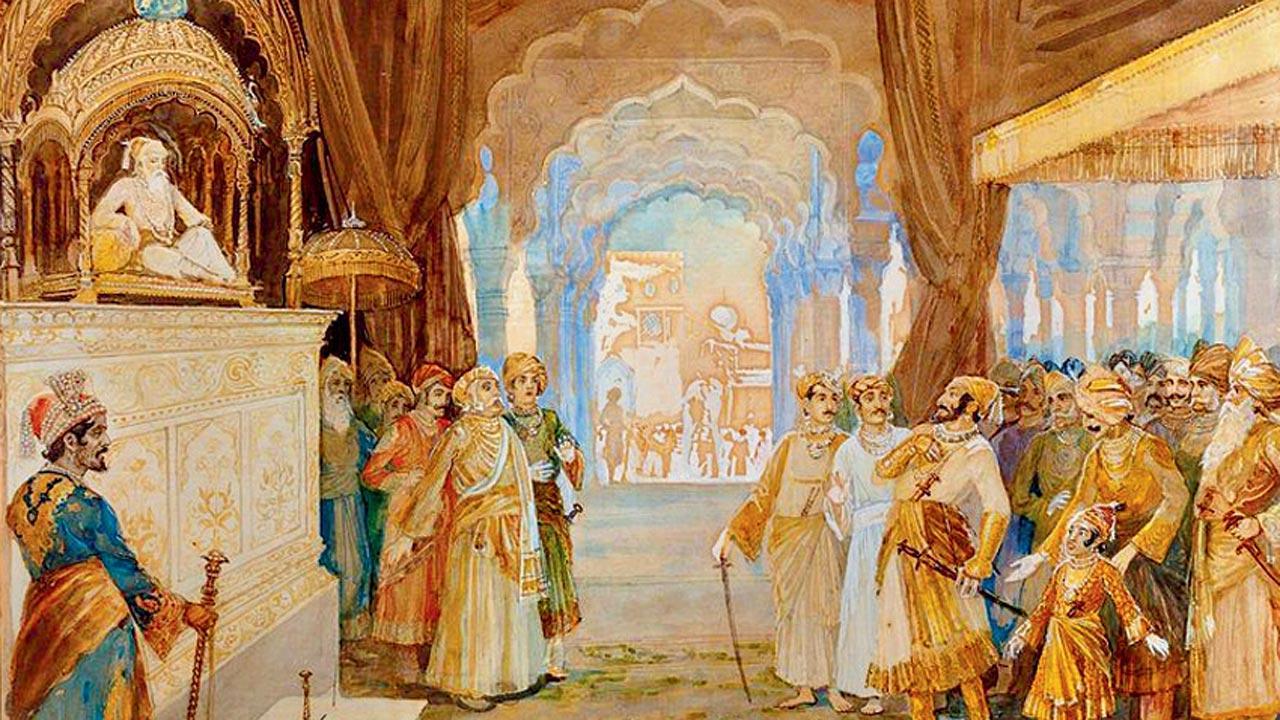
threshold of my Court”. But when he made him stand in a line meant for paanch hazari officials which was the third row of ranking officials, Shivaji got offended and stormed out. He was placed under house arrest. Pic/MV Dhurandhar; Wikimedia Commons
Journalist Vaibhav Purandare has been invested in Shivaji Bhosle I, popularly known as Chhatrapati Shivaji, since he was a school student. He recalls writing down every bit of information that he could find on the 17th century Maratha warrior. These stories, he says, never left him. When he “seriously” began researching Shivaji seven years ago, Purandare’s effort was to create a comprehensive portrait of the leader, which he felt has eluded most historians. “...A vast variety of Marathi sources have been completely disregarded by people writing in English about Chhatrapati Shivaji Maharaj,” says Mumbai-based Purandare in an interview to mid-day. He specifically highlights the accounts of two chroniclers, both Shivaji’s contemporaries—Parmanand, who authored Shivabharat, and the writer of Sabhasad Bakha, Krishnaji Anant Sabhasad. “Parmanand was an associate of Shivaji, and witnessed some of the key events in his life. In fact, he accompanied Shivaji to many of the battles that he was fighting. In some of his descriptions, you will even find precise details of what Shivaji was wearing on a particular occasion,” he says. “Both Parmanand and Sabhasad’s accounts are important, because they were personally present when events were unfolding around Shivaji.”
Purandare says that the oversight was a result of the language barrier. The two chroniclers wrote in Marathi, but historians like Jadunath Sarkar and Dennis Kincaid, whose works on Shivaji continue to be widely read, researched and referenced, could not read Marathi. “Of course, you cannot arbitrarily dismiss their works [on these grounds]. That would be a very unfair approach. But it does explain why these historians got fundamental details wrong... like his birth year [Shivaji was born on February 19, 1630],” he says, arguing, “It’s important to restore the primacy of these narratives, because both Parmanand and Sabhasad were eyewitnesses. Does this mean we have to swallow every word they said? Not at all. We have to weigh their evidence against other contemporary evidence.”
Trending Stories
Latest Photos
Latest Videos
Latest Web Stories
ADVERTISEMENT

Ganeshotsav 2026

ADVERTISEMENT