
With sexual misconduct accusations emerging in two new high-profile cases, one might question if anything’s changed at all since #MeToo. Well, at least one thing has — these women and men are here to ensure no survivor has to walk alone
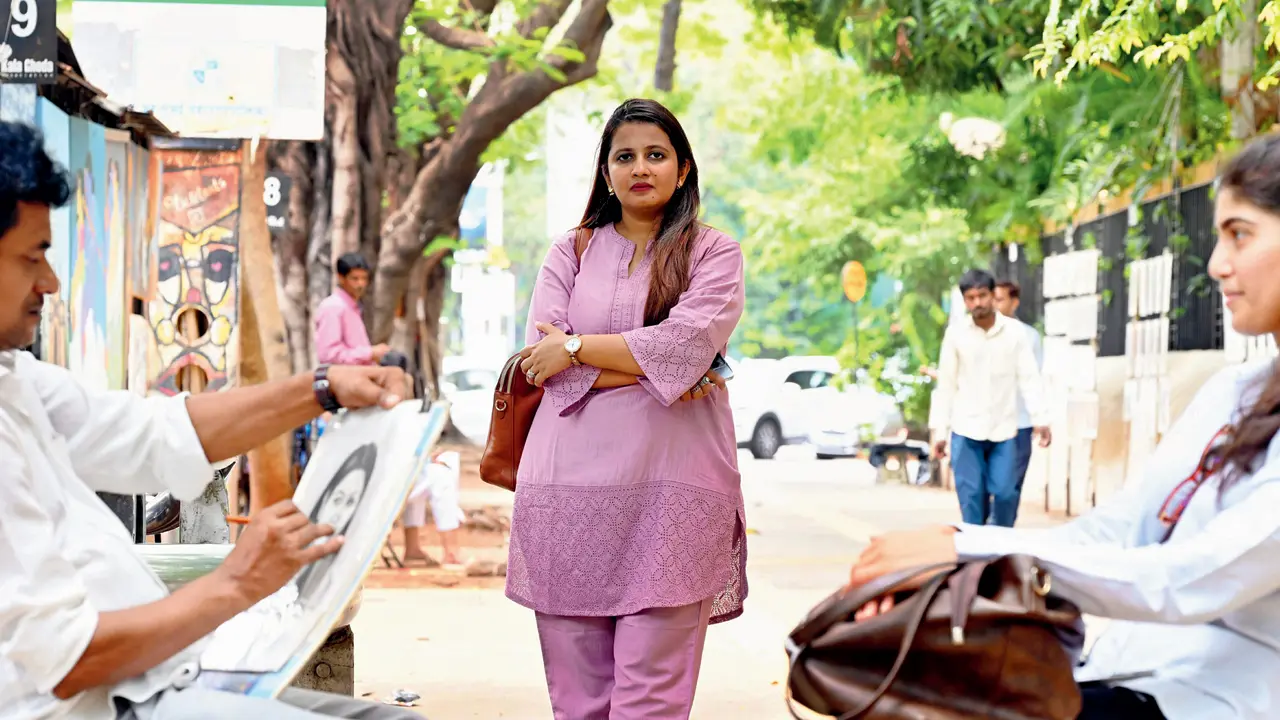
Visual artist Radhika Maheshwari consults with other women artists about inappropriate behaviour meted out in the art world. Pic/Kirti Surve Parade
When the #MeToo movement hit India back in 2018, this journalist remembers meeting a senior male reporter in a government office. When we went in for a handshake, the reporter told us: “Abhi toh tum logo se haath milaane ko bhi dar lagta hai [We’re afraid of even a simple handshake].” This line might seem harmless to most, but for us, it was symptomatic of how men across industries looked at the movement: just women getting hysterical and making things difficult for them. Now, with explosive allegations of sexual misconduct emerging around independent journalist Omar Rashid, and Homebound cinematographer Pratik Shah back to back in the past month, it’s like #MeToo all over again.

Juhi Sharma. Pic/Instagram@juhifilms
Speaking to Sunday mid-day, several women say they believe that Rashid and Shah, just like other accused in the past, will simply go underground and emerge eventually with new projects and collaborations. In 2018, one of the first #MeToo cases in India was based on actor Tanushree Dutta’s allegations against fellow actor Nana Patekar. Patekar — who was given a clean chit in court; the verdict was contested by Dutta — is in the news again with his new film Housefull 5 having just opened at theatres this weekend. The accusation doesn’t seem to have slowed down his career, nor that of journalist and former minister MJ Akbar, who was accused in another key #MeToo case. Akbar, too, has been in the news recently with his inclusion in the all-party delegation for the global outreach for Operation Sindoor.

It’s still women who continue to pay the price in many cases. This writer reached out to a woman who had to move to corporate communications after not finding a job in media after she spoke about sexual harassment at her former workplace. We ask her if she feels like anything has changed after the movement. “Firstly, I definitely think that more women believe each other now when they speak up about being harassed by a man in power,” she says. “You are seeing it in all industries; women have bonded while talking about a known predator. This sort of solidarity is unprecedented.”
Back in 2018, when Tanushree Dutta’s allegations against Nana Patekar set off #MeToo in India, visual artist Radhika Maheshwari was 22 years old. Even then, she knew she had to be careful how she navigated the art world, which is dominated by senior male artists.

Smriti Kiran. Pic/Instagram@smritikiran
Now, the 27-year-old also runs an art marketing and management consultancy, Rad Art Media, and finds herself guiding women clients on the same concerns. “Women artists often tell me how senior male artists, art critics, self-proclaimed curators, or someone posing as a buyer has called them for a drink after a gallery show,” she says. “Many use the public awe that surrounds them and their work to get women to trust them. This leaves the women open to exploitation.”
Her advice stems from her own experiences. “Most days, working in the art world feels safe and respectful, especially for women like me, navigating spaces behind the scenes. But once in a while, there’s that one interaction. Subtle, inappropriate, unnecessary. And I’m reminded that while the industry is evolving, it still needs women to hold the line. So I do — firmly, quietly, and without making a show of it. Because respect isn’t optional, no matter the setting,” she says.
“A lot of male artists comment on my clothes. One artist asked me — just after I helped him set up his workshop — ‘What are you wearing for my workshop tomorrow?’ When I asked what that had to do with anything, he weaselled out from giving me a proper answer,” says Maheshwari, who shuttles between Mumbai and Pune for work.
“Even now, sometimes when I tell [male] artists that they can book a consult call with me, they say something like, ‘Oh, I just thought we could go for a coffee and talk about some other things’. What other things?” she asks incredulously.

Anmol Ahuja. Pic/Instagram@ghantaghartalkies
Now, she uses these incidents as cautionary tales for other young artists. She also uses her own network to gauge who’s safe or not so safe. “If I hear about a male artist being shifty or behaving inappropriately, I tell my female clients to decline to meet them alone or without another woman present,” she adds.
In a tight-knit fraternity like the art world, where opportunities are dependent on goodwill and networking, younger female artists can be apprehensive about coming across as standoffish or “disrespectful”. “Most gallery curators are women, so I think that ensures safety. But among artists, most famous ones are men, and women feel they are being disrespectful if they say no to a friendly invite to ‘hang out’,” says Maheshwari.
“Some women have never been in a typical workplace, as they work out of their homes or studios,” she adds, “Sometimes I have to step in and point out the red flags to them. So, when a client has a show, I often warn them that if they get an invite like ‘Let’s go to my room and talk’, it’s a big no-no.” The power dynamic is much the same in the film industry, as the Justice Hema Committee report showed. Released last year, the report revealed systemic sexual exploitation of women in the Malayalam film industry by powerful men.
In a disappointing development last week, the Kerala Police dropped 35 sexual assault cases that had been registered on the basis of the report, citing the survivors’ reluctance to testify. Meanwhile, the actor Dileep — accused in an ongoing 2017 sexual assault trial, the very case that sparked the formation of the Justice Hema panel — went on to release his 150th film last month.
Closer to home in Mumbai, a member of the Producers Guild of India tells Sunday mid-day of a proposal they have been working on, which they believe could be a step towards ensuring impartial investigations in such cases. “The recent accusations against Pratik Shah have once again brought the issue of women’s safety in our industry into sharp focus. A few of us are pushing for a system that actually works — we want to appoint an independent advocacy officer,” they say.
And what recourse is available to those in the film industry now? Nothing significant, they admit: “Frankly, the way complaints are handled currently is far from transparent. Even though many production houses have Internal Complaints Committees (ICCs), the process often feels skewed or unclear. How have people been absolved and reinstated despite multiple cases?”
“What we need is someone completely independent, like the advocacy officers they have in Hollywood. They help educate the crew, make sure ICCs are actually in place, and support people in recognising and preventing harassment before it happens,” they explain, “We’re proposing that producers, guilds, and agencies chip in a small, fixed amount per project to fund this role. That way, the officer remains independent of any conflict of interest. It’s time we moved toward real accountability and a safer working environment for everyone.”
One of the few men in the industry who have actually taken steps in this direction is Anmol Ahuja, Co-founder of Casting Bay. “When the #MeToo movement took full force in India, we introduced a clear, anonymous redressal system where women — especially newcomers — could report any incidents of harassment or exploitation. This includes mental and emotional harassment, and not just physical. The idea was to offer them an accessible platform to speak up without fear of retaliation,” he says.
The company also conducted training programmes for its teams on how to handle such complaints “with empathy and discretion”. “As of today, the redressal system is still very much active and evolving. We continue to receive feedback and concerns from both men and women in the industry. Thankfully, the complaints have been less frequent, but that’s not to say the issue is gone entirely,” he adds. The biggest change he has seen since #MeToo is how women’s approach to conversations around harassment has changed: “There’s more openness, more conversations about mutual respect, and clearer understanding about what’s acceptable and what’s not.”
The more openly they talk about sexual exploitation and abuse, the more women have come to realise that they can be each other’s best support system. Cinematographer-filmmaker Juhi Sharma tells us about WhatsApp and Facebook groups that serve as lifelines for women across the country. Meeting a potential employer who happens to be a man? The groups will tell you what warning signs to watch out for. “The groups has a range of women, from senior fraternity members to 21-year-olds. Once we had a person on the group who had approach us for a friend who was sexually harassed but most reach out to us individually,” says Sharma, a member of the Indian Women Cinematographers Collective.
The seniors, on the other hand, are very open and generous in their warnings: “Ensure your meeting is in a public space, in the daytime. If you are promised something, follow up on it with a text and email, and push for a contract. We also tell them to check what the terms of the contract are, and if there is any kind of compromise attached to it — if yes, then they are advised to immediately flag it and speak to someone about it.”
The group has become a mental health resource too. “We freely share contacts of therapists and lawyers, because we are not professionally capable of handling those issues,” says Sharma.
The forums also function as a watchlist for “creeps”. “We are seeing an unofficial blacklist of sorts, with women warning each other ‘Don’t work for him, he’s a creep’,” she says. Unfortunately, there’s a catch; some of those men have friends in the groups too. “Some of the women are friends with these predators, so the news does reach the men,” admits Sharma, adding, “There was a defamation case against someone who called one man a predator; it was a mess. Experience has taught us that it’s better to give out these warnings in smaller, more trusted circles and always back it up with some kind of evidence. Without evidence, it can become a matter of he says-she says.”
Burning issue? Not for policymakers
In 2022, Pallavi Guha, an professor at Towson University, US, put out a paper titled From Sexual Assault to Political Campaign Issue. One of its findings was that #MeTooIndia was mentioned in more than 35,000 tweets and 60,646 Facebook posts in just seven months in 2018. Despite this, the parliamentary elections of 2019 and assembly elections of 2020 didn’t see sexual violence as a campaign issue.
Sharine Jacob,
Clinical Psychologist (RCI registered) and Psychotherapist
“What often gets missed is the use of manipulative words are used like when people say they made a decision for ‘our own good’. An adult is capable of making their decisions and knows what’s good for them without someone else deciding for them. But we get manipulated into believing that someone else is thinking for our good.
When the person says that, they do certain things as they love us, but probably their words and actions hurt us or cause boundary violations whether emotional or verbal or physical or sexual.
Toxic love is not healthy or nurturing love.
When our boundaries are disregarded, it may be because the other person thinks we are keeping a distance, or they don’t like boundaries. But boundaries are always meant to protect us, and we are today entitled to define them on our terms.”
A list of commonly seen red flags
>> Controlling behaviour by the partner — they get to have the final say in your affairs, even how you manage your time, your career decisions, or who your friends are etc
>> Micromanaging your choices, decisions, and even your daily activities is a part of controlling behaviours.
>> Disregard for boundaries — both emotional and physical. You are to determine your emotional and physical needs and boundaries, not the other person.
>> Also, when you have defined your boundaries, but the other person keeps pushing them or disrespecting them
>> Guilt trips — This is where the other person makes you feel guilty for their thoughts, feelings and actions instead of them taking responsibility for it.
>> Highly possessive behaviour that makes you feel suffocated.
>> Excessive jealousy.
>> Stonewalling in the face of conflicts
 Subscribe today by clicking the link and stay updated with the latest news!" Click here!