








Our netas pretend they don’t care about style, or they risk being labelled frivolous. And yet, these excerpts from fashion writer Shefalee Vasudev’s new book show how women politicians use clothes to signal power
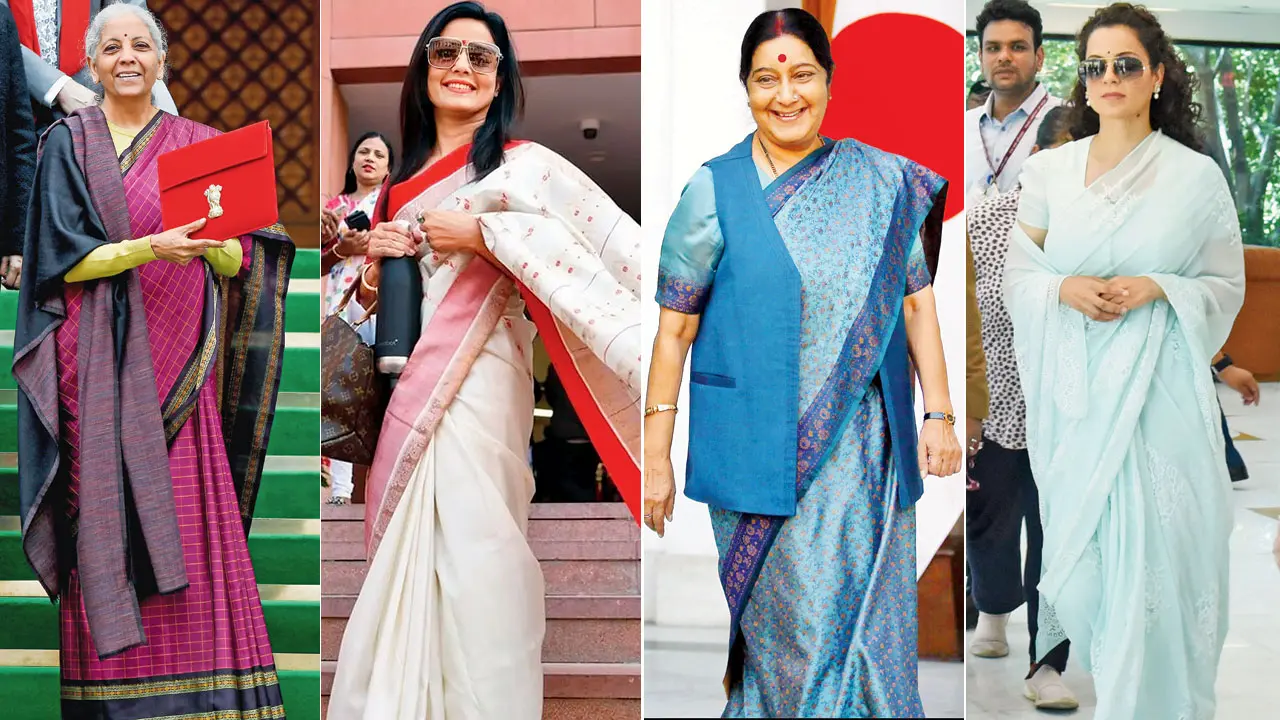
(From left) Nirmala Sitharaman’s most striking sartorial move was to replace the standard black Budget briefcase with a red folder, evoking the baniya’s traditional ledger; Mahua Moitra wears her fashion choices unapologetically, including her much-discussed Louis Vuitton bag. PIC/INSTAGRAM@mahuamoitra_fansclub; former minister Sushma Swaraj’s signature bandis that she wore over her sari were a practical choice for their handy pockets; Kangana Ranaut’s sari looks at the Parliament are always deemed elegant and classy. Pics/Getty Images
The deeply held belief that leaders must be above luxurious indulgence takes a turn towards sharper judgement when it comes to women politicians. To some extent, it explains why a self-styled politician like Mahua Moitra attracts disproportionate trolling and misogynistic sniggering. Moitra wears her fashion choices unapologetically, indifferent to their projected symbolism. She has taste, and she employs it — consciously — in defining her political persona. She is also outspoken and direct in manner. That has led to an image being pasted onto her. She is labelled as ‘firebrand’ — as if defiance must come with a warning label.
There’s a deeper complexity here. Like Moitra, who is routinely labelled ‘firebrand’ or rebellious by male politicians or political spectators, some female leaders, too, use misogynistic rhetoric when it suits them. Moitra herself got wired in that conflict. In 2023, she attacked Rekha Sharma, the chairperson of the National Commission for Women, for not holding her own umbrella during a visit to the victims of the Hathras stampede. “She is too busy holding up her boss’s pyjamas,” Moitra quipped. An FIR was lodged against her.
The same Moitra, responding to BJP spokesperson Shehzad Poonawalla’s criticism, posted on X: “I am telling him and every single BJP karyakarta... I am a Bengali woman. We wear what we want. We eat what we want. We say what we want. We love who we want. And we worship who we want. Our clothes will remain exactly how it was. You change your mentality. Your soch and nazar are gandi. That’s not going to change based on what we wear.”
The reaction to Moitra’s fashion is peculiar. In 2022, she was mocked for allegedly slipping her Louis Vuitton handbag under her desk during a parliamentary debate on inflation. That reflexive gesture — hiding a luxury bag during a conversation on rising prices — was branded hypocrisy. A BJP MP called her ‘Marie Antoinette’ — a clumsy insult, poorly understood, that only underlined the paradox between fashion and political power.
Among those who criticised Moitra was Shaina NC, a BJP politician and self-identified fashion designer. Shaina has staged exhibitions of her sari designs, been interviewed for introducing more than a hundred draping styles, and has been featured in fashion magazines. She highlights that facet of her public persona when it serves her narrative.
American-Hungarian aesthetician Julia Sonnevend explains these contradictions and conflicts in image-making with informed analysis in her 2024 book Charm: How Magnetic Personalities Shape Global Politics. “The fact that charm is a two-way street makes it volatile. Charm works especially well when you want to be charmed ... But charm often fails if you don’t want to see it or if you do, but conclude that it doesn’t reflect some underlying reality!
Moitra, true more to the charm-offensive, refused to get cowed down. She appeared in court to fight the ‘cash-for-query’ case, carrying not one but three Louis Vuitton bags.
• • •
As with all female politicians, including BJP’s ‘ordinary’ women who promise extraordinary progress to their constituencies, there is the personalised touch. The late Sushma Swaraj’s bespoke bandis tailored for every sari in her wardrobe became signature. They were an unusual androgynous choice for a woman who wore sindoor and mangalsutra as part of her uniform. “They have a functional purpose. They are for my phone, pen or keys, she once told [journalist-editor] Vandita Mishra casually, off the record. Saris have no pockets, after all.
Not all disruptions come through clothing or colour. Take Nirmala Sitharaman. While she steers clear of the saffron and marigold palette commonly seen on BJP women, favouring instead Venkatgiris or other handlooms and Kalamkari blouses from her home state of Andhra Pradesh and rich pattu saris from Tamil Nadu, her most striking break from tradition came not in fabric but in symbolism. In 2019, as finance minister, she replaced the standard black budget briefcase with a red folder made of cloth, bearing the Government of India insignia-the three lions and the Ashoka Chakra. The red evoked the bahi khaata, the traditional ledger of the Indian baniya, signalling a deliberate shift towards local imagery in the nation’s fiscal performance.
The BJP woman’s middle-class, relatable quotient though stands serious threat from Kangana Ranaut. She might recalibrate the ‘lewk’, as fashion stylists would say. Her plain saris — cottons and linens with pencil-thin borders — her crisp blouses, some with puffed sleeves, slim gold bracelets and wavy hair up in a ponytail are styled beautifully. She is the only one to wear sleeveless blouses, which are high-necked, does not shy away from delicate jewellery or luxury bags. She has not shed her starry glamour, but redirected it to cast a new image. Going by comments on her social media handles, even when she is derogatively called a ‘twit, her looks are deemed ‘elegant and classy’.
Should she stay in politics, Kangana may compete with the mythology created around Indira Gandhi’s saris. It’s a premature prediction — but I am winging it on Kangana’s inherent sense of style, having seen her on the fashion ramp and in films before this performance.
‘Behenji’ Mayawati: Sorry, no saris
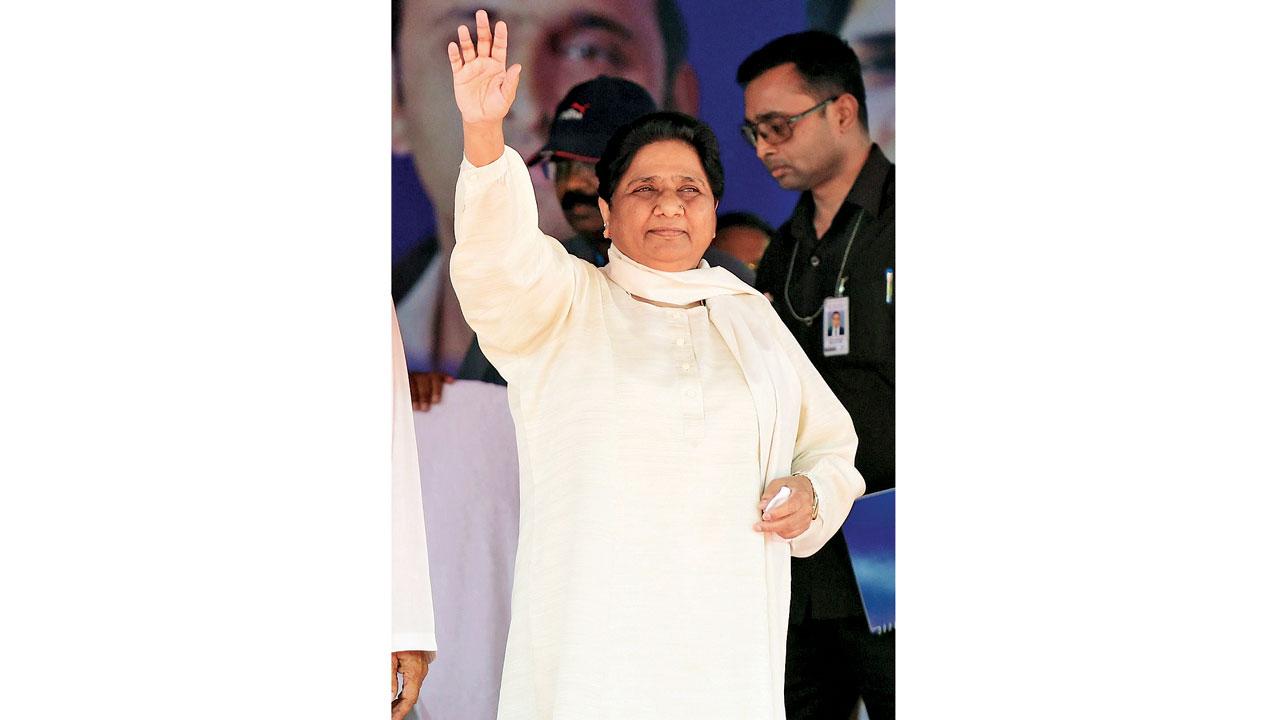 Mayawati’s rejection of the sari was intentional; she neither wanted to look like Indira Gandhi nor like a chiffon-draped maharani
Women politicians like Mayawati assert their identity by strategically rejecting the sari.
As the four-time chief minister of Uttar Pradesh (of which three were truncated terms) and Bahujan Samaj Party (BSP) leader, the Dalit ‘firebrand’, also called ‘Behenji’, crafted a public image in stark opposition to elite privilege and upper-caste snobbery. Her garb: synthetic-looking salwar-kameez sets (often pink), occasionally paired with Banarasi dupattas or faux-leather jackets. Her ever-present handbag became a metonym-for the power she gained. Her rejection of the sari was intentional; she neither wanted to look like a [Indira] Gandhi nor like a chiffon-draped maharani.
Her dupattas looped around her neck, never worn as decorative drapes, and her diamond jewellery not excesses of taste but assertions. She wore wealth to confront what had been denied to the Dalits. Her taste in shoes and handbags became the stuff of mocking memes. So did the parks and stone statues in her likeness that she commissioned from Lucknow to Noida.
Blue-border politics
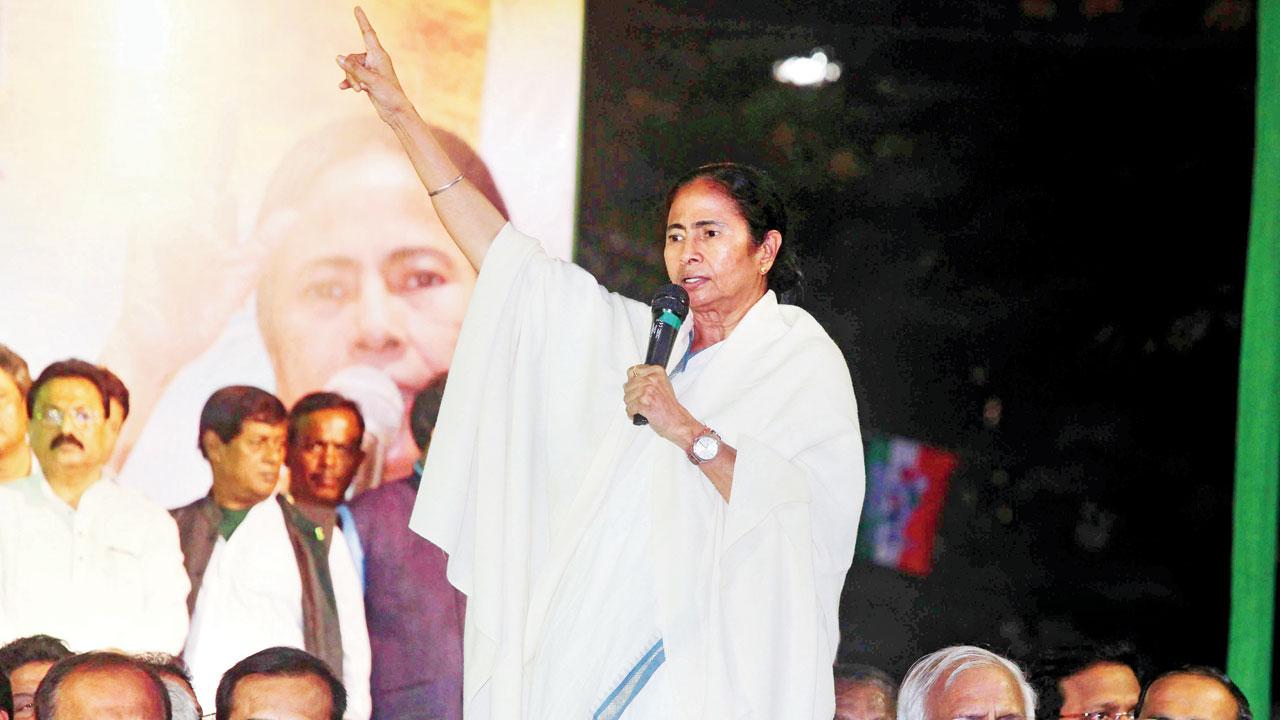 Mamata Banerjee’s simple saris with blue borders — ‘Mother Teresa saris’, as they are called — are a symbol of frugality
Subversions in Indian political dressing largely remain the preserve of women. If Mayawati subverted the sari, Mamata Banerjee reclaimed it as a symbol of frugality. Her political image is built on two pillars: fiery rhetoric and austere dress. She is always seen in ordinary saris with blue borders — ‘Mother Teresa saris’, as they are called colloquially, worn with everyday slippers.
West Bengal, a state shaped by communism, hand-woven muslins and Jamdanis, and a deep-rooted sensibility for music, education and art, has produced its own symbols of power. But Didi chose the visual echoes of the Saint of the Gutter — an identity of service and saintliness. The cover of nearly every book on her — there are more than a dozen, including several in Bengali — repeats similar imagery: mic in hand, arm raised, blue-bordered sari pulled tightly around her shoulders. Some things have shifted: she now wears a smartwatch, her slippers are no longer worn thin and her saris appear freshly pressed. She is older, wears spectacles with her angst which sometimes turns into wrath for the ruling party. Not a single male politician from West Bengal, from any party, came up in the recollections of distinctive dressing when I was reporting this essay.
Excerpted with permission from Stories We Wear: Status, Spectacle and the Politics of Appearance by Shefalee Vasudev, Westland Books.
 Subscribe today by clicking the link and stay updated with the latest news!" Click here!