Home / Sunday-mid-day / Article /
How this became most important city, east of Suez
Updated On: 04 September, 2022 11:42 AM IST | Mumbai | Mitali Parekh
The third in a series that looks at who built Mumbai, reveals that shipbuilding and cotton mills developed the hinterland of the islands, where trade had only skimmed its shores





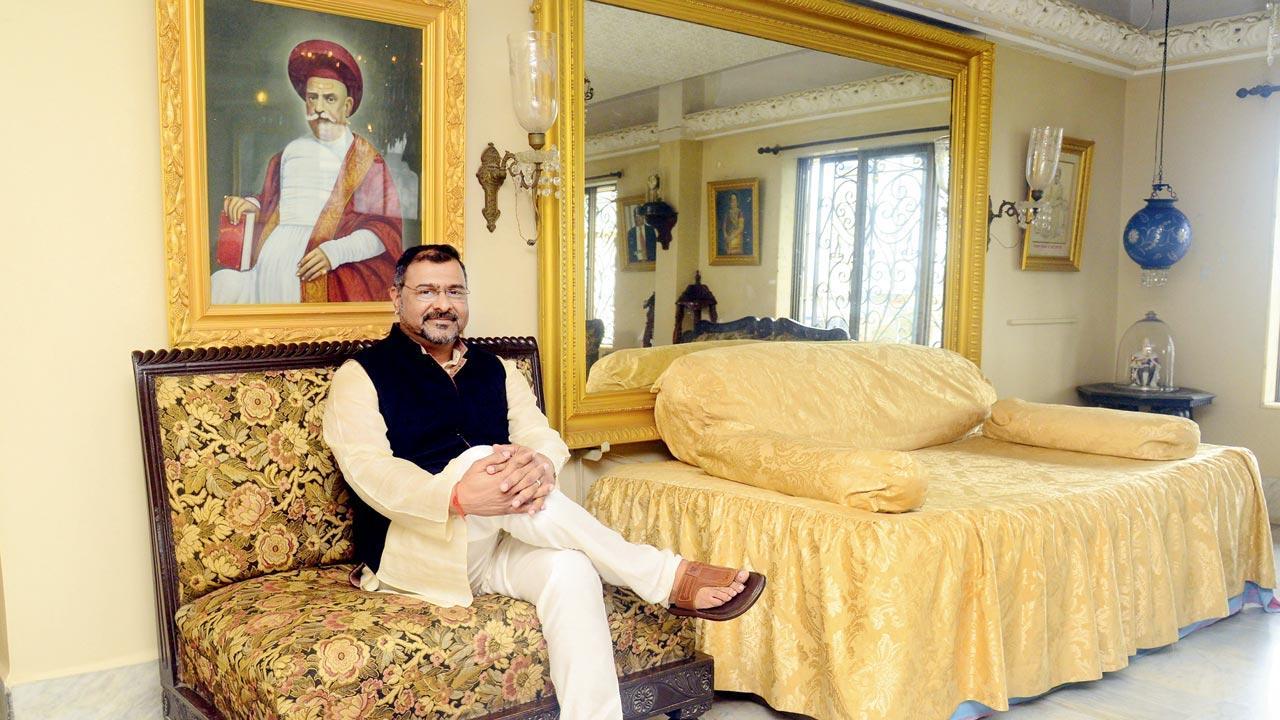
Amar Sunkersett, a sixth generation descendant of Jagannath ‘Nana’ Sunkersett, says his ancestor started the first school for girls in the western region. Pic/Shadab Khan
The Sunkersett bungalow, nestled in Girgaum, was more than a family home. In its backyard, bejewelled young girls in nauvari sarees, sat for lessons at a time when women were not allowed into schools. In one of the inner rooms, the first ever train ticket was issued by the Great Indian Peninsular Railway (GIPR)—from Bori Bunder to Thane.
By the time the most illustrious of the clan—Jugonnath Sunkersett Murkute (Jagannath Shankershett) aka Nana—helped shape the city, the family had been in Bombay for six generations and were financially comfortable enough to lend money to the British. Gunbow Street, which had the city’s first court, is the anglicization of his grandfather, Ganba Shett, after whom the street was named. The family had arrived from Murbad via Ghorbunder, now a part of Greater Bombay, as had many ‘sethia’ communities on the invitation of the English East India Company (EEIC) to conduct business in this new city they were building.
In 1661, the seven islands of Bombay— Bombay, Mazagaon, Parel, Worli, Mahim, Little Colaba or the Old Woman’s Island, and Colaba—became part of Catherine of Braganza’s (daughter of Portugal’s King John IV) dowry when she married Charles II of England. The swampy islands were a political and financial liability by the Crown, and it leased it to the English East India Company (EEIC) in 1668 for an annual rent of £10 (marking the only time in the city’s history that rents were so low).
Trending Stories
Latest Photos
Latest Videos
Latest Web Stories
ADVERTISEMENT

Ganeshotsav 2026

ADVERTISEMENT