shot-button
BMC Elections 2026 BMC Elections 2026
Home > Sunday Mid Day News > MUMBae As we enter 2026 Mumbaikars share why they love the city despite everything they endure daily

MUMBae: As we enter 2026, Mumbaikars share why they love the city despite everything they endure daily

Updated on: 28 December,2025 07:46 AM IST  |  Mumbai
Team SMD |

In a recent survey, Mumbai was voted the happiest city in Asia. We took that declaration personally, because all of us at Sunday mid-day are truly the happiest in Mumbai. We will continue to highlight the infrastructure and logistical problems, the pollution, the corruption, etc. But in our year-ender issue, we decided to celebrate the Mumbaikars

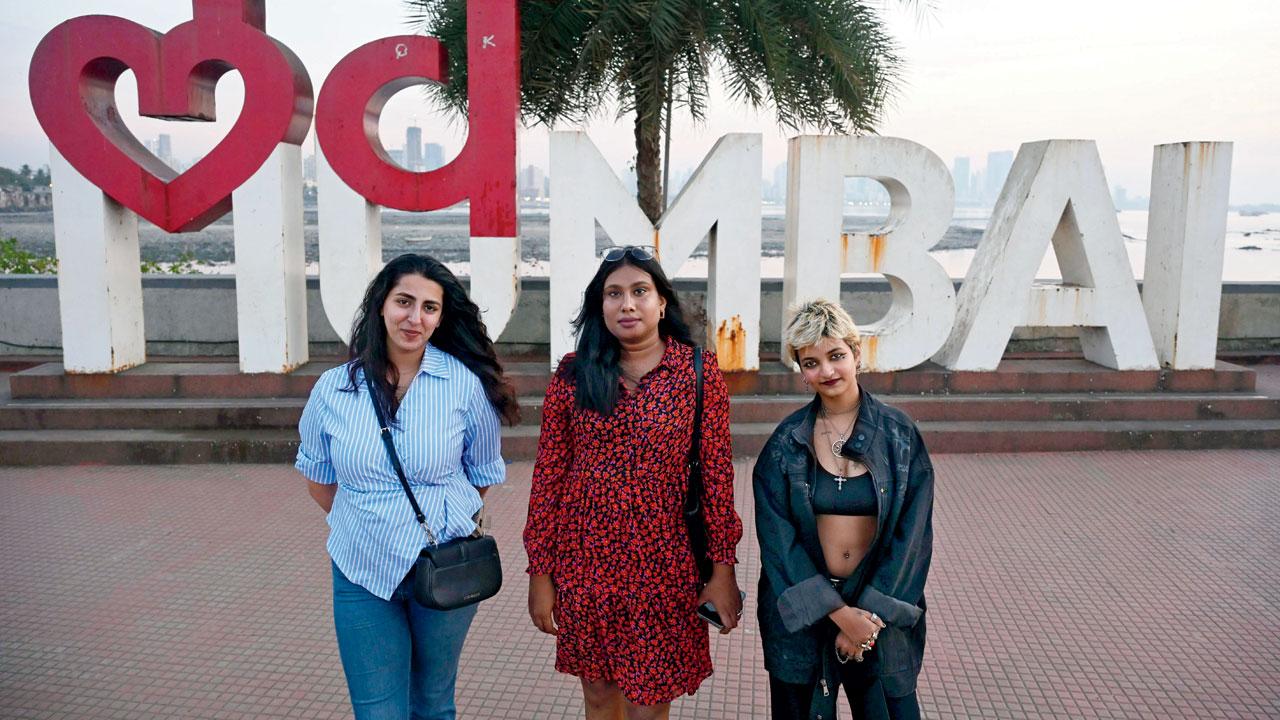
MUMBae: As we enter 2026, Mumbaikars share why they love the city despite everything they endure daily

(From Left)) Mumbaikars Drishtii Asknani, Asisha Behera, and Arson

‘You are allowed to be who you are’

Hailing from Finland, Meeri Shenoy has found happiness in Mumbai. Her favourite place in the city is Marine Drive, because if the entire city is chaos, this is the place one can find pause. Pic/Atul KambleHailing from Finland, Meeri Shenoy has found happiness in Mumbai. Her favourite place in the city is Marine Drive, because if the entire city is chaos, this is the place one can find pause. Pic/Atul Kamble


Meeri Shenoy///Age: 26 Finnish citizen working at FIS Finland International School
Moved to Mumbai in 2023


Akshita Maheshwari

IF you’re from Finland, the happiest country in the world, people assume you must already have happiness figured out. So when Meeri Shenoy tells you she has chosen to live in Mumbai — chaotic, crowded, loud, and now officially the happiest city in Asia — it raises a fair question: What does happiness look like when you move from silence to noise?

Growing up in Finland, Shenoy was drawn to India long before she ever set foot here. Indian classical music, Bollywood films, stories she couldn’t quite trace back to a single source. Somehow, they found her. “Something really moved within me,” she says, still sounding slightly surprised by it herself. Finland, she explains, was a country she loved deeply, but it never felt like home. “I always felt like I was supposed to be somewhere else.”
That somewhere else first materialised in 2019. At 19, Shenoy landed in India at Delhi airport, followed by a quick flight to Dehradun, and then Rishikesh. Mumbai came later, almost as an afterthought. She was only visiting. But the city had other plans.

“I remember feeling so at peace,” she says, “I just knew this was where I was supposed to be.” It was the sort of realisation that came with a strange sense of recognition. “People ask me if I had culture shock,” she laughs, “And I always say no. It felt very normal, like I had already lived here.”

From that first visit onwards, everything Shenoy did was quietly geared towards returning to Mumbai. Studying humanities came naturally — history, culture, people. She eventually joined FIS Finland International School. Today, at 26, Shenoy teaches humanities to students from Grades 6 to 10, guiding them through geography, history, social sciences, and the layered complexities of the world. 

As a humanities lover, the city constantly feeds her curiosity. “It feels like a sociological study every day,” she says. Mumbai’s history fascinates her — the colonial legacy of the Bombay Presidency, the indigenous Koli community, the Parsis, the way layers of time sit. “The cultural richness is unmatched.”
But the happiness of this city, according to her, lives within the bones of its people. “Mumbai welcomes everyone,” Shenoy says simply, “That’s what makes it special.” Coming from Finland — quiet, spacious, often inward-looking — Mumbai should have felt overwhelming. Instead, it felt exactly like home. “There’s kindness. There’s acceptance. You’re allowed to be who you are.”

This sense of belonging is what ultimately anchors her to the city. She has built a life here now. Friends who are mostly local, an Indian husband she met in this very city, and most importantly, a home. “At the end of the day, the place that makes you feel like you belong is where you’re meant to be,” she says.

And if you ask Shenoy where she feels happiest in Mumbai, she is very quick to respond. “Marine Drive is just a classic,” she says. There’s something poetic about it: a woman from the happiest country in the world finding peace along a curved stretch of sea and concrete. It’s one of the few places where Mumbai pauses. “It’s grounding,” she says, “You feel connected to the city, but also to yourself.”

When asked how Mumbai earned its title as Asia’s happiest city, Shenoy doesn’t talk about rankings or statistics. “It’s chaotic, yes,” she says, “But there’s so much joy here.” Happiness, in Mumbai, is collective. It spills out onto streets, into conversations, onto footpaths and cafés. 

Finding parallels between Finland and Mumbai, she admits, is difficult. “They’re opposites in almost every way,” she laughs. And yet, perhaps that’s the point. Happiness does not have a single shape. In Finland, it might come from stillness. In Mumbai, it comes from belonging.

And for Shenoy, happiness looks like this: a city that never asks her to explain herself, a profession she loves, a home she chose, and the sea always waiting at Marine Drive. 

‘I love that Mumbai doesn’t care’ 

Pic/Ashish RajePic/Ashish Raje

Asisha Behera/// Age: 30 Transwoman, works at the Hamsafar Trust 
Moved to Mumbai in May 2025 from Odisha, Khorda  

Arpika Bhosale

Though Asisha Behera is an engineer by training, she started working in HIV awareness and was a grassroots-level worker to promote use of condoms in Bhubaneswar. “When I was a child, my father would say that I was too feminine. He told me that if I studied engineering, I would somehow become masculine,” she says. “So of course, I haven’t gone in that direction,” she adds.

Behera, who moved to Mumbai for a job at the Humsafar Trust, feels her struggles started when she was very young. “My family used to beat me a lot. They used to do black magic to ‘cure’ me and finally my father threw me out of the house at the age of 19. So, I used to beg on the train, but it was not enough to support myself. I realised I had a lot of anger coupled with anxiety, leading me to be self-destructive,” she says. Behera quickly identified that she is on a slippery slope. “I started working in the social sector gradually and that’s when I moved to Bhubaneswar,” she adds.

Behera’s last profile before heading to Mumbai this year was working for HIV awareness as well as advocacy for People Living with HIV (PLHIV). She may have chosen a different calling than her father’s wishes, but she was a go-getter, and did well at work. “From outreach work, I became a field coordinator, then worked as a CSR coordinator, and finally a senior placement executive. But, my dream was to work with Humsafar Trust, because in the community [queer] it’s one of the most valued organisations. So when I got the offer, there was no way to refuse to come to Mumbai,” she adds.

Behera loves the anonymity that comes with the fast pace of the city. “When I walk in the city or get on the train, most of the time no one cares. Most of the people are not judgemental about my gender identity. No one is asking ‘What are you wearing? How am I walking? What am I? What is under my clothes? What is my gender identity? Do I share my bed with anyone?’ The people here don’t care about it. I love that about Mumbai,” she says. “This was not the case in Odisha, definitely. I will say, in Odisha, acceptance has just kind of started, but not as much as Mumbai,” she says. 

Mumbai, feels Behera, has also allowed her a chance to play around with concepts and experiences, “The play is now — what can I do? What is my boundary? [I can explore] the things that I could not do earlier,” she says. As far as making it work as a migrant with the city burning a hole through her pocket, she is still positive, “Mumbai is a very expensive city, and it is very challenging for me. I started off with R6000, but Mumbai has given me the confidence that maybe it will become R1 lakh tomorrow!” 

Her favourite place? “I love beaches, but my favourite is Versova because it is right behind my home, I often go there to work out my feelings along the shore,” she says. As for getting unwanted looks during these walks, she says, “I usually say something like ‘Do you recognise me? If you really want to look at me, take me home and feed me food. Most of the time it elicits laughter from men, and they move on,” she adds.

Maybe that’s why we love Mumbai? She might laugh, but it’s always with us, and not at us. 

‘The only city with a culture for artistes’

As an aspiring actor, Aakarshit Arora’s favourite place in Mumbai is the Western Express Highway. He loves seeing the film posters scattered all over the highway and hopes to see his own face up there one day. Pic/Shadab KhanAs an aspiring actor, Aakarshit Arora’s favourite place in Mumbai is the Western Express Highway. He loves seeing the film posters scattered all over the highway and hopes to see his own face up there one day. Pic/Shadab Khan

Aakarshit Arora///Age: 26 Actor
Moved to Mumbai in February 2023 from Gurugram 

Akshita Maheshwari

If you’re born in Delhi and live in Mumbai, there is one question you can never escape: Which city is better? Gurugram-da-munda Aakarshit Arora is no stranger to this question. He walks Delhi, talks Delhi, breathes Delhi, yet his heart remains in the city that lets him pursue his dreams: Mumbai. Born to a finance bro dad, Arora was destined to be a finance bro himself. “Mumbai was never in the plan,” he says. So what made him choose the city of dreams? “I have been doing theatre since I was in the fourth grade,” he gives us a simple answer, “I did a finance degree, moved back to Gurugram during the pandemic, I did a finance job too. But that keeda [bug] remained. Acting always called my name.”

On the particular Monday morning this writer met up with Arora, the sun shone a little too bright. It was hot, even in December. Yet Arora stood diligently on a scorching Western Express Highway, posing for his pictures with a smile on his face. This highway is Arora’s favourite place in Mumbai, you see. A sentiment not shared by most Mumbaikars. In fact, if you ask this writer, WEH is perhaps the place we hate most in the city. All we see on this road is the sea of cars, the barrage of traffic, the unbearable red of the brake lights. All Arora sees are the billboards with film posters. They’re reminders of what he came to the city for. Whenever he has a bad day, he finds himself staring at the billboards, dreaming and hoping to see his own face up there one day.

Arora is an actor. One meeting with him will tell you that he is the most filmi boy you’ll meet that month. His first stint in Mumbai was for college. All throughout his finance degree, he kept doing theatre on the side. In the last year of college, the pandemic hit. This meant a one-way ticket to Gurugram. But the keeda didn’t stop. Arora pursued a brief stint in music. “My first song is called Kathor. I have it tattooed on my fingers,” he shows us, “Kathor was also the first introduction to filmmaking. I made a music video for the song,” he says. Soon, a one-way ticket to Mumbai was on the cards. “The first year I was in Mumbai, I got no gigs. Nothing was working out. I’d quit my finance job because I couldn’t manage it with acting,” he says. 

“I didn’t know how to earn money. One day, this idea came to me, ‘The life of an actor in Mumbai’. I thought I’ll just upload three videos a week [on Instagram]. I won’t look at the reach or the comments. I won’t look at anything.” His earnestness worked. His Reels started going viral. He got attention from audiences and finally, he became a recognisable face in casting circles. 

One fine day, Arora opened his Instagram and saw the most unexpected name: Arjun Kapoor. Arora says, “He started following me. I had to shoot my shot, so I DMed him, ‘Sir, it would be great if I could meet you some day,’ and he immediately said, ‘Let’s meet, come’.” And so Arora went over to have a coffee with Arjun Kapoor. “He’s so chill, and so kind. Then and there, he connected me to Mukesh Chabbra and that’s how I got my next role.”

Lately, life’s been good for Arora. “In 2024, I got my first gig as a tertiary character in Rana Naidu Season 2. Although that got cut later,” he laughs, “I also got a Marathi film Aarpar. I did an OTT show called Baat Pakki.” He’s got some big projects in the pipeline too, but gets coy when this writer speculates about them. All this and much more came to him in Mumbai. So when this writer asks Mr Gurugram the quintessential question, ‘Mumbai or Delhi?’, he says, “If there wasn’t the issue of pollution, Gurugram would have been a banger city to live in,” he says. The charm of home never dies. Life is simply easier back home. So what makes him stay? “For the past three years, I’ve really started liking Mumbai. I see myself spending my life here. At some point, I want to buy a house here.” 

He adds, “This time around, I sort of changed my company. I realised that I want to be with like-minded people, creative people. I want to earn a living by doing something I love. Mumbai is the only city where I see a culture where artistes can feel comfortable. As an artiste, if you’re working in a city like Gurugram, you will feel out of place constantly. Because you don’t have your tribe. Here, I find people who want to do the same thing. A little bit of a Fakir’s mindset: money will be made at some point. Let’s make art now. Let’s make something good, now. The rest will be seen. And, I love that.”

In the last month of 2025, as we work on this edition, this writer has only been thinking about what makes people love Mumbai. Everyone we meet, we ask this question. Never have we ever received an answer such as Arora’s, “If I’m being very honest, in the summers, on just a warm sunny day, I just love the way the sunlight hits the city. There’s something about the way the light falls into your windows here. It isn’t like this in any other city.”

‘This city brings out a kind of daring in people’

Pic/Ashish RajePic/Ashish Raje

Deepanjana Pal /// Age: 46  Author 
Moved to Mumbai in 2005 from the UK
Just released Lightning in a Shot Glass, a romcom set in Mumbai

Debjani Paul

Twenty years ago, when author-journalist Deepanjana Pal moved to the city from the UK, she fell in love with Bandra. “At that time, Bandra was just starting to become cool. It had not yet become the Brooklyn of Bombay, but was very much on its way there,” she recalls, “We had a two-bedroom apartment in a building near where Bandra Born stands today. We had a large kitchen and three bathrooms, and we paid R25,000 in rent — unimaginable today.”

At first, Bandra was a practical decision, “we had friends in the suburbs, I had family in south Mumbai, and work was somewhere in the middle at Mahalakshmi”. Once she moved there, she fell head over heels for the neighbourhood’s old-world charm. “Mumbai, in general, is very dear to me, but Bandra felt really like home in a way that no other place ever has for me. One of the reasons was just how incredibly walkable the neighbourhood was. Again, today, this sounds like complete fiction, given how every road is dug up. Despite that, Bandra still remains one of the most walkable places in the city,” she says.

Pal and her friends would just walk to each other’s places in the suburb, never needing a car or two-wheeler. “Those walks were so pretty; the houses were the stuff of stories. Every lane we entered, we’d look at the homes and go, ‘If only that uncle or auntie would adopt me, then the house could be mine’,” she says, chuckling. 

It is here, in the queen of suburbs, that Pal has set her latest book, Lightning in a Shot Glass. It follows two women — a divorced 40-year-old and her roommate, a 29-year-old intern — as they navigate romantic dalliances, workplace politics, and life crises in a city that’s constantly moving and shifting around them.

“With these two women, it was important to me to figure out a space where they were able to take unconventional decisions. One of the women, Aalo, is starting off as an intern at the age of 29. It’s not a conventional choice by a long shot; by 29, we’re expected to have figured out our lives. But Mumbai is the kind of city that respects your choice to take a risk, make an effort. Most of my characters are not doing conventional things, be it the kind of lives that they choose to have, or the chosen family they’re building. These are all things I found [the space for] in Mumbai, and it made sense to me that these characters would find it here as well. I can’t imagine another city where you get the freedom to do that. 

“The book is very much my little love letter to the city and the places here that are dear to me,” Pal continues, “One of the characters in the book says, ‘I don’t think I’d be the same person if I grew up in Nagpur’. Every city brings out different things in a person. This city brings out a certain kind of daring, and I love that. For me, it’s particularly lovely to see this among women, because there are so few spaces that encourage us to be daring and unconventional.”

It’s not all sunshine and roses — Pal’s journalist’s gaze can’t ignore all that’s wrong in the city: Dug-up roads, polluted air, lack of open spaces, skyrocketing rent… the list has no end, much like the traffic jams. And yet, a stubborn streak of hope prevails in Pal’s characters, just like the famed Mumbaikar resilience. “It’s not a city where it’s easy to find a house or job. But the city is filled with people like you who’re trying to do things, to find their way. It gives you space to feel lost, there’s space to feel found. There’s space to just be and this last one, I think, one is very rare,” she says.

‘I’m made for this place, and this place is made for me’

ArsonArson

Arson///Age: 23 Queer Rapper
Moved to Mumbai in July 2024 from Jamshedpur, Jharkhand 

Dhwani Gaikwad

Every part of Mumbai serves as a catalyst for creative people — whether that is the architecture, the fashion, the rap scene, comedy shows, acting industry, and so much more that a single sentence cannot do justice. For people with creativity, every street, along with its nooks and corners packed with bustling people, buzzes with an energy that draws them towards it. 

For Arson, leaving Jamshedpur and stepping into the jam-packed scene that is Mumbai, was one of the best decisions that he could make. He says, “Back in my hometown, everybody has a narrow mindset and a narrow plan for their life. As a creative person who wanted to explore multiple creative industries, there were no doors for me there. On the other hand, Mumbai is a city that offers opportunities in every single creative sector — music, visual art, performance art, you name it. There is just so much happening all the time.”

This quality is also something that keeps the city going all the time. With events, workshops and art gallery exhibitions happening all the time, who could ever get bored of living in the city? Step out and it offers you a myriad of things to do. To Arson, it feels just the same; he could meet a new person randomly and they would end up becoming his mentor. 

To most people who move to Mumbai for work, it is not always easy. Some could even describe it as trying to surf on a high-tide day. When Arson came to the city in July 2024, his first week was spent in Fort, which ended up becoming his favourite area. He shares, “Fort is home to such beautiful architecture. There are so many stores, so many pockets of history. I remember leaving my hotel room, buying a Cosmo or a Vogue, and having breakfast with coffee. This memory is now very dear to me because that is how it all began.”

Like a lot of rappers who have moved to Mumbai for work, the place immediately felt like home to Arson. “After the first week, I began feeling like I’m made for this place, and this place is made for me,” he expresses. The city has also had a huge influence on his art. He says, “Social issues and the issues that I have faced personally have always been a major part of my writing and even my sound. Mumbai has made me very aware of things, especially class disparity.” His experiences have helped him shape his work. “Being in a city that’s hustling 24/7, I have noticed the pay gap and the struggles of the people, and it reflects in the kind of art I create. My sound has become gritty and I have become a conscious writer. I have met rappers who were born in this city and there is so much that I have learnt from them. All of it has affected my music.” 

“I think I am reminded of my love for Mumbai all over again when people are nice to me,” says Arson, reminiscing about his adoration for the city. “I work with a lot of service workers, and am friends with a lot of bouncers and club staff. One of my best memories is celebrating my birthday with a service staff member at Khar Social. These people make the city, and I have always cherished my interactions with them.”

‘It’s culturally a happy city’

Ayesha Parikh is in her happy place at Art and Charlie gallery in Pali Village, Bandra. Pic/Satej ShindeAyesha Parikh is in her happy place at Art and Charlie gallery in Pali Village, Bandra. Pic/Satej Shinde

Ayesha Parikh/// Age: 39 
Founder of Art and Charlie gallery, Bandra 
Moved to Mumbai in 2017 from London

Debjani Paul

When Ayesha Parikh decided to move back from London, UK, to India, Mumbai was a very clear choice for the city she’d call home.

For Parikh, who had just quit her job with management consultancy giant McKinsey, and was looking to start her own art gallery, there were only two cities she could start her new life: Mumbai or Delhi. 

“Mumbai was a no-brainer,” says Parikh, who went on to found Art and Charlie, a contemporary art gallery in Bandra. The first reason that sprang to mind was, of course, the sheer freedom of movement she’d have as a woman. Having lived abroad, Parikh couldn’t bear the thought of coming back to the aggressive Indian male gaze while walking on the streets. “I don’t want to ask a guy to drop me home. I don’t want to have to depend on anybody; why should I?” she says.

“Mumbai felt like a city where a woman can do whatever she wants. You can be going home at 3 am in an auto, and you’ll be fine. I don’t even have to think about what I’m going to wear when I step out in Bandra,” she adds.

On moving here and setting up the gallery, though, she found much more to love about the city. “There is a collaborative warmth in the industry here,” says Parikh, who also co-leads the Mumbai Gallery Association (MGA), “There are 35 galleries in the association. Delhi, on the other hand, doesn’t have a central organisation like that for galleries.”

Because of the MGA, the galleries collaborate a lot more, including for the upcoming Mumbai Gallery Weekend, slated for January 8-11. 

At a time when Indian art is witnessing a global boom, it’s Mumbai — not Delhi, as some might assume — that’s seen a bunch of new galleries being set up in the past five years. Mumbai is also home to some of the oldest galleries in the nation, such as Jehangir Art Gallery (est 1951) and Chemould Prescott Road (est 1963). 

“I run a three-year-old gallery, but am also currently leading the MGA for the next two years. Which goes to show how open Mumbai’s established players are to newer entrants,” says Parikh, adding, “These are not things I was aware of earlier, but knowing the scene now, I’m so glad I started in Bombay.”

It can be hard to remember the good things about the city when we’re all complaining about the constant construction, dug-up roads, poor air quality, and a glaring lack of space — outdoors and inside our matchbox homes. “I think the lack of space is made up for by the cultural vibrance here,” says Parikh, “We have places like Prithvi Theatre, or more indie spaces like [performance space] Harkat Studios or [art space-library] Fluxus Chapel. Mumbai is a culturally happy city; happy despite its infrastructural challenges.”

Her favourite place in the city is, of course, her gallery space, set up in a heritage Portuguese bungalow in Pali Village.  

“It is a kind of manifestation of my ethos. I love that the gallery is on a walking street, and not on some grand boulevard where buses and cars are honking all the time,” she says, adding, “I love that the building itself is steeped in history. It’s located in this village of Portuguese origin, dating back to the 15th century. I have placed a wooden bench outside that anybody can come sit on. My favourite thing is just to sit there with a coffee and watch the village go about its day.” 

It’s also a city that’s universally acknowledged as friendly. “In Bandra, particularly, which is such an immigrant-expat hub, there’s an easy mingling vibe at bars and cafes, so you can strike up a conversation with anyone. It’s the people here who make it a happy city,” she concludes.

‘I can run around in shorts’

Singer and songwriter Apoorva Vishwakarma loves the safety and freedom that Mumbai provides her. Pic/Nimesh DaveSinger and songwriter Apoorva Vishwakarma loves the safety and freedom that Mumbai provides her. Pic/Nimesh Dave

Apoorva Vishwakarma ///Age: 28  
Singer and songwriter
Moved to Mumbai in 2022 from Kanpur, Uttar Pradesh 

Tanisha Banerjee

When Apoorva Vishwakarma moved from Kanpur to Mumbai in 2022, it wasn’t a leap of blind faith as much as a calculated act of ambition. At 28, the singer-songwriter knew exactly what she was chasing, which was the space to release her EP, and room to grow as an independent musician. Mumbai was a city that could sustain both her art and her everyday life.

“I came here to pursue my music seriously,” Vishwakarma says. “And I stayed because of the opportunities.” For an independent artiste, she explains, survival and creativity are deeply intertwined. “You have to do everything — gigs, sessions, collaborations — to sustain yourself. Mumbai is great for that.” Unlike cities where music scenes can feel scattered or limited, Mumbai offers volume and variety. “There’s more work here than anywhere else, especially for independent musicians.” The city’s relentless pace, often described as exhausting, becomes for Vishwakarma a kind of momentum; one that keeps her moving forward.

But her attachment to Mumbai goes beyond professional practicality. As a woman living alone, safety plays a crucial role in her sense of belonging. “What I really love is how safe the city feels,” she says. “The societies are regulated, there are rules, and it creates a very homely environment. I can run around in shorts.” She currently lives in an SRA building, but says the label barely registers in daily life. “My building is full of families. And they’re always concerned for me as they know I live alone. I’ve never had this familial feeling anywhere else.” That sense of community has been quietly reassuring. “It’s not intrusive,” she adds. Having lived in Delhi before, the contrast is stark. “There, nobody really cares. Here, people look out for you.”
Equally important is the freedom Mumbai affords, especially for someone whose work depends on expression and audience. “I’ve never experienced this kind of freedom anywhere else,” she says. “There’s an audience for everything here.” 

Mumbai also functions as a teacher. Watching the daily rhythm of millions, people waking up early, commuting long distances, and working relentlessly has altered her own relationship with effort. “When you see so many people hustling every single day, you start noticing where you stand. It pushes you to work harder.”

Vishwakarma doesn’t romanticise Mumbai as an easy city or a forgiving one. It is demanding, crowded, and unrelenting, but deeply enabling. As she continues to build her music career, the city remains both stage and sounding board where ambition is expected, not just accepted. 

‘Mumbai makes you feel like the main character’ 

Pic/Ashish RajePic/Ashish Raje

Drishtii Asknani///Age: 23 PR manager
Born and grown up in Mumbai 

Aastha Atray Banan

Drishtii Asknani is a pukka Mumbaikar, who can’t just choose one reason to love the city. But if she had to, “it would be the ocean, the way it calms you, grounds you, and reminds you to pause, no matter how fast life gets,” says the Thane resident. 

But like all the rest of us, who may have come from different places in India, to become who we want to become, for Asknani as well, the biggest pro of living in Mumbai is “opportunity”. That feeling, that if you have to do something, it may just be possible here. “Mumbai somehow makes you feel like the main character in your story, while still giving you a strange sense of safety and belonging,” she says. 

The con for her is that it has slowly turned into a commercial forest — “tall, crowded, and constantly chasing growth, sometimes at the cost of its breathing space”.

But we ask her, is it hard to love the city? “Honestly, it depends on the people. I’ve seen some live here for five years and never feel at home, while others start thriving in a few months. Mumbai, in its own way, chooses you.” But she does say it takes some work to keep loving it. “My people help me. When things get tough, I take them and run to the beach or Marine Drive, talk for hours, have some street food, and everything starts feeling a little easier.”
For Asknani, Mumbai is home, and so it’s easy to be happiest here. “The people feel like family, even the road-ragers seem funny. There’s something in the air. To quote Salaam Bombay, ‘Yeh sheher sabko apna bana leta hai’.”

‘It’s where the sea gives you the answers’

Ishu didi finds that there is no problem so big that it couldn’t be solved if you just spend five minutes with the sea. Pic/Shadab KhanIshu didi finds that there is no problem so big that it couldn’t be solved if you just spend five minutes with the sea. Pic/Shadab Khan

Ishu Didi///Age: 27  Content creator
Born and brought up in Mumbai 

Akshita Maheshwari

IF you live in Mumbai and spend any amount of time on the Internet, chances are that you’ve come across a spunky, older sister with an ultra-cool-girl vibe named Ishu Didi. Her series about “being a Bombay Girl”, where she just talks about different experiences of living in Mumbai, has garnered millions of views. She says, “I knew that I wanted to have an Internet presence. Except, I didn’t know what to talk about. What can I actually talk about with authority? Is it pop culture? Yes and no. Is it Mumbai? Yes. I love knowing everything there is to know about the city. I currently have three books that I’ve purchased and five that are in my wish list, all about Mumbai. Till date, the video I have the most views on is a video I made in Marathi, and I am really proud of that.”

One scroll on her page and you’ll know that 27-year-old Ishu is born and bred from Mumbai. “The best part about Mumbai is that you don’t have to be born here to be from here. If you accept the city as your own, it will accept you as its own as well,” she says. Ishu’s love for the city comes from the autonomy it gives her. “As a woman, I wouldn’t want to be in any other city in India. This has canonically been the safest, most liberal city for women. It’s relatively kind to all minorities, to women, to queer people.” Beyond that too, no city has the culture of Mumbai. “It has always set the scene for art and culture especially, and fashion. It’s the most explorative city when it comes to culture,” she says. 

She’s especially a fan of the bars in the city. Her series on rating bars in the city is a testament to that. “No one knows where to go on a Friday night. If you want to drink, where do you go? Well, I wanted to answer that question,” she says, “A lot of people actually think I’m an alcoholic, but I’m really not,” she jokes, “I’ve just been to different bars. I drink once or twice a month.”

As a long-time lover of this city, Ishu has her complaints too, “I think we’re losing the essence of what makes Mumbai, Mumbai. You know what fuels this city? Hope. You get torn to shreds and built back up again every day. Over and over. And we’ve always had this mentality that nothing [too bad] will happen. The city will survive. So, once we stop having hope for anything to get better, that’s when we’re losing our essence as a city. We do need to have hope. Otherwise, it will all fail. Lately it feels like that some of that hope is slipping away.”

“When I was thrown into design college, I was just exposed to something called...” she pauses, “...a class barrier. Nothing divides the city more than class. The glitz and glamour of the city attracts everyone. Everyone wants to come here for the high-rises and the posh little life of a sea-facing apartment. Except to get to that sea-facing apartment, you might have to lose all ethics and integrity.”

The people make a city. Mumbai is no exception. “I was reading about this concept of public privacy,” says Ishu, “For example, you’re on a local or a metro. You share that space with all strangers. And you don’t owe anyone anything there. You can act like whatever, be whoever. Yet, people choose to be nice to each other. You’re completely anonymous. No one is there to critique your behaviour or question your moral spine. And that’s why a lot of people say that Mumbai people are inherently very nice. Because I think there’s a mutual understanding that even if you don’t know where the person in front of you is coming from, you give them the benefit of the doubt.”

Except for public transport, we ask Ishu, what’s her favourite place in the city. “The Worli promenade. Before the Promenade, there was the sea face. It’s just the sea. I think nothing can come close to what the sea makes you feel, in all its vastness. It feels like it’s an open conversation between me and her. If you’re ever feeling really low and you’re just looking at the sea and thinking, ‘What do I do now?’ She will give you the answer, even if the answer is, ‘You just need to calm down for a second.’” 

‘The chaos is comforting’ 

Pic/Ashish RajePic/Ashish Raje

Rijul Gulati///Age: 32  
Executive Chef, Indian Accent, Mumbai
Moved to Mumbai in May 2023 from New Delhi

Nasrin Modak Siddiqi

After an eight-year tenure at Indian Accent, New Delhi, where he rose to Senior Sous Chef, Rijul Gulati moved to Mumbai to help set up Indian Accent’s first outpost in the city. As Cluster Executive Chef, Mumbai City, Fireback, Comorin and Drift Cafe and Bar now, he leads a team of over 20 chefs, laying a strong culinary foundation for EHV International. He continues crafting award-winning menus for Indian Accent that have earned him international recognition, including a Knife Award at The Best Chef Awards 2025 in Milan and a No. 47 ranking on Culinary Culture’s #Next30 Chefs 2025 list.

“Mumbai has a comforting chaos,” says Gulati. “It’s a global city — the city of dreams — where nobody judges you for what you do. You can walk around freely, even at odd hours. After a late-night shift, I’ve eaten greasy Chinese at 2 am, and for a chef who thinks about food all the time, that kind of carefree meal feels incredibly liberating,” he smiles.

While Gulati has represented the restaurant at pop-ups and collaborations across the world, including Italy, Austria, Israel, New Zealand and Riyadh, it is Mumbai’s easy nonchalance that holds him. “Mumbai lets you be ambitious without apologising for it,” he says. “And it somehow makes room for everything — for family, street food, the sea and the air.”

Today, the city feels firmly like home. “My better half loves it too, for obvious reasons — safety, and even the slightly better air quality everyone’s talking about,” he adds. 

Gulati feels Mumbai has been voted the happiest city in Asia for good reason. “I’ve cut through traffic in the rain just for a bite of vada pav, taken chai breaks that effortlessly turn into long conversations, and watched the city unfold at its countless corners where tea is brewed on shop counters and cycle carts, day and night. That’s the generosity of Mumbai — it feeds you at any hour, without question. In the end, that’s its true joy and simplicity: a happy belly makes a happy day.”

Mumbai teaches you to move fast, but think deeply. The city is layered — much like its food and its diversity. “I see it as a truly global city, where people and flavours from across the world coexist effortlessly. Some of the country’s most celebrated, award-winning restaurants sit alongside much-loved local favourites, and that constant exposure to diverse flavours shapes the way you cook. Over time, cooking becomes more instinctive — less precious, more confident,” he adds.

Gulati believes that Mumbai also teaches discipline. Its chaos only works because there is an underlying structure holding it together. “That sensibility reflects in the menus I create today. A diner’s favourite on my current menu is the chilli cheese vada, red amaranth keema, brun pao, a vegetarian reinterpretation of Bombay’s beloved keema-and-vada pairing. Red amaranth, or lal saag, is one of the brightest, most striking greens you’ll spot at any bhajiwala, and paired with a chilli cheese vada, it captures the city’s spirit perfectly. After all, Mumbai loves chilli cheese — on toast, in sandwiches, on pav — and this dish lets that familiar comfort do all the magic,” he adds.

Gulati’s favourite place in the city is Marine Drive late at night. “It resets everything,” he says. “You can be exhausted or overstimulated, and the city simply lets you sit quietly in a corner. You can be alone with your thoughts, relax, or just watch the waves roll in. I don’t think any other city gives you that kind of space without asking anything in return — at least not in India.”  

The centre stage that is Mumbai 

Tanish Jacob-Rego adores Prithvi Theatre, having a personal and professional connection with theatre. Pic/Shadab KhanTanish Jacob-Rego adores Prithvi Theatre, having a personal and professional connection with theatre. Pic/Shadab Khan

Tanish Jacob-Rego///Age: 21 
Theatre artiste Born and brought up in Mumbai

Tanisha Banerjee

At 21, Tanish Jacob-Rego already wears many hats in Mumbai’s theatre ecosystem — actor, technical operator, production manager, assistant director, and an associate at Tamaasha Studios. Freelancing across roles, he represents a generation of theatre practitioners for whom the city is not just a backdrop, but an active collaborator. For Rego, Mumbai’s pull is inseparable from the way theatre here feels as one open, generous, and constant playground in motion.
Born and brought up in Mumbai, Rego sees the city’s diversity as its defining strength. “Mumbai is such a mixed place. People are here from everywhere,” he says. That mix, he believes, shapes the theatre community in fundamental ways. When he first started working in theatre, what stood out was the people more than work. “The people you interact with in the theatre are very warm. That’s one of the biggest reasons I’ve stayed in this sphere; in this city.”
He credits the city for creating an environment where personal backgrounds and social conditioning don’t become barriers. “Mumbai allows you to break past that,” he explains,“It allows for relationships that are more than just professional or transactional.” That openness, he feels, directly reflects in the kind of theatre being made with work that is collaborative, porous, and emotionally invested rather than rigidly hierarchical.

Opportunity is the second pillar of his attachment to the city. Theatre, often seen as financially precarious, feels more viable in Mumbai because of the overlaps between industries. “Being in theatre is not really as difficult here as it might be in another city,” he says, “There are so many theatre-related things you can do.” With film, advertising, digital media, and live performance co-existing in close quarters, Mumbai allows artistes to support themselves while continuing to experiment. “So many industries meet and overlap in this one city, which makes it a little easier to sustain yourself.”

What excites Rego most is Mumbai’s appetite for risk. “People here are very innovative. They’re pushing boundaries,” he says. He contrasts this with cities where theatre follows a more traditional path, governed by conventions and established rules. “Mumbai is a place where people really experiment with theatre.” He situates this spirit within a larger legacy, pointing to the experimental theatre movement that emerged in the city in the 1980s. That lineage matters to him, not as nostalgia, but as proof that the city has long been willing to question form and content.

Unsurprisingly, his favourite spot is Prithvi Theatre in Juhu, a space synonymous with that history of experimentation and dialogue. 

Beyond theatre, the city’s geography and history deepen his affection. “It’s a coastal city. I like the fact that whenever I want, I can just go to the beach,” he says. He’s equally drawn to Mumbai’s layered past. “I find the history of the city very interesting — especially, the culture and the history that have led to this moment right now.” 

‘It’s a city that tells you dreams can come true’

Smruti KoppikarSmruti Koppikar

Smruti Koppikar///Age: 58  Journalist, teacher
Started living in Mumbai in 1980

Tanisha Banerjee

For Smruti Koppikar, Mumbai is not just a city she has lived in. It is the city that has made her. A journalist and urban chronicler for over 35 years, Koppikar is the founder-editor of Question of Cities, an online journal focused on cities, ecology, and social equity. Though her family traces its roots to Hubli–Dharwad–Kumta, she has lived in Bombay — now Mumbai — continuously since 1980, witnessing its transformations from close quarters, with a reporter’s eye and a citizen’s stake.

She arrived in the city in the early 1980s, a time when Mumbai offered young women a rare combination of mobility and independence. “Bombay, back in the ’80s, allowed me to be mobile and independent without worrying too much about safety,” she says. That freedom shaped her ambitions early on. It gave her the confidence to imagine herself as a journalist who could navigate streets, offices and power corridors with relative ease. Mumbai also instilled in her a deep sense of equality. “You could go and meet even the most powerful people here,” she says, contrasting it with more status-conscious cities.

Over the decades, the city has reshaped the way she understands belonging and happiness. Mumbai, “is not one story or weave, but a patchwork quilt of different, often contrasting, narratives.” That complexity is what gives the city its “unique and irreplaceable energy”.

Her reporting career mirrors the city’s most turbulent chapters. From covering the post-Babri demolition riots and the 1992–93 serial blasts to documenting slum demolitions, the destruction of the Mithi river, and now the steady erasure of mangroves, her work has remained anchored in Mumbai’s lived realities. “The common thread,” she says, “has been the passion for the city to tell all its stories, and to see it better than it used to be.” While she admits that the quality of life has deteriorated over the years, she refuses to surrender hope. People’s movements, she believes, can still push back against the destruction presided over by authorities.

What keeps her rooted here, despite the chaos, is precisely that hope. Quoting the line “Woh subah kabhi toh aayegi [that morning will come sometime]”, she says Mumbai offers the belief that tomorrow can be better than today. Her understanding of cities, shaped by years of studying urban affairs, tells her that chaos is not necessarily a flaw. “The alternative is a clinical, sanitised city, often devoid of imagination and energy.”

Her memories of Mumbai are inseparable from moments of collective resilience. She recalls reporting from Dharavi during its first redevelopment in the early 1990s, witnessing the violence of January 1993, and watching Chhatrapati Shivaji Maharaj Terminus tentatively return to rhythm even as the 26/11 siege unfolded at the Taj Hotel. Two moments, however, stand out as emblematic of the city’s spirit: local trains and buses running despite the March 12, 1993 blasts, and the Bombay Stock Exchange resuming trading days later. “It showed the world that India would not be cowed down,” she says. Recent citizen movements defending Sanjay Gandhi National Park, Aarey forest, and mangroves have given her renewed optimism.

Despite its many flaws, Mumbai continues to inspire her. “This city shows you can dream and work towards making that dream come true,” she says. She loves its waterfronts — though she wishes they were more accessible — its affordable street food available round the clock, and its distinct language, slang, and idiom.

Asked about her favourite place, she refuses to choose just one. 

It could be the upper deck front seat on BEST route 123, the window seat of a Borivli–Churchgate fast train, a quiet spot on Marine Drive, walking paths in Aarey, parts of Juhu beach at sunset, or even Mankhurd and Govandi — places that remind her how much work still remains. For Koppikar, Mumbai is both the story and the unfinished draft, demanding attention, care, and relentless questioning.

‘Mumbai mein khul ke jeeno ko mila’ 

Shreyansh understands that it is difficult to survive in Mumbai, but he is grateful that it lets him be himself Shreyansh understands that it is difficult to survive in Mumbai, but he is grateful that it lets him be himself 

Shreyansh///Age: 25 Transman, works in LGBTQIA+ Advocacy, Humsafar Trust
Moved to Mumbai in 2022 

Arpika Bhosale 

Shreyansh is soft spoken, almost too soft, but full of confidence. In the last three years, Mumbai has embraced Shreyansh but also taught him hard lessons, especially as a transman from Kolkata.

“I saw a fellowship that was trans exclusive in Mumbai and I applied. I got it,” he said. The management programme was for a few months and helped trans folk and non-binary people develop skills that aid them in the job market after graduation. “I was one of 20 participants selected from across the country and I did get a job after six months, but I was responsible for receiving many phone calls. It soon became a problem for me because the customers would often call me ma’am, and it made me stressed.” Shreyansh quit and pursued other stints. “Since July this year, I have been working with the Humsafar Trust,” he says.

Shreyansh understands that it is difficult to survive in Mumbai. “But I am very grateful for the city. With the fellowship money, I got my top surgery or mastectomy done in the first year itself and started my Hormone Replacement Therapy (HRT) as well,” he  says. “Aisa laga ki mein khul ke jee sakta hoon [I felt like I could finally live freely]. It’s not like Mumbai is problem-free, but I feel that what it gives you in return makes it worth it,” he says.

The only hard time he really had? “It was between my job as ward boy and the Humsafar Trust job, when I had the hardest time and was considering returning back home. But, a few friends offered me a place to stay, and I stayed at a trangender shelters in the city, so I was never homeless,” he said.

In October of this year, Shreyansh’s father passed away suddenly, “Before he passed, I had visited home for a bit and he had finally begun to see me for me,” he adds. Shreyansh, true to his adventurous spirit, tells us that his favourite place in Mumbai is Gateway of India. “I like Bandra Fort and even boating at the lake in Sanjay Gandhi National Park,” he says.

"Exciting news! Mid-day is now on WhatsApp Channels Subscribe today by clicking the link and stay updated with the latest news!" Click here!

Did you find this article helpful?

Yes
No

Help us improve further by providing more detailed feedback and stand a chance to win a 3-month e-paper subscription! Click Here

Note: Winners will be selected via a lucky draw.

Help us improve further by providing more detailed feedback and stand a chance to win a 3-month e-paper subscription! Click Here

Note: Winners will be selected via a lucky draw.

mumbai asia gurugram odisha Jharkhand Sunday Mid-Day culture news

Mid-Day Web Stories

Mid-Day Web Stories

This website uses cookie or similar technologies, to enhance your browsing experience and provide personalised recommendations. By continuing to use our website, you agree to our Privacy Policy and Cookie Policy. OK