









With Raat Akeli Hai’s sequel, once again, murder is not the only societal ill under Inspector Jatil’s scanner, as director Honey Trehan and actors Nawazuddin Siddiqui and Chitrangada Singh tell us

Nawazuddin Siddiqui reprises his role as Inspector Jatil Yadav for the second film
The story is as old as time. A rich aristocrat with many sins to his name is dead. An investigation begins. Lies unfold. Tragedies come to light. A recipe for a great whodunnit. To this, director Honey Trehan adds the tadka of Inspector Jatil, a morally complex police officer. If you haven’t watched Raat Akeli Hai (2020), spoiler alert. When the powerful and influential Raghuveer Singh’s death is being investigated by Jatil, he discovers that it was his rape victim who killed him. What follows is not the pursuit of justice as the law defines it, but justice as Jatil understands it. Jatil refuses to mourn a predator simply because he was wealthy. Instead, he aligns himself with the women the system has long abandoned.
With such sensibilities, Jatil enters the next film in this universe, Raat Akeli Hai: The Bansal Murders, now out on Netflix. The film opens with the massacre of the media-owning, influential Bansal family. It is Trehan’s classic recipe of a whodunnit with social commentary that leaves you uncomfortably exposed. If the first film took down the patriarchy, the second one takes on the media ecosystem.
“I want to park an idea in my films, but I can’t be a poster for the message. I don’t even want to underline a message. A film is a bridge. Through my film, I want to reach the audience. If I cross that bridge without anything to say, then why cross it at all?” says Trehan.
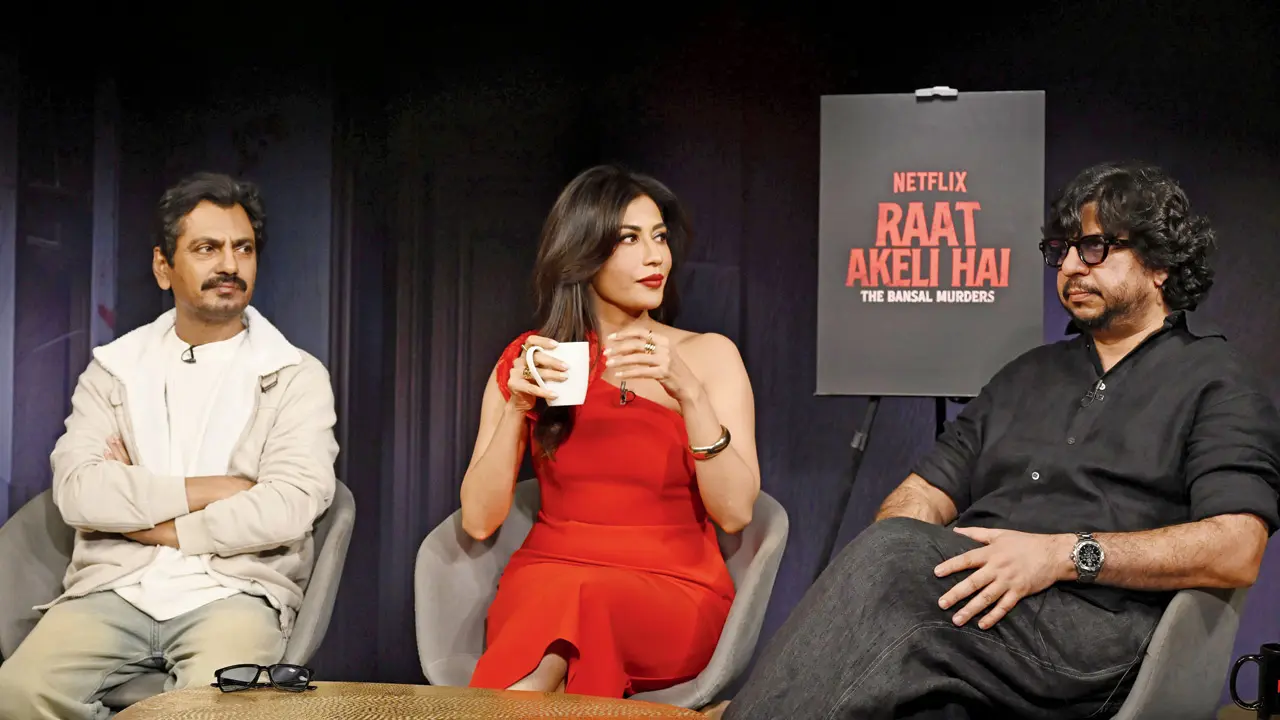
From left to right, Nawazuddin Siddiqui, Chitrangada Singh, and Honey Trehan. PIC/ASHISH RAJE
At the centre of this universe is Inspector Jatil — played once again by Nawazuddin Siddiqui — whose moral compass does not always point north, but somehow lands exactly where it needs to. “The name of the character is the same,” Trehan says, almost dismissively, “but his complexities are new. In the first film, he was coming out of patriarchy. Here, he is dealing with something else entirely.” For the director, the sequel is not a continuation so much as a fresh excavation. Same universe, new wounds.
Siddiqui echoes this idea of evolution, describing Jatil as a character who grows deeper rather than louder. “The basics remain the same,” he says, “but because it’s a new case, and a very complicated one, the depth has changed.” But what he admits to, almost unexpectedly, is how much of himself he leaves behind with Jatil each time. “When you’re making a film, you are also fighting your own complexities,” he says, “In the first part, I was dealing with my own things. I used Fair & Lovely in the film, it was my own complexity. When a character’s problem gets solved, something inside you also gets solved. There’s a give-and-take. You take something from the character, the character takes something from you. At the end of the day, a lot of things in your real life also get resolved.”
Into this uneasy world steps Chitrangada Singh, playing Meera, a scion of the Bansal family and another character who exists firmly in the grey. “She’s not entirely good or bad,” Singh says, “Even she is confused about her own morality, where she stands.” The role marked a departure for the actor, not just in genre but in emotional weight. “She’s really down and out,” Singh explains, “Emotionally broken. And then she finds her strength again. There’s a graph.”
There is one scene in particular that stayed with her long after the shoot wrapped, a quiet moment where Meera washes her face, almost violently. “She’s trying to wash away all the noise, the anger, the hate,” Singh says, “It’s a very beautiful scene. It took me back to some emotions in my own life that you don’t want to revisit. You think you’ve overcome them, that you’ll never be that woman again, never feel that way again. But some writing is such. It forces you to go back there.” Trehan, listening in, breaks the heaviness with a grin, “And if the writing doesn’t take you there,” he quips, “Jatil will.”
That idea about power, truth, and who gets protected by the system runs quietly beneath the film’s mystery. Singh points to the relevance of that subtext today. “The truth is being sold today. If you repeat a lie enough times, it becomes the truth,” she says, noting that Meera’s profession as the owner of a news agency sharpens the film’s critique.
Siddiqui, however, resists the urge to prescribe takeaway messages. “My job is to play the character honestly,” he says, “Audience reactions are very personal. Everyone comes with their own mindset. What they take away is private to them.” Trehan’s perspective is simple. “I promise you a good two hours and eight minutes. That’s my responsibility, to respect your time. Beyond that, it’s up to you.”
 Subscribe today by clicking the link and stay updated with the latest news!" Click here!


