
Machismo is so ‘yesterday’. The new-age man is not afraid to practise active kindness or to show vulnerability with loved ones. This is the guy who remembers your favourite flowers, the one who doesn’t back away from an honest conversation, and whose heart is bigger than his biceps
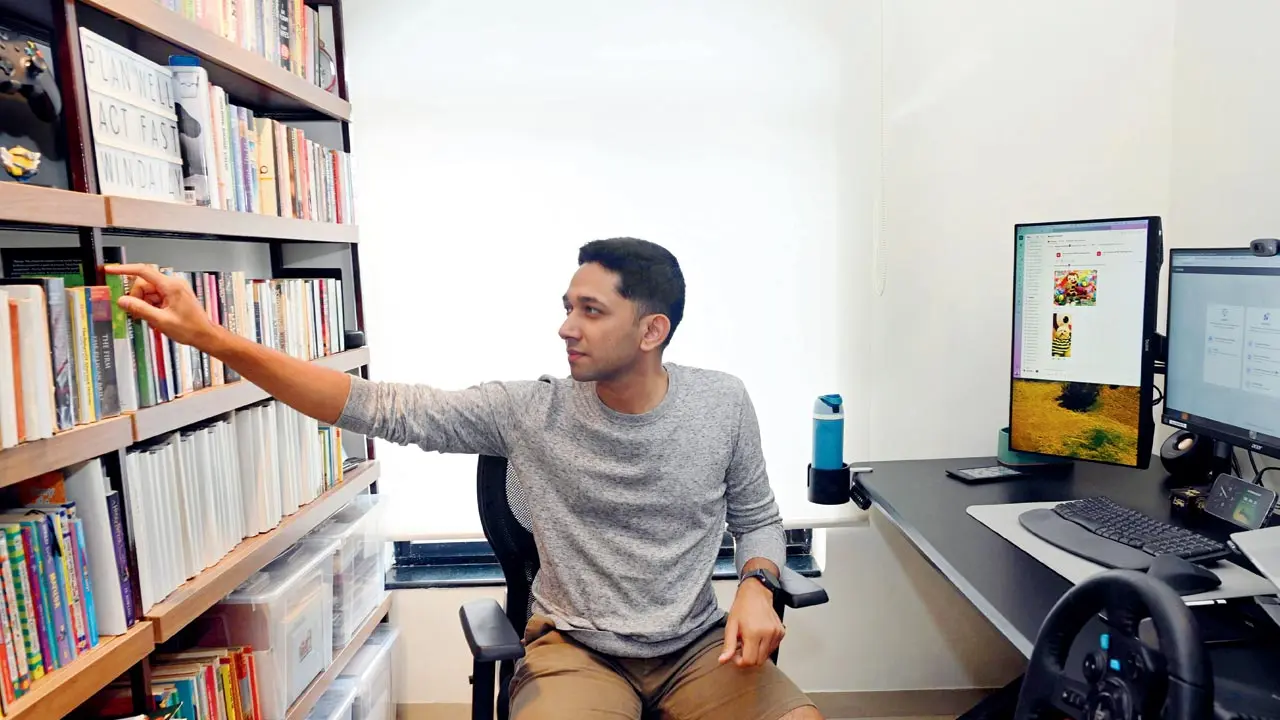
Whether it’s sexist ‘wife’ jokes on WhatsApp, or needless aggression in arguments with friends, Georges Cheruvelil has learnt to put some distance between himself and toxic masculinity. Pic/Satej Shinde
Gen Z calls them “softboi”, those of us from earlier generations call them a gentleman. This is the man who remembers that you love butterscotch ice cream, that you hate/love flowers as an apology, or that soft toys are your self-soothing indulgence, despite being a full-blown adult.
From Mr Darcy in Pride and Prejudice to Conrad Fisher in The Summer I Turned Pretty, we love to fantasise about the wholesome and thoughtful man who is kind without seeking a reward for it. But in a world where men are more preoccupied with being the alpha or the top dog — thanks to the Andrew Tates of the world — the gentleman has become an endangered species.
 Shubham Soni is a 25-year-old scientist who went from burnout to therapy, where he learnt the importance of self-care and having tough conversations with his friends. Pic/Atul Kamble
Young men today are fighting a solitary battle across college campuses and workplaces to hold on to the softness in their hearts, refusing to succumb to the popular culture of “macho men” and “boys will be boys”. One of them is Dvij, a 20-year-old who has contributed over 70 stuffed animals to his girlfriend’s collection over the three years they have been together. In a photo essay for a college assignment that he shared with us, he writes, “Plushies are more than just soft toys, they are a warm hug for the soul”. The essay goes on to talk about eight of them, with their name and characteristics and how his girlfriend values each because it brings her comfort. Dvij tells us that he really doesn’t care if other men feel this is too “pansy” or “gay” — both words used by his classmates quite liberally to describe him.
Currently pursuing his second year in a South Mumbai college, Dvij feels that most social norms for “what makes a man” are very toxic. Empathy and openness ought to be celebrated as a virtue in anybody, and yet it led to Dvij being ostracised by other boys, and now young men his age, for being “too soft”. “Many think I am gay and in the closet just because of the way I act,” he says, “There is so much wrong with this thought, that if you are kind, you must be gay.”
 Georges Cheruvelil and wife Jisha, chat in their children’s home in Borivli. The couple are trying to raise their daughter and son without any special treatment or gender bias. Pic/Satej Shinde
The archetype of the macho man or alpha male that has no room for kindness or any kind of softness has been entrenched even deeper in the minds of many youth through the “manosphere”, a digital ecosystem of masculinity influencers, such as self-proclaimed misogynist Andrew Tate.
As a young man trying to have a healthy romantic relationship and friendships, Dvij tries to not be too judgemental, but there are some red flags he has learnt to look out for. “There was a disagreement between two of my friends,” he recalls, “and I was trying to listen to both sides. Then I happened to hear one of them listening to Andrew Tate and I immediately distanced myself from the situation. I look out for such things now, such as what media a person consumes or reads.” He is a big fan of the recent Superman movie starring James Gunn that has admittedly featured the most emotionally mature version of the iconic superhero, and the Percy Jackson series.
 Shubham Soni says he wants to be open in a relationship and collaborate with his future partner. Pic/Atul Kamble
The other assumption is that a kind person must be a pushover. Indeed, people have taken advantage of Dvij’s kindness in the past, leading him to be more careful about who he trusts. “I want to be someone that people think of as reliable and kind. I am also a people pleaser I guess,” he admits, “But I choose whom to please.”
The path to reaching this version of himself has been lonely, especially in school, but undergraduate has worked hard to find friends and a romantic partner in college who allow him to be himself. “I know that being non-macho will not make me less attractive to her [his girlfriend], in fact it helps,” he chuckles.
 Conrad Fisher from The Summer I Turned Pretty has been hailed as a softboi that the whole world has fallen for
When we first put out a call on social media looking for men who don’t believe in aggressive masculinity, we received responses from women that ranged from “If you find this man, please let me know” to “Lol, good luck” to the more hopeful “My boyfriend is one”. There were some men who volunteered themselves with slight trepidation. “Is there a qualifying test? I believe I fit the criteria [accompanied by the tears of joy emoji],” states the response from Shubham Soni, that tickled our funny bone as well as curiosity.
“I grew up in Mumbai, but pursued my Masters in Pondicherry and lived for a bit in Bengaluru, so I think these cities have contributed to how I conduct myself,” he adds.
 Rahul Gandhi has been christened as India’s softboi
Shortly later, the 25-year-old tells us over a phone call that his journey to self-awareness started with self-care and therapy. Soni, who is pursuing a PhD in Lithuania on ecology and the behaviour of animals, is currently back home in Mumbai for a short break. He recalls how his hectic schedule — prepping for BSc finals, fieldwork at 5 am on Sundays, rejection from universities with Masters programmes — during the final year of his undergraduate studies had led to burnout. He signed up for free therapy sessions with psychology students at the varsity. “One of things I learned from these sessions is ‘smart goals’, where you break down your calls and create a goal that is specific, measurable, and time-bound. These are more doable; it’s a tool I use till date,” he adds.
One form of self-care eventually taught Soni to show himself grace in other ways too, such as being unafraid of vulnerability. Ever the scholar, he is a big fan of Brené Brown, an American academic who is known for her work on vulnerability and leadership. When it comes to his friendships, too, Soni is not one to avoid a heart-to-heart talk. He recalls a conversation with a friend whom he no longer saw eye-to-eye with on a lot of things. “We felt that we were on very different growth paths and tried to address the differences but for the time being we decided to end the friendship,” he recalls.
 Bluey is one of the 70 plushies that Dvij gave his girlfriend and was a part of a photo essay/presentation that he made in class
His career is the single-most important thing for him right now, he says, adding that he doesn’t have time for either romance or friendships that don’t contribute to his well being. He is open to a romantic relationship in the future, and wants to be “open to change and empathetic towards my partner”. It’s easier said than done, though, he says. “We have internalised patriarchy to such an extent that it takes a conscious effort to understand: it is absolutely normal for a man to cook everyday in the household. Lastly, I wish to be with someone with whom I can simply sit, talk, and figure things out with ease,” he adds.
Georges Cheruvelil is a 39-year-old ad-tech professional and is known to be a loving husband and kind father to a three-year-old son and eight-year-old daughter. A cousin of his says she is grateful that her niece has a role model like James. “Men like him give us hope,” she tells us.
“She is being too kind,” Cheruvelil responds when he tell him about this over the phone. Both he and his wife Jisha had an arranged marriage 10 years ago, and he was careful to assuage any apprehensions she had before moving in with a new family. “We had an arranged marriage but we were speaking for around six months before, since she is from Bengaluru one of the few things that she feared was size of homes in Mumbai and how we would manage because we stay with our parents and at the time my grandmother was there too, but I think some of those fears were put to rest when her family came home,” he recalls, “While she was also worried about the family dynamics; she didn’t really want to stay separately in fact, she insisted that she wanted to live in a joint family but these were initially
issues we talked about and slowly we came to an understanding.”
He does confess that being an only child did lead him to being spoiled silly, but he has made efforts to break the cycle with his children. “My grandma was a large part of my upbringing and she grew up in a very traditional home so she wouldn’t let my dad enter the kitchen as far as possible and I was part of that special treatment as well. So, simple things like after food, keeping the plate back. It wasn’t expected of me. But now that I’m a father and even though my son is only three-years-old I have tried to raise my daughter and him with the same values,” he adds.
Talking about his male friendships, James mentions that he grew up during the peak of the WhatsApp forwards era. “There used to be a lot of ‘wife jokes’ in these forwards. I’ve consciously tried to distance myself from the senders, although it is unavoidable in some cases,” he adds.
His approach to conflict too has matured over the years, especially if it’s a political disagreement: “Earlier, I would argue with someone over them propagating hate politics but now I know better, I just don’t engage.”
At the age of 35, Avinash Shahri, a human resource consultant breaks down the interplay of male friendships. “Among men, it’s like ‘Who is the bigger bad@#s?’ But this kind of masculinity is very ‘yesterday’. This is a toxic loop that men indulge in. It benefits no one, including the so-called alpha man, because everyone ends up hating that person. This makes the experience of being in a group of male friends thrilling for a few moments, but lonely otherwise. Which is why I have a few real friends and I really cherish the synchronicity among us,” he says.
Shahri is also a source recommended by a woman friend, and the ‘why’ is reflective throughout the chat, as he tells us that his first religion has always been kindness. On his equation with his wife, he says, “With her, it’s active kindness and empathy, everyday — in small things and big. As long as one understands and accepts that there’s work to be done on oneself, that’s all that counts in every relationship,” he ends.
His wife, Rinku Gajria, says that the best thing about him is that “he always makes me feel safe and secure in our relationship”. “Our relationship is more like a partnership; we motivate and inspire each other to bring out the best versions of ourselves,” she adds.
What’s the biggest no-no for her? “I think for both of us, it’s disrespecting each other.” Well, no wonder it seems to work.
Aniket Wakankar, works with redefining masculinity
 Aniket Wakankar
Wakankar who worked with The Gender Lab for six years went to schools across the city and spoke to boys who were in the age group of 12 to 13. “We used to ask boys to draw what man looks like and you would get a man with strong muscles or someone who is going to work. Then we would show them the movie Bombay Talkies were the lead is a boy who wants to dance and wears his sister’s clothes and uses mom’s jewellery. We come back to their drawing and ask them if that boy is like those drawings. Then we ask questions like can men and boys wear bangles. I try to frame it as “If this was me, can I wear bangles?” They slowly begin to get the idea of how gender can be non traditional. Most of them in class 8 are open to change but we have observed that when we speak to boys in class 9 they are suddenly very rigid of their gender roles and stuck to what the roles were very stereotypical,” he says. “It just proves the innumerable research that we have that says to address gender roles when men are young, the younger the better,” he adds.
What is the next gen like?

Neha D Gupta, image consultant and founder of The Finishing School
“A lot of my clients are couples, especially working professionals. A lot of times, men are brought there by their wives. A lot of men are open to change and know that their partner is doing something for their collective future. Only a few times have I seen a man be a little stubborn to change and push back. It’s usually the younger men whom I see having a lot of issues. Gen Z and older men are held up to extremely high standards of having to be ‘one of the boys’ even at the workplace.”

Rakshanda INAM, Psychotherapist
“Toxic masculinity can also be termed as narcissism and nobody wants a partner like that. Women are changing as well and want a partner and not a dictator and also in the same breath we are seeing a lot of relationships ending because of a refusal to change. However, I am also working with a 19-year-old boy who is called a sissy because he carries a medical kit in his bag, but is comfortable in his skin. He does question himself when he is being bullied. He needs occasional reassurance to know that he is on the right path. We are raising a kinder generation now because a lot of mothers are making an effort in raising their male child with empathy.”
 Subscribe today by clicking the link and stay updated with the latest news!" Click here!