Home / Sunday-mid-day / Article /
What Solvyns saw in India
Updated On: 21 April, 2024 06:17 AM IST | Mumbai | Team SMD
Flemish artist F Baltazard Solvyns, who arrived in India in the 1790s, was scared of banias, ignored the Muslim elite, and focused on the servants because with them “the picture of their domestic life would not have been complete”. A delightful exhibit displays his portraits of people and professions.





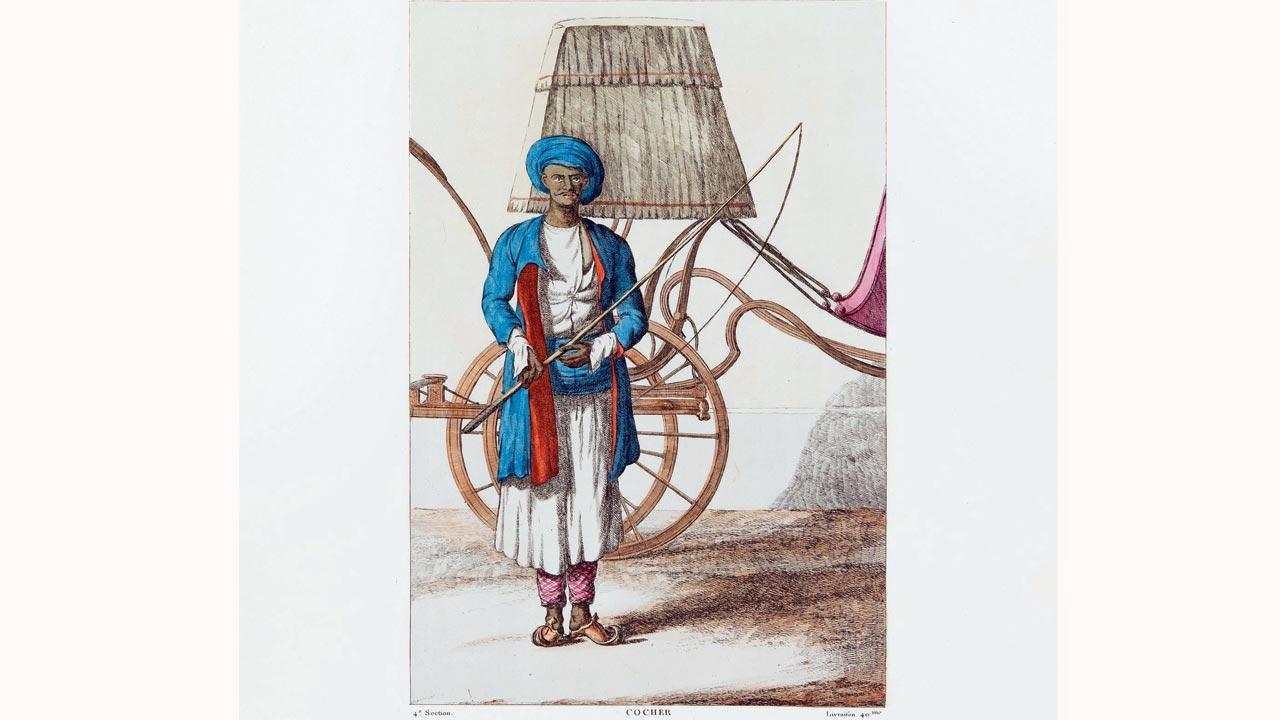
Cocher (coachman) The coachmen in India are all Mussulmans, and wear the turban and girdle of the same colour as those of the other servants of the house, says Solvyns’ record. Pic Courtesy/The DAG Collection
Born in Antwerp, in the Austrian Netherlands, in 1760, Baltazard Solvyns trained as a marine painter. To escape political unrest in northern Europe, and in the hope of making his fortune, he embarked on a journey to India in July 1790. Though undertaken more in hope than expectation, his plan was not outlandish: numerous English artists had succeeded in making at least a living, and some had prospered in India. But Solvyns travelled on board L’Etrusco, a ship that was owned and commanded by Captain Home Popham, sailing from Ostend, and that put him in a compromising position. Captain Popham was engaging in illegal trade that ignored the East India Company’s monopoly; and Solvyns had failed to obtain permission from the Company’s board of directors in London to live in Bengal, as was required by law.
Neither man was subjected to any serious legal penalty, as officials on the ground in Calcutta were willing to overlook such infractions, but Solvyns’s status as an unlicensed resident did limit the extent to which he was accepted into European society in the city. He was, for example, not invited to attend meetings of the Asiatic Society, which—given his curiosity about Indian civilization—he would certainly have wished to do.7 And he lived at a succession of addresses in central Calcutta around Tank Square, at a time when most Europeans were trying to escape this congested area and heading for what was then the spacious suburb of Chowringhee. If not quite excluded, he lived somewhat on the margins of the city’s European world, and in closer contact with its Indian quarters. Exploring Chitpore and other native districts, and meeting local residents to assemble the material for his great work, he learnt far more about the Indian life of Calcutta than did most other Europeans of his time, who knew it chiefly through interaction with their servants. It is this position apart, away from the stand-offish Brits, and his immersion in Indian life, that his self-depiction in his image of ‘Nations différentes’ seems to hint at.
Trending Stories
Latest Photos
Latest Videos
Latest Web Stories
ADVERTISEMENT
Mid-Day Fast
ADVERTISEMENT