|
At the height of his arrest controversy late last month, Shiv Sena chief Bal Thackeray had announced to a newsmagazine that he had but one condition to be fulfilled if he was arrested: ''I want to be lodged in a cell with an Indian style toilet. I won't accept the western commode.'' Had Thackeray actually been put behind bars and the case not dismissed, he need not have worried on that count at all. Because prisons in Maharashtra boast only of Indian style loos, albeit in filthy and dilapidated conditions.
Take the case of Byculla jail. The toilets here are blocked with shit, their gaudy blue doors broken and they have no flush. Thackeray would have had to fill his own bucket from a dirty water tank placed just outside the loo.
Such is the appalling condition of our jails that instead of acting as correctional centres they have become breeding grounds for fresh criminal recruits.
Says Kanwal Shahpuri, former member of the Board of Visitors to the Prisons of Bombay, a statutory body appointed to suggest ways to improve conditions in prisons, ''Our jail authorities are still stuck in the old mode of thinking that prisoners do not deserve a decent life. 'Why should they be treated well when they have committed such gruesome crimes' is their justification. They completely override the liberal philosophy around which a jail ought to be built: an offender is sent to prison as a punishment and not for further punishment. That seclusion from society and loss of personal freedom is punishment enough. That incarceration is an opportunity for 'correction' rather than 'penal servitude'.
Explains former Inspector General (Prisons) Kiran Bedi, ''Just because some inmates are poor does not mean that they have to be worse off inside the jail. Once an individual is arrested, he or she becomes the government's responsibility. You must provide for their proper upkeep and development. The reforms are no luxury. The facilities are not only for their comfort but a part of their enabling process, their mental and physical development.''
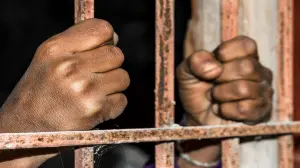
Unfortunately a visit to the three jails - Byculla, Arthur Road and Thane Central proves otherwise. As you enter the monstrous red iron gate of the Thane Prison, a peculiar smell greets you. It's common to all the prisons. A number of human faces - some wearing expressions of awe, shock and bewilderment, silently stare in your direction. They are biding time to enter a special enclosure for their evening meeting with family and relatives.
In the Navi Jail Vibhag, a cell roughly 20 ft by 100 ft in size is packed with 100 to 150 prisoners in a space meant for 50. In cramped cemented barracks dozens of men lie uneasy on the floor with barely any space to turn over. Clothes hang loosely from lines across the length and breadth of the room and Hindu gods stare out of cheap photo frames on drab walls.
There is just one 'night loo' for these inmates. A huge copper tank stands outside it. The water inside is stagnant, filthy and mosquito-infested. One doesn't know whether it contains drinking water because ''drinking water and bathing water are the same in jails'', admits Minister of State for Home Manikrao Thakre.
At the Byculla Jail, some 'day' toilets are blocked with human excreta. Situated next to them is a long water trough from where the inmates not only fill water for their morning ablutions but also drink it when they are thirsty. Plus they wash clothes and utensils and bathe as well, that is if the tap is running. Sometimes it just does not run.
Says Meena Mutha, former member of the Bombay Prison Board and vice president of Astha, a NGO working for the betterment of prisons, ''The condition of loos in jails is atrocious as is basic hygeine and sanitation. Time and again the board has tried to raise this issue but to no avail. In fact, I had personally offered to get donors to construct new toilets at the Byculla Jail on the condition that the contract be given to agenices other than the Public Works Department. But I am yet to hear from the jail authorities.''
If the jail loos are bad, the food is worse.
It's 5 pm. Outside the barracks in the New Jail Vibhag at Thane, there is a long queue of prisoners with aluminium thalis and vatis waiting to be served their evening meals.
The dal is thin, bland and watery, almost like gruel; the rice tasteless and the rotis coarse and dry. ''How can you serve such unpalatable stuff?'' I ask a jail staff. ''Well you can't expect prisoners to get the same treatment that they would in their homes,'' he retorts back.
At the Arthur Road Jail's female ward, a fat and portly Marukh, arrested under Section 420, surreptiously dangles a burnt chapati in our direction. ''The authorities will paint you a rosy picture of how much they take care of us. But we know what the reality is,'' she whispers, lest DIG (Prisons) Ashok Kinninge (who is taking us around the jail) overhears her.
Former IG (Prisons) M G Naravne, however, maintains that on an average, the jail authorities spend Rs 30 to 50 per head per day. ''Whereas our per capita income is Rs 10,000 per year, we spend around Rs 17,000 on each prisoner annually. Which means he is getting better facilities, food and a higher standard of living than the common man of India.''
* I don't agree with Manikrao Thakre's contention that because of a resource crunch, he can't improve the conditions of jails in Mumbai. I firmly believe that prison management ultimately boils down to leadership. Our prison manuals are so flexible that a dynamic inspector general of prisons with commitment to reformation can achieve just about anything.
* The Tihar model based on the 3-Cs (Corrective, Collective and Community Based) is a functioning and successful example of prison management. Mumbai Jails can replicate and adopt it. The model stresses on community participation. If your jails have poor living conditions, it doesn't mean that you can't have reformation programmes. Programmes are not linked to dilapidated buildings.You can start one right under a tree. Bombay is full of community-support systems and NGOs. All you have to do is select them and give them an opportunity. And they will not even charge you anything for it. Instead they will only thank you for giving them a chance to serve.
* If gangs are operating in your jails and mobile phones are being smuggled inside, then it is directly linked to the integrity of your staff. Improve your vigilance. Mix the staff or introduce people participation. I think the problem does not defy solution. There are technological answers as well. Mount cameras or bring in screening systems. Reduce your dependence on human security systems. Sniffer dogs and sniffing machines to sniff drugs can also be explored.
* It is possible to reform hardened gangsters like Arun Gawli by individualising the treatment procedure. Give them meditation and counselling sessions on an one-to-one basis. Special techniques are also available. Don't club them with the others and don't leave them alone either. Work on them so that they don't become desperate gangsters. According to Bedi, there can be only one reason for the food being unpalatable - lack of supervision and corruption.
Unfortunately, even though a system of a petition box through which inmates can voice their grievances anonymously does exist in all the three jails, the prisoners are a suppressed lot. ''Whenever we open the petition boxes at Byculla Jail, we find them empty. We expect names of guards extorting bribes and warders who inflict beating to turn up in the box. The inmates are always afraid to express themselves freely,'' points out Shahpuri.
He adds that with the keys of petition boxes resting in the hands of jail authorities, it was only natural that the prisoners were scared because everything in the jails is censored, including their mail. ''Moreover, whenever we cajole the inmates to air their grievances, they complain, ''Kagaz aur pencil hi nahin hai, kaise likhen?
Most prisoners, says Meena Mutha, are not aware of their rights. ''They don't know that they are entitled to pen and paper.''
Take the case of the undertrials. Many have no idea that under the law, the maximum period that an undertrial can be kept in jail is three months. Unfortunately, 80 per cent inmates in all the three jails are undertrials languishing for years. Some have been there for the last five to six years, without a single date in court.
Asphaq Sayed Shaikh, who claims to have been arrested in connection with the Santa Cruz train bomb blast case three years ago, is a case in point. ''In all these years that I have been inside this special cell at the Byculla Jail, not once have I been to the court. I don't even know what is happening to my case,'' he says.
Shahpuri had tried to help by getting two advocates sponsored through the Rotary Club to expedite the court process of undertrials. ''But the jail authorities don't seem to be interested.''
With the overall approach of the jail authorities geared towards nitty-gritties like food and security, are any efforts being made to reform and rehabilitate the prisoners? 'No', exclaims Marukh, inmate at the female ward of Arthur Road Jail. ''What improvement are you talking about? The yoga teacher visits us only once a month. Books from the library hardly ever reach us and I have never attended spiritual and moral discourses. At least I can't see any change happening inside me or my colleagues. We are just the same.''
Shekh Kadgi Magru, a prisoner at Arthur Road, is one such example. I do my yogasanas daily and read the newspapers as well. But I know nothing about the library books. At least I have not received any.''
The Arthur Road Jail library basically comprises two cupboards stacked with 971 books ranging from the Bhagwad Geeta to the holy Bible and the Ramayan. The cupboards are locked and the books dust-ridden, almost as if they have been lying around unused for a long time.
Points out Bedi, ''Unless the superitendents take interest, things won't happen. He can't afford to be just a warder. He must play the role of a teacher, reformer, criminologist and a sociologist all rolled in one. He must walk the prison everyday and personally organise these activities. If he doesn't, then it only means that his jail is not being administered. After all a prison is like a township and not some locked-up godown or warehouse of people.''
According to Mutha, there is absolutely no initiative coming from the authorities on the reformation front. ''Basically they take cover under the excuse that it is not their obligatory duty to initiate reform measures as a majority of prisoners at these three jails happen to be undertrials and not convicts.'' ''Under the law we can't force undertrials to engage in constructive activity. Plus we are battling with the problem of overcrowding in our jails. Our resources, staff strength and infrastructure is limited compared to the number of inmates,'' says DIG (Prisons) Ashok Kinninge. As a result, these jails have become perfect grounds for nurturing criminal minds, says Shahpuri. ''Young petty offenders come into daily contact with hardened gangsters who are waiting to pick them up and initiate them into the world of gruesome crime. Luring them with bail money, legal aid and other comforts, they enroll them to work for their gangs.''
The government, adds Mutha, does not have the resources to introduce rehabilitation programmes. So much of the correctional work including literacy programmes, yoga, counselling and provision of legal aid is being done by NGOs like Astha, Prayas and the TISS. Bedi, however, feels that such community participation and NGO entry need to encouraged. ''Because the metamorphosis from criminality to humanity can be achieved only through a 3-C model of prison management based on a Corrective, Collective and Community-based approach. At least that is how I did it at Tihar Jail.'' This holistic process, she says, stresses on NGO and community participation, adoption of the panchayat system in jails, introduction of a mobile petition box, education, introduction of vipassana meditation and vocational training among other things. ''Most important, the authorities must realise that the main purpose of a jail is to reform and restore. It's not a holding institution but a place for white washing, dry cleaning, reforming and restoring aberrant individuals to society.'' Traces of this approach are evident at the Thane Prison. Thanks to superitendent R B Mahale who believes that ''crime is a sign of a diseased mind. Our objective should be to treat the prisoner's diseased mind and help him get integrated into society''.
In his jail's Kalapani Section, young boys can be seen playing volleyball in their courtyard. Plus they got together to put up a small skit called Andhere Se Prakash Ki Aur.
Says Mahale, everyday some 600 inmates attend yoga sessions conducted by the Prajapita Brahmakumari Ishwariya Vishwa Vidyalaya here. ''It works wonders for the destructive and deviated mindsets of the prisoners and some have even confessed that they have become better humans. Arun Gawli, who is housed in my jail, meditates regularly. So do the Chhota Shakeel gang guys. I can already see a change in the Gawli boys. Earlier they would be so rude to me. Now they greet me with 'Om Shanti'.''
Since many convicts are spurned by their families after release and social acceptability is low, it is very difficult for them to get jobs. Part of the exercise, says Mahale, is to create opportunities of self-employment for them. Vocational training and counselling helps them overcome maladjustment and get integrated in society.
At Thane, vocational training is imparted to 125 inmates who are paid a daily wage of Rs 25.50. The jail's factory production is worth Rs 56 lakh per year.
The full-fledged factory section comprises the carpentary, bakery, powerloom, laundry and tailoring sections. Prisoners clad in white uniforms can be seen making bread that is supplied daily to the mental and civil hospitals here. In the carpentary section they make chairs and tables on placement of orders from government departments.
Says Papu Uday Prakash, an inmate for the last two years, ''When I arrived in this prison, I was a very confused person. I had problems in my family. Today I can see the whole thing in perspective. When I go out of here, I want to apologise to my parents and start life afresh on a clean slate. I do yoga daily. Mere andhar bahut parivartan aaya hai. Main apna jeevan sudharoonga (A change has occurred within me. I want to improve my life).'' 'I admit that all is not hunky dory with our jails' - Manikrao Thakre, Minister of State for Home (Rural, including jails) I ADMIT that all is not hunky dory with our jails. One of the main reasons being the resource crunch. Prisons are not high on the government's list of priorities; drinking water and education are. So, even if I want to improve conditions of our jails, with a limited budget of Rs 49,58,06,00 at my disposal I can only do this much and no more.
One of the first things that I would like to do is supply clean drinking water to our prisoners. I agree that today drinking and bathing water flow from the same tap, though the water may not be so unfit for consumption as it is made out to be. We also propose to improve the quality of meals by introducing a uniform system of food service.
There is no denying that loos are in appalling shape. But there is a move to construct new toilets which is pending clearance from the Cabinet. The idea is to give these projects to private parties and NGOs instead of the PWD.
Reformation also needs to be looked at more closely. The prisoners at Arthur Road and Thane happen to be undertrials and unlike convicts, we cannot force them to take up constructive activity. Nevertheless, I am talking to retired IGs of prisons to suggest ways in which we can bring about a qualitative change in the life of our prisoners.
What worries me most is the overcrowding in our jails. At Arthur Road Jail, the load gets further accentuated because prisoners from far off cells like Amravati are also brought here on account of their court dates in Mumbai. We will have to put up with this scenario for three more years, till our proposed 2,500-capacity jail at Vasai comes up.
I am aware of gangs openly operating in our prisons. We are trying to avoid the smuggling of mobile phones into jail premises through strict security checks of undertrials returning from courts. Plus, we have passed a bill at our March Assembly session not to allow food tiffins from outside to be brought inside the jail premises. Now if the court gives permission, we can't help it. A businessman recounts his three-month experience in the Arthur Road Jail I WAS in Arthur Road Jail between March and June 1999. They had locked me up in the Egg Cell meant for white-collar criminals, people arrested for economic offences like FERA violations, excise and custom duty frauds, filmfolk and businessmen.
White-collar criminals are kept separately from gangsters because if the two come in contact, the latter issue threats and demand huge amounts of extortion money from them. In the past, several gangsters have tortured and beaten up hoteliers and businessmen in jails, forcing them to write letters to their families directing them to pay up.
The gangsters tried their best to identify me but I kept telling them a lie - that I had shot my employer following a caste dispute. I wanted to be one with them to protect myself. I did not reveal my identity as a businessman.
Gangsters of big gangs were housed in separate barracks in order to prevent them from coming to blows with each other on account of rivalry. Nevertheless, one would often witness typical brawls between them across barracks. Big gangsters lured petty criminals with bail money, legal aid, good food and other comforts. Once out of prisons, they start working for these gangsters as informers or shooters. This is how gangs are expanded.
Subhash Singh Thakur and Shyam Kishoregarikapati of the Ali Budesh Gang, who are now close to gangster Chhota Rajan, were in the jail at the time I was there. They were kept in a separate cell. On hindsight, I realised that the attempt on filmstar Rakesh Roshan and the kidnapping of Chiranjeev Vaghani of Milton Plastics were plotted by them in the jail in connivance with the Abu Salem gang.
Subhash Thakur's day began with two to three hours of morning pooja followed by exercises and sit-ups. These gangsters love to flaunt their macho bodies a la Sunjay Dutt. In the afternoons, he held his 'bhai darbar' where his henchman played on buckets, plates and spoons and sang his glory. They massaged his feet and fanned him with wet towels popularly called 'bhai ka AC pankha'. From his cell, he carried out operations and issued orders over the mobile phone. A lot of cellphones, miniature liquor bottles, drugs and narcotics and sometimes even tiny weapons were smuggled in through the canteen van which made trips to the market once every two to three days. There was an understanding between the owner of the canteen, the driver and the gangsters. They were paid handsome bribes for smuggling these things into the premises. Sometimes phones and messages were smuggled inside in tiffin boxes for criminals - a mobile phone cushioned inside a 'pav', narcotics in gutka packs. Often narcotic packets were thrown over the high prison walls from surrounding slums.
All gangs paid a fixed income to the jailors to eke out a comfortable existence for themselves. During inspection, the jailors would hide the mobile phones for the criminals and would also recharge them when the battery was down.
I had paid a total of Rs 50,000 to various levels of the jail staff for my tiffin boxes, visits and other comforts. If you paid Rs 500 to the jailor on mulakat duty, he allowed you to meet your relatives everyday for two minutes. Otherwise it is once a week for undertrials and once a month for convicts. For a 10-minute extension, I had to bribe him another Rs 500-1000. And the mother of all mulakats, the special visit lasting over 15 to 20 minutes, cost Rs 5,000.
Even the prison doctor had to be bribed to get proper treatment. Once I was down with fever, I had to pay him Rs 100 to get treated.
Reformation is a big eyewash. The jail authorities are not bothered about rehabilitation. Yoga sessions were once in a while. Not many prisoners were interested. Books from the library were hardly ever made available. Most prisoners spent time playing cards, reading newspapers or watching TV. Some narrated their life stories over and over again, others sang hindi film songs, bhajans and kirtans or simply read the Hanuman Chalisa. |