Home / Mumbai / Mumbai News / Article /
'I see it is as the closing of a chapter in my life'
Updated On: 25 March, 2019 07:59 AM IST | Mumbai | Rishi Majumder
Indian-American businessman Rajat Gupta who spent 2 years in jail after being convicted of insider trading pleads his innocence in a newly published book, but is ready to move on





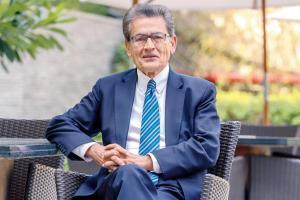
During his time in prison, Rajat Gupta says he interviewed 40 prisoners on their life story, how they got into trouble etc. His future plans include doing some work on the criminal justice system in the US. Pic/Nishad Alam
Rajat Gupta, former McKinsey Chief and board member of corporations like Procter & Gamble and Goldman Sachs was the toast of New York's corporate elite. He was also at the centre of one of the biggest insider trading cases in history. Charges on which he was indicted revolve around his phone calls to hedge fund manager and Sri Lankan-American billionaire Raj Rajaratnam, revealing insider information about Berkshire Hathaway's 5 billion dollar investment in Goldman Sachs and Goldman's impending losses. Having served his time in prison, Gupta continues to maintain he's innocent. He didn't testify during his trial but has now written a book, Mind Without Fear (published by Juggernaut), that tells his side of the story. Edited excerpts from an interview.
In January, this year, the appeal you had pending before the Supreme Court based on the Newman case was denied. Why? Is there a legal way forward now?
The Newman case had to do with the fact that there had to be a quid pro quo and a benefit. They turned down the appeal on the basis that, if I had this argument available to me on my first appeal then why didn't I present it then. They also said they didn't find anything wrong in the way the trial was conducted. The jury instructions. We had appealed against that. So basically they didn't substantively look into the case. It was more procedural. But it took them over two years to write the opinion, from 2016 to now. So it was a bit strange.
As far as the legal path ahead is concerned, it's over now.
How did you come to be associated with Raj Rajaratnam?
Firstly, he had a great reputation at the time I had gotten associated with him. I also checked out with Hank Paulson (Former Secretary of the US Treasury) who was a good friend and Gary Cohn who was president of Goldman Sachs before I got into this Voyager business with him (Rajaratnam) and they came up with very high marks, not just for his success but also evaluating him as a person. But also he was a generous donor to the Indian School of Business. And I felt this was a school in India and this was a guy from Sri Lanka and he was being very generous.
So I thought he was a good person, very talented in his field and came with high references. So I didn't think twice about giving him money to invest. That's what that was about. I generally trust lots of people so I wasn't looking at it critically and doing due diligence on him.
How do you process the past few years?
My father used to say that you can't always control what happens to you but you can control how to react to it. One of the things I wanted to do was react to it with generosity of spirit, grace, forgiveness, lack of anger or rancour or bitterness. Largely I've been able to do that. I also think life is a series of experiences. Nothing is good or bad. It's what you make of it. I went to prison and resolved that going to prison I would want to come out of it stronger in every way: physically in better shape, mentally, emotionally, spiritually… and I believe I was largely able to achieve that. Even though it was hard at times, by and large it was fine even in solitary confinement. From these last six years, there are obviously a lot of regrets. I regret that I couldn't continue on my journey of doing a lot of philanthropic things, creating institutions… I was on the verge of creating an institution for urban development in India which I could not complete. So I feel very badly that this thing took away six-seven years of my life and I couldn't do the things that were near and dear to my heart.
But of the good that has come out of it, this book itself is one of the things. I wrote it because I felt it was an interesting story. I've gone through a lot. If you read it I hope that you'll be able to relate to some pieces of it. In your own life, your own career. You'll be able to see how I reacted to things, think of how you would react to them, learn some lessons from it and so on… so the idea is very much to say: "I've gone through this. Let me narrate how I felt, how I made decisions- some good, some bad." And articulate a life philosophy. And hopefully that'll be beneficial to some readers. I also wanted to write an interesting story. If you take my name away from the cover, just say it's a fictional story, it should be an interesting story to read.
Do you see your book as a comeback vehicle, or a means of preserving your legacy?
Neither. As I said, first and foremost, I see it as a way of writing an interesting story. I hope people can learn lessons from it. But another way I see it is as the closing of a chapter in my life. It was difficult to write, a cathartic experience. I've gone through the legal process from 2011 to now 2019. That's eight years. Now I've published this book. I'm going to spend the next few months doing interviews, talking about the book and so on. And it'll be over. In some sense it's a closure.
What are your future plans?
I'm in relatively good health. I have a lot of energy. My mind still works well. So I'm not one to sit around at home. I'm connected with the institutions I founded. I advise them. I mentor a lot of people. I started doing some work in public health — maternal and child health — in Gujarat, which has been going on now for a year and will grow. And I've started doing some work on the criminal justice system in the US, prison reform. I've started engaging with an organisation called The Marshall Project. It's started by journalists and it is to put the spotlight on issues related to the criminal justice system. Every aspect of it, prison, bails, court system, appeals… And they write stories about injustices that happen. They've asked me to do some writing based on my own experiences which I'll do and I'll try to help them in other ways. There are two other organizations. One is called Rise-N-Step. It's a membership organization with prisoners and their families. It's for their welfare and tries to figure out how they can reintegrate into society and become useful, productive members of society. It's started by a guy named Manny who I write about in the book. He and I are working together for that organization. Then there's a guy named Greg Earls. He and I have been thinking of something called Bold Start which is really a life coaching thing for halfway houses. Once you come out of prison you go to a halfway house.
And I hope to do something completely different. I don't know what it will be. But maybe something interesting.
Once the charges came up you recused yourself from positions with different institutions. What is the nature of your involvement with these institutions now?
There were institutions I had a strong role in founding, such as ISB (International School of Business), PHFI (Public Health Foundation of India) and AIF (American India Foundation). They are in a way like my babies. Even today. A short while ago I met with the Dean of ISB and we exchanged ideas on what strategies he was following. He keeps me abreast. So I'm a sort of informal advisor to him. I also visit the campus and speak to the students from time to time. For PHFI, I talk a lot with Srinath Reddy who is the head of it. Right now, Mr Ramadorai has taken over as chairman. Srinath, Mr Ramadorai and I had a meeting where we were discussing the issues facing PHFI and how we were trying to get the Hyderabad Institute of PHFI formed. I'm working with the Gandhinagar institutions in my projects.
Trending Stories
Latest Photos
Latest Videos
Latest Web Stories
ADVERTISEMENT

Ganeshotsav 2026

ADVERTISEMENT