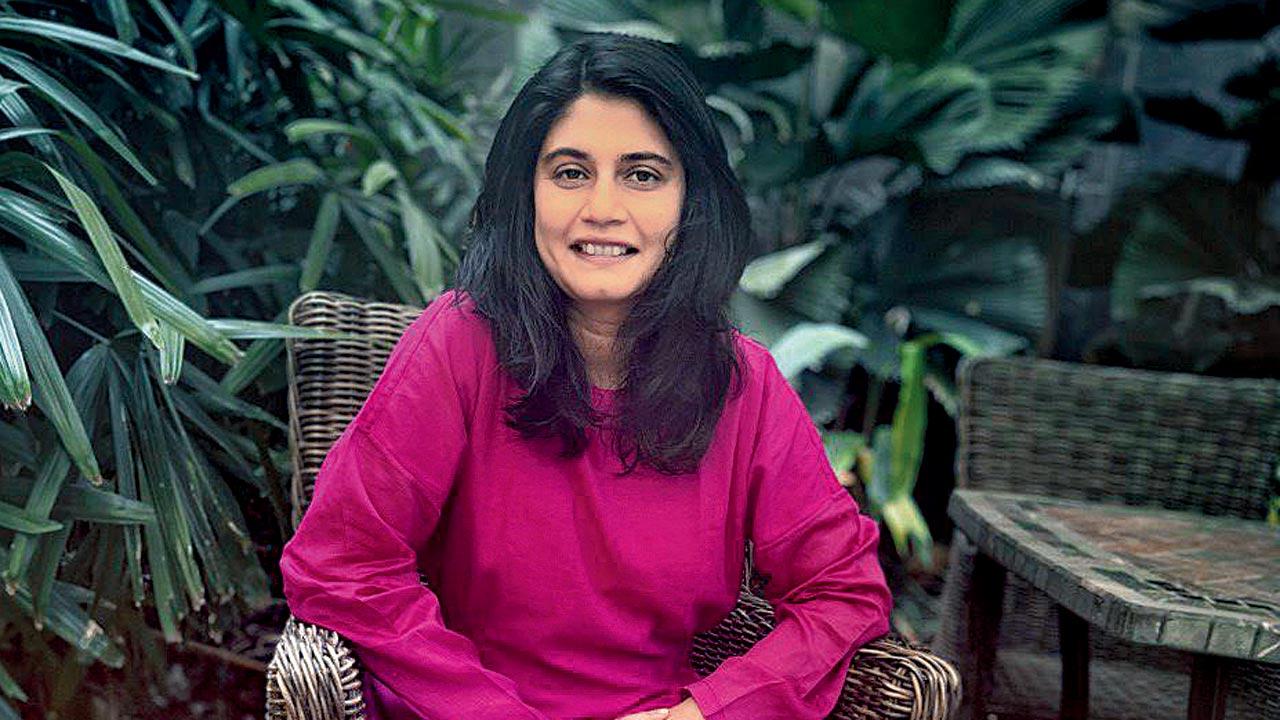
Admitting the struggle to find backing for sci-fi projects has taken its toll, director Arati Kadav on why she is choosing to go independent

Arati Kadav
She began with boundless energy and optimism, but director Arati Kadav — known for one of 2025’s most-discussed films Mrs — is now weary of an industry she says is risk-averse. Her dream? To make a big, mainstream sci-fi film. After Cargo (2019) starring Vikrant Massey and Shweta Tripathi, she followed it up with the award-winning short The Astronaut and His Parrot (2022) with Ali Fazal. In 2023, she began her third sci-fi feature, only to watch it stuck in limbo. Having invested years and even relinquished intellectual property, Kadav declared in a tweet: “I have decided I will never write sci-fi for any Indian producer anymore.”
Over a call, Kadav told mid-day the repeated cycle of investing years of passion and energy into projects that stall has pushed her to step away from collaborating with mainstream producers. She said, "I’ve been very passionate about science fiction. This is the third time I’ve worked on a project for almost two years, and then it just went nowhere. It becomes very defeating, you know? Back-to-back, you pour yourself into something because you’re passionate about it. I want to make a big mainstream sci-fi film, a blockbuster that everyone can watch. A film my parents would be proud of, kids would be fascinated by, young people would say “wow, that’s cool.” And every time I get a chance, I work very hard, but then something or the other happens and the project collapses. This is the third time I’ve worked on a sci-fi concept for over a year, almost two years. And in the process, you even give away your IP sometimes because you’re working in collaboration. Then the projects just sit in limbo. You’re left wondering, what was all that for? It’s very frustrating. That’s where that tweet came from."
A still from ‘The Astronaut and His Parrot’; (right) A still from ‘Cargo’
Kadav describes the system as structurally incapable of nurturing sci-fi projects. She points to an industry that prioritises what looks “safe on paper” over innovation or imagination, leaving little space for creators to experiment with ambitious concepts. "Working with a production house is not an easy process. It becomes laborious because I have to constantly take them along with me -- explain, justify, listen to feedback, argue my point. It’s exhausting. And after all that, they still don’t get it. I really believe you can make good mainstream, funny, accessible science fiction. Cargo itself was mainstream sci-fi. But something happens in the process of putting a project together—it just doesn’t come alive. I don’t know why, even after years of work, decks, meetings, sitting with them endlessly. I also feel it’s the market’s risk-taking ability. Because there isn’t money, there isn't the bandwidth to take risks. Everybody just wants to rehash what’s been done. I think the industry has become so risk-averse. It’s like a content pipeline madness—people only care about what looks safe on paper, not about what audiences might actually like. Producers are picking projects that are “safe on paper.”"
Won't the success of Mrs embolden stakeholders? "I still have the energy of a child for this genre. I can wake up in the middle of the night and start working on sci-fi. But all the sci-fi I’ve made so far has been self-funded. And it’s not like I had money. I was literally broke, but still funding those stories because of my passion. At some point, though, you need financing. Good science fiction requires decent budgets, not something an individual can bear alone. You need producers and organisations to come together. That’s why my frustration burst out. I am exhausted."
Even the much-hyped entry of OTT platforms, she says, has failed to deliver on the promise of risk-taking. While streamers initially appeared to widen the spectrum of stories being told, they too have increasingly gravitated towards formula-driven content, leaving science fiction out of the mainstream conversation. "There was hope OTTs would broaden the landscape. But they haven’t delivered on that hope. Yes, there’s a slightly wider set of stories being told, and one should be grateful. But it’s not as wide as we thought. They’re also going back to safe formulas -- cop dramas, family sagas and comedy shows. They’re not innovating as much as expected. Also, when I was younger, I had that innocence and passion. I remember how I made Cargo. I stayed at it. But later, you start balancing things, and you slip into a kind of survival mode with your profession. In that mode, you can’t really attempt these kinds of experiments anymore. When you’re starting out, there are a lot of illusions—nobody is expecting anything from you, so you feel free to innovate and try new things. But later, you begin to play it safe. You start saying, ‘I want the safety of this much budget, I want the security of that much backing,’ and that safety takes over."
The recognition
2019
‘Cargo’ premièred at the Mumbai Film Festival (MAMI) in 2019. It was hailed as India’s first space-set indie sci-fi feature. Arati Kadav earned the trailblazer tag in indie circles.
2022
‘The Astronaut and His Parrot’ was screened at Clermont-Ferrand International Short Film Festival, Busan International Short Film Festival, and Tampere Film Festival, among others.
Subscribe today by clicking the link and stay updated with the latest news!" Click here!