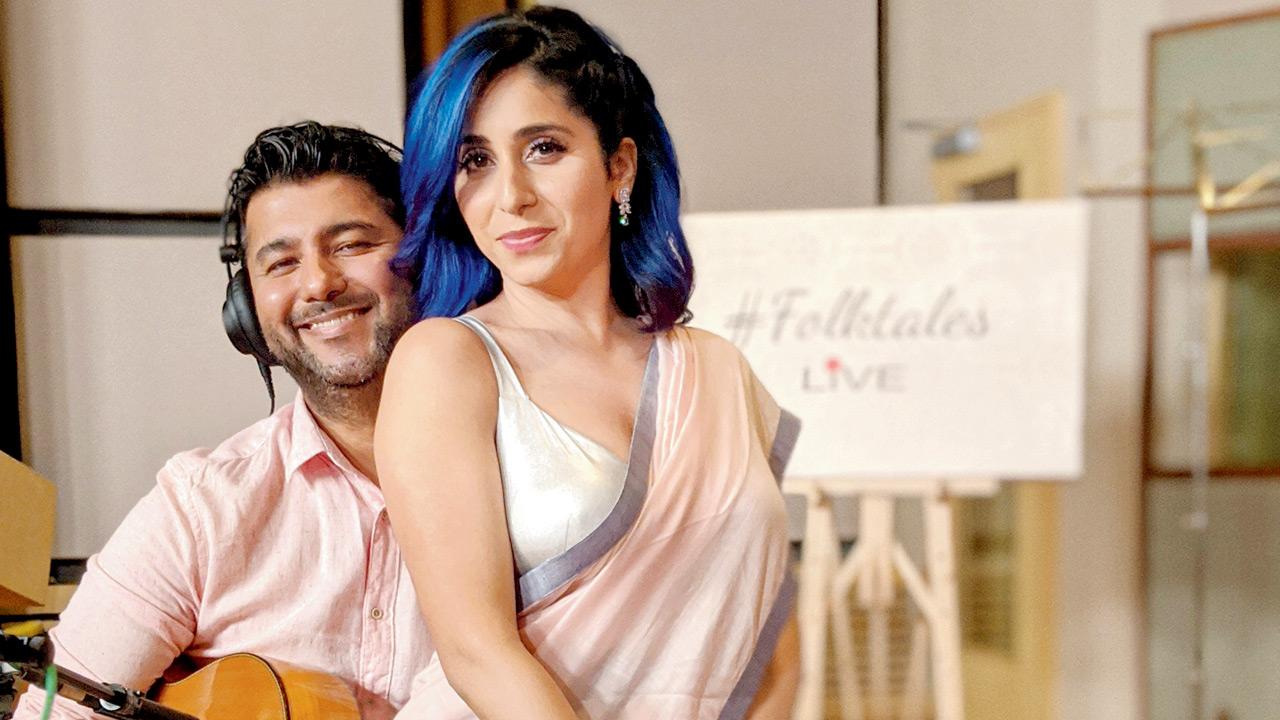
As her five-year-old song Jutti Meri tops charts on streaming apps in 2025, singer Neha Bhasin opens up about how good art is timeless and feeling vindicated as an indie artiste

(From left) Sameer Uddin and Neha Bhasin
Thumak Thumak Jaandi Ae Mahiye De Naal is a line that’s all over social media, whether one understands the lyrics or not. Neha Bhasin’s Punjabi folk song, Jutti Meri, is going viral, topping charts on audio-streaming apps, including YouTube and Spotify. What makes it surprising is that Jutti Meri was released in 2020, created as a part of Bhasin and her husband Sameer Uddin’s passion project, Folktales Live.
Bhasin remembers releasing the song — which reimagines the popular Punjabi folk song of the same name — on March 16, 2020, days before the country went into lockdown. “We couldn’t promote it at all,” laments the singer. The song being rediscovered five years after its release makes Bhasin feel vindicated as an independent artiste who marches to her own drum.
“I always wondered just because I don’t bow down to the music industry’s rules, why should my song not be a commercial hit? So, to get that is the universe telling us that we’ve been on the right path. I also believe my late father has a hand in this. It’s been charting on YouTube in the top 30. My distribution team, Virgin Music, says no old song ever enters the trending list on YouTube. The numbers are showing that the song has gone crazily viral. It has got the fate that it always deserved,” she smiles.
On August 18, Jutti Meri topped the Spotify Viral India list, and was seventh on the global list. It’s currently ranked sixth on the India viral chart. At the moment, the song has 13.06 million streams to its credit, which amounts to a growth of over seven million in the last one month. On YouTube, it has amassed 28 million views— ranking 13th in top 100 songs India, 16th in top 100 music videos India and 30th globally, and third in top weekly videos Punjabi.
“With streaming figures that are on par with a popular movie at the box office, Jutti Meri may be regarded as a huge smash. Even though the song was released years ago, it is now in every chart,” says Amit Sharma, Country Head, India, Virgin Music.
For musician Uddin, the song’s renaissance busts a big myth — that marketing is as important as music. “As we live in an era of low attention and high deception, even the most deserving songs go unnoticed. So, as two artistes with a very small but strong team running the label (5am Audio), it is encouraging to see that without spending the big bucks on ad words, marketing, influencers, paid playlists and bots, we got a seat on the big boy's table, where only powerful labels or artistes with big financial backers get to sit,” he says.
What makes this development even more special, Uddin says, is that the song’s social media popularity is leading people to explore the full song, something that's getting lost in the times of Instagram reels and YouTube shorts.
“The chances of something running on pure merit in the digital noise may be bleak but the cultural embrace that Jutti Meri has got is sheer validation that the chance does exist. The number of hours you have spent in front of your favourite painting or watching your favourite movie will never come close to your favourite song that you have heard on loop for hours and months over years. Music is not a mere art form, but a key that rips the time-space continuum and creates a microverse. You don't listen to a song, you live inside it. So the longevity of a song is infinite; otherwise, it’s just a mere gimmick. What makes this even more special is that Jutti Meri is not just a one-time 30-second meme but people are also playlisting it, consuming it for its real purpose— listening,” he says.
Bhasin always believed that good art is timeless. Jutti Meri being embraced today solidifies her notion. She asserts, “Songs don’t have a shelf life. When I was a child, I was listening to yesteryear artistes, not knowing at that point what era they belong to. I feel we undermine the new generation. Jutti Meri is a traditional song. We are not doing cool hip-hop, rap music, which is usually considered synonymous with Gen Z. But this is our culture, this is in our blood. When I started doing folk music, Sameer told me, ’It's in your DNA, Neha. You know this music,’ because I was the cool generation of the 90s, singing pop and pop-rock. Culture found me, and I found culture. So why do we undermine the newer generation? Why do we feel we need to feed them something that will become a hit? For me, what this says is that be yourself as an artiste. You put out what you believe in, and let the generations adopt you. Let the generations find you cool. Don't try to become cool for them,” she says.
2020
When ‘Jutti Meri’ released
Sixth
Its current rank on Spotify Viral India
Subscribe today by clicking the link and stay updated with the latest news!" Click here!