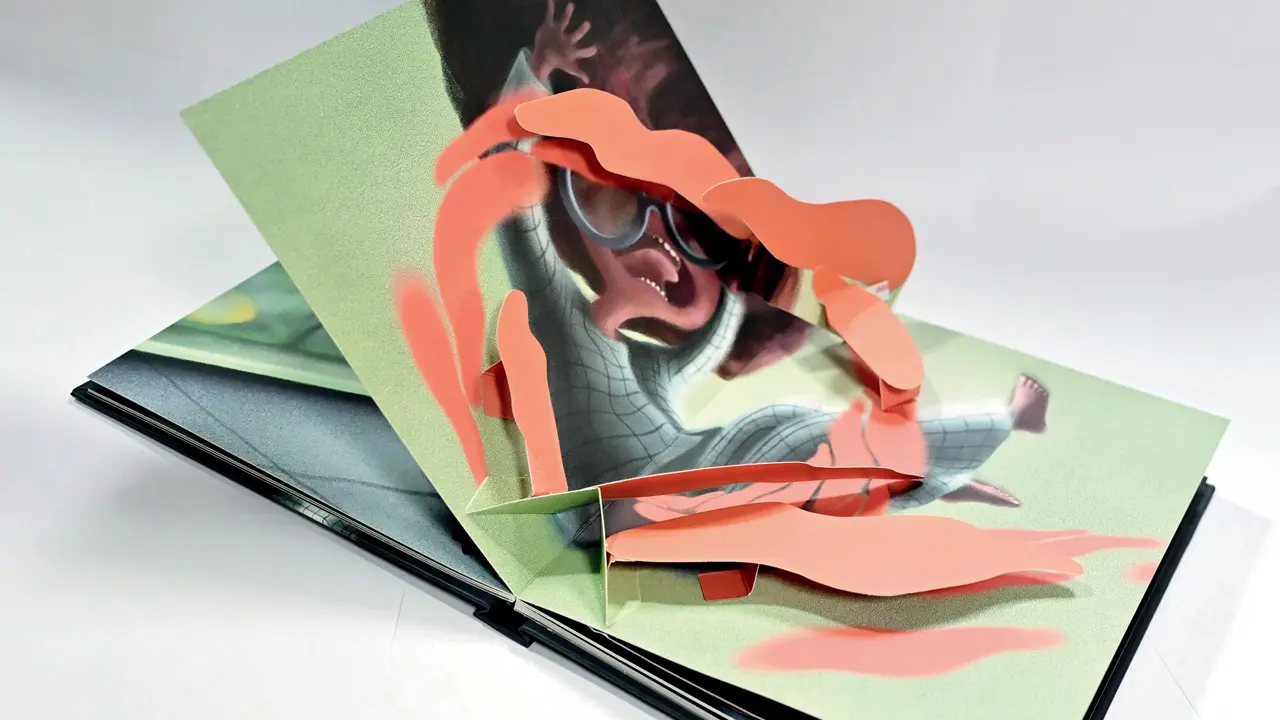
Tara Goes Aahhhhh by Garima Gupta is a brilliantly crafted wordless pop-up book that opens up the conversation about fear, anxiety, and loneliness, and how it can impact young minds if not addressed immediately. Excerpts from the interview

In pop-up books every page must be print-ready and assembly-line ready. This means thinking about how a pop-up will be glued, folded, and constructed in a factory setting. The back-and-forth between my desk and the printer’s desk was intense. We had to redo major sections of the book — twice — to meet those complex requirements, informs Gupta. PICS/HARPERCOLLINS INDIA, SHADAB KHAN
Why did you want to tell Tara’s story?
Somewhere, I believe Tara’s story is also my story. And it’s likely the story of every child who grows up to become an adult with a complicated relationship with fear. All my life I’ve heard mine, and so many other parents and caregivers say, “Don’t be scared of that,” or “Why are you afraid? It’s just a ____.” But if we pause for a moment, we know that fear doesn’t magically disappear if we willed it to or disappear with age. Even as adults, we carry fears — of failure, of uncertainty, of authority figures, of losing loved ones, of making mistakes. Fear is part of our lives. So, why do we expect children to just brush it off? When it is left unspoken or unacknowledged, fear can grow in confusing ways, turning into anxiety, anger, or emotional shutdowns later.

This forms part of Unstuck, a series of wordless, pop-up books to introduce young readers to the realm of feelings including anxiety, fear, anger and loneliness
Even when children pick them up from adults, understanding and navigating those feelings is incredibly hard. If a feeling is experienced but isn’t named or explored gently, it can leave lasting marks that surface later. The question was: How should we start talking about feelings? At what age? How does one talk to a generation of children who are plugged into devices? How do we get their attention to have this slightly difficult conversation?

Did you imagine that the book would take this shape and form?
Yes, from the get-go I’ve been clear and confident that this format is exactly what a book about fear needs. Movement engages young learners and gently encourages them to shift beyond their current state of mind. It invites the child to become part of the experience, engaging both body and mind — even briefly — out of a state where they feel stuck. Now when I read this book aloud, I notice that children are immediately curious as soon as the book opens up, with characters seemingly jumping out. They move around the book, eager to discover where those characters were hiding. That alone brings much joy, because during that time, they’re breaking away from the passive screen-viewing habits many have developed. It gently breaks open their indifference towards the subject and they are eager to tell me what all scares them.

Please share about the process to create this wordless pop-up book.
When I set out to create this book, I had no formal training in pop-up engineering. I taught myself by watching YouTube tutorials and looking at other pop-up books. It was slow, painstaking work — trial-and-error, and lots of cutting and folding. Pop-up bookmaking is a multi-layered process that involves designing mechanisms that work, illustrating them in ways that feel natural, and then marrying the two so they function seamlessly. Each page went through many iterations; often starting over from scratch when the engineering didn’t quite match the visuals — or vice versa. Once the layouts were done, another challenge began: production. The publisher and I were navigating unfamiliar territory since it was their first pop-up book. We had to figure out everything — from prototyping to production — while keeping a close eye on the budget.
And how did Ketan Mehta’s input help?
Like me, Reproscan has been home to many with lofty ideas and little to no understanding of printing and production. Ketan bhai has always been the person I turn to when I know what I want but have no idea how to make it happen. He has consistently welcomed my wild ways of working — and even encouraged them — fully aware that he’ll be the one holding his head when it comes down to the brass tacks.

Garima Gupta
The story of Ketan bhai’s involvement was no different. As always, the first call went to him, and without hesitation, he asked me to come to Mumbai with my drafts. He may have shifted the studio three times since I first started working with him, but it always feels like home — sharing his dabba, chatting and making strange, mad work together.
Log on to: harpercollins.in
Subscribe today by clicking the link and stay updated with the latest news!" Click here!