









In the inaugural edition of Arts Adda — mid-day’s tribute to Mumbai’s champions of culture and the arts — we chat with Literature Live! The Mumbai LitFest co-directors Amy Fernandes and Quasar Thakore Padamsee who recall the journey, the challenges, and the future

Quasar Thakore Padamsee and Amy Fernandes in conversation. Pics/Ashish Raje
The rain has delayed things slightly, and one of our guests is late. But that is to be expected in the week preceding the city’s premiere literature festivals when we meet two giants who have been steering Mumbai’s literary arts scene with this annual spectacle, now in its 16th year.
“Things are always in motion,” admits festival co-director, Amy Fernandes, as she plays the genial host. As Quasar Thakore Padamsee walks in, there is some worry. “I hope the rain slows down. We were not expecting wet weather in November,” the playwright admits later. The duo has been part of Mumbai’s first, and oldest, literary festival, Literature Live! The Mumbai LitFest since it was founded by Anil Dharker and Shashi Baliga.
Excerpts from the conversation.
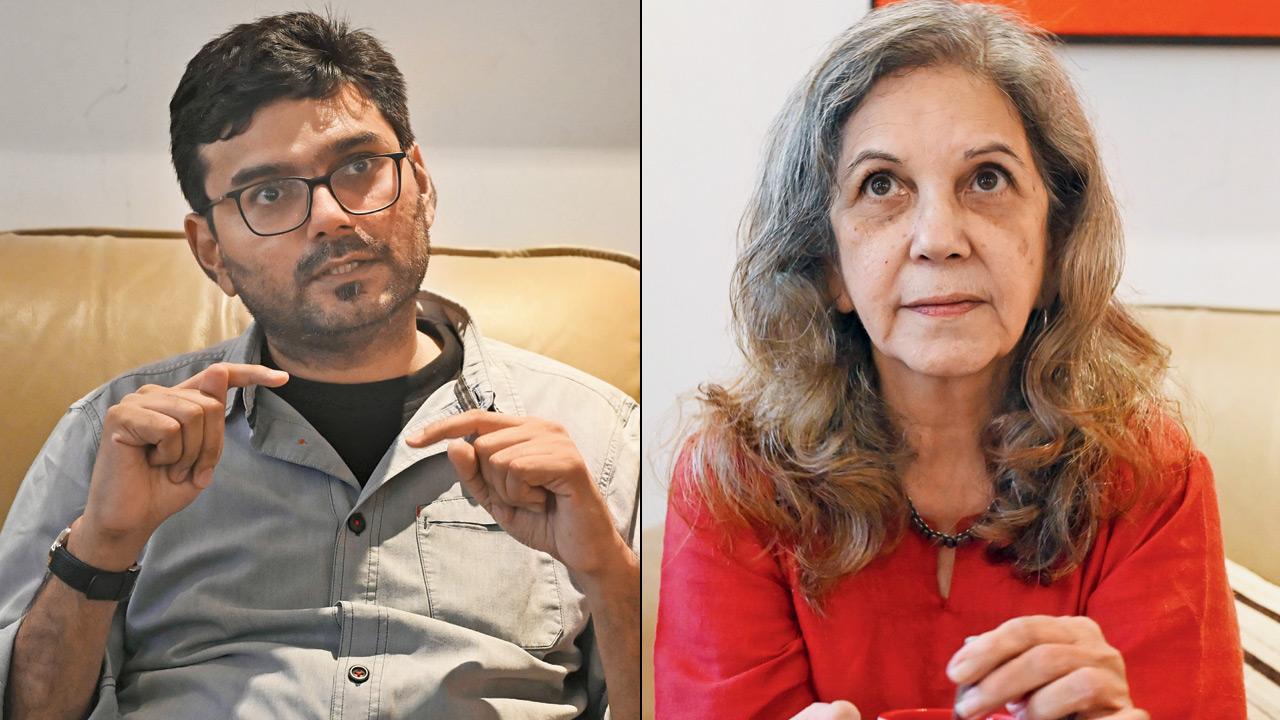
Quasar Thakore Padamsee and Amy Fernandes
Take us back to the beginning in 2010. What was the first conversation with Anil Dharker about the festival?
Amy Fernandes: Anil [Dharker] was at a dinner at a friend’s house. I remember Gerson [Da Cunha], and Quasar were among the guests present during the conversation.
Quasar Thakore Padamsee: At some point, the conversation veered to why Mumbai does not have a literary festival despite being such a literary city.
AF: It was then that some of the guests, like Gerson, suggested we should take it on. After that, I remember Anil taking on the cause to make it happen.
QTP: The first festival was in 2010, but the idea began in 2008. Honestly, the odd conversation would happen, and then it would die down. But behind the scenes, Anil was knocking on doors, talking to people, tying things down with the tenacity that only he had.
AF: He was a man who loved his books, as you can see. He respected the written word, and felt that Mumbai deserved a literary festival.
This, despite us boasting of Nissim Ezekiel, Arun Kolatkar, Eunice De Souza and Dom Moraes. Plus, a vibrant ecosystem for the arts...
QTP: There were multiple activities in silos. In a weird way, it took someone outside those silos, and with a journalistic mindset to see the world as it is; to spot a pattern.

From Anil Dharker, Amy, Jerry Pinto, even Gerson Da Cunha, there is a newspaper connection as well. Was it like being back in the newsroom?
AF: Not quite. We argue very civilly here [she laughs]. We argue, bicker, and discuss.
QTP: Anil, Amy, Antoine [Lewis], Jerry and Shashi [Baliga] were journalists. I think that is where the rigour comes from. In some ways, it was like a newsroom. It was something Anil made happen. He would allow you to convince him over two or three meetings. He would keep asking you to refine the argument. I think that has remained.
AF: That is why it takes from December to November. There is such a long gestation period between the ideas.
What are your pet peeves that you bicker about?
QTP: Amy always brings wafers to every meeting, and I cannot stop at just one.
AF: That’s okay. We love peeves, and turn it into something good. No festival is an easy run, and it gets tougher every year. There is something that will throw us back and bring us back.
QTP: We forget that aside from the writing community, an audience, there is a supporting community. We have been fortunate in that regard — from the Tatas and the NCPA, and now, Godrej Industries Group is our presenting partner. It is reaffirming when someone else buys into the idea.
What were the early challenges, then?
AF: After the first year, Anil struck out on his own. The Tatas came along, and were with us for 13 years. They allowed us to grow. And we grew, sometimes, incrementally, and sometimes, exponentially. Anil had this habit of suddenly springing an idea onto us, and then, we would figure out a way about how it would happen. I think in the second year we started the awards, with the late Mahasweta Devi being the first recipient. Today, we have a huge smorgasbord of awards.
QTP: The awards are now a festival within a festival. But for him, it was one more thing to add.
AF: Every time he would pitch an idea, I would watch everyone wonder how we were going to do this. But it [a small team] is a gift. We closely understand what the festival is about.

Quasar Thakore Padamsee and Amy Fernandes (right) at the latter’s Worli residence
How then was the curation process arrived on?
AF: We should have had Antoine [Lewis] here, for that. He is a deep thinker, and he would come up with a unique session idea. Then, everyone populates it with their inputs. Shireen [Mistry] is our eagle eye. Reena [Agrawal] looks after the Little Festival.
QTP: Shashi Baliga [then executive director] actually called Antoine to occasionally help, when we began. Suddenly, he found himself at the table solving author problems.
When it comes to curation, the thing to remember is that all our activities are connected to the written word. It is also our responsibility to tell the audience that these are things people are writing about.
AF: Even the debates, largely emanate from the books or an idea that is shaping the narrative. Right now, it is about all the literature coming out of China.
How and when do you strike the balance and know what the city [reader] wants?
AF: We do not know that [laughs].
QTP: At no point are we saying that this is what the city needs. We simply are talking about what people are writing and talking about. For instance, this year, there is a wonderful collection of stories, The Only City, by Mumbai-based authors that uses the city as an inspiration. It fits completely with what we are about. But that will only happen this year. That allows us to guide our programming.
AF: However, that does not become our theme. There will be an occasional shift in the narrative, and we have to recognise that.
Were there elements that you let go over the years in this process?
QTP: It is not as though we let go of things, we just evolve and adapt. Like the Quiz, or the Book in Focus sessions; we invent new formats
as well.
AF: We also have become more inclusive. A few years ago, we brought in Marathi and Gujarati as languages in focus. When we feel a need where audiences and writers demand it, we are open to it.
QTP: For instance, take the conversation with Godrej DEI for the Pomegranate Workshop of first-time queer poets coming together. We are expanding this year with A Wish Upon The Sky featuring 12 first time poets, from marginalised communities and across genders.
Has this changing horizon of rising literature festivals, reading communities, and open mics influenced the curation?
AF: It has not influenced the curation as such. But poetry, music, prose, everything blends together at some point during the ideating process. We are not closing our doors to anything.
QTP: Talking about the old Poetry Circle, poetry was then a nascent art form. Today, everyone has a platform, and has open mics. We have to acknowledge that and give it space. At the same time, we are part of a larger movement of people discovering and wanting to read.
This year, we have groups of 11 to 18-year-olds, walking around the fest, attending workshops, and writing reports. This is our way of acknowledging that there are younger readers out there.
AF: The new generation consumes literature differently, or digitally.
How do you view it?
AF: Definitely better. Publishers are coming out with a tsunami of books every year. Self-publishing is huge.
QTP: Every year they say that the e-reader will be the death of books. Today, every little café in the city is adding a bookshelf.
Reading has gone from a solitary to a communal experience...
QTP: Yes, that’s why we have the Mumbai Bookies coming up with a reading session at the festival.
AF: I still think reading will remain a solitary pursuit. Watching someone read might cause a domino effect and push you to read. I am happy with that. But in the end, reading for me is personal and solitary.
Children’s literature has also acquired importance today. How important was it to bring that voice to the fore?
AF: We had started the Little Festival some years ago, but stopped it during COVID-19. We resumed again because a lot of younger children are invested. This year, we have a 12-year-old opening her book.
QTP: Environment has become a big subject. Kids today are engaged with the world and having a real conversation. We also forget what it means to a child. To actually witness them, running around and asking for author signatures is quite a sight.
AF: Also, the young poets and writers; it is so great that they have a platform. Their poems have such depth. We also have a workshop for librarians to figure out new ideas to get children to come into libraries.
Then, is there a session you loved putting together this year?
AF: We cannot choose between our children. All of them, and the Little Festival.
QTP: Our opening session is quite unique. We have a Booker Prize-winner [Shehan Karunatilaka], a Nobel Prize-winner [Venki Ramakrishnan] and a digital journalist [Christian Stöcker], coming together to answer the question, What is Truth? That is a fascinating one.
What is the next step, and is there a shift in the horizon?
AF: We don’t know. We have to wait for AI to tell us how things will change. I think we are going to be far more attentive to what it does and an author does now.
QTP: It is a part of the conversation. We are a festival of ideas as well. These things become a lot more interesting as they are talked about.
From November 7 to 9
At NCPA, Nariman Point.
Log on to litlive.in
 Subscribe today by clicking the link and stay updated with the latest news!" Click here!