Clothing designer and visual artist Kallol Datta’s just-opened solo debut at a Colaba gallery examines textiles as a lens for social, political and daily lives

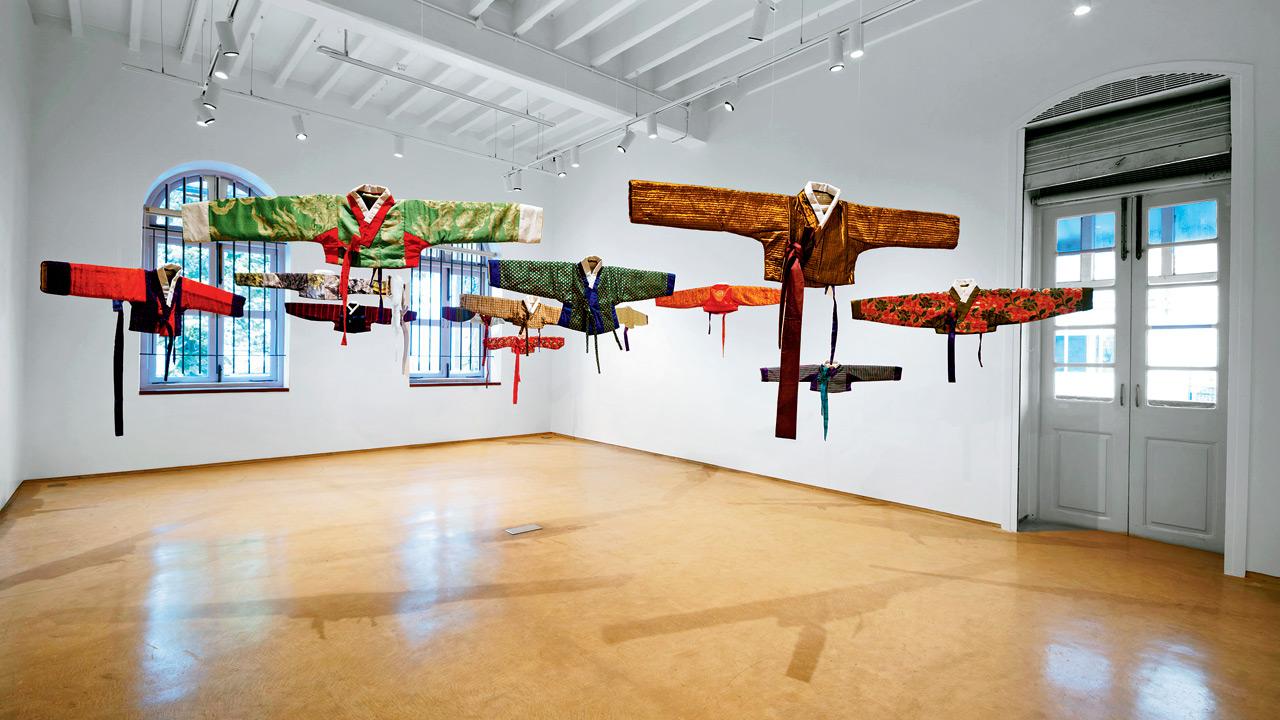
A view of the jeogoris in the section, Truths Our Clothes Told Us. PICS COURTESY/KALLOL DATTA, EXPERIMENTER COLABA, RUSHA BOSE
From Mahatma Gandhi’s ‘loincloth’ to the keffiyeh, clothes can often reflect far more than comfortable fashion. Khadi became a political statement in the Independence Movement, and the Kolhapuri chappal recently stirred a storm, evolving into a symbol of its own. For Kallol Datta, it might not seem surprising. The Kolkata-based textile designer and visual artist’s debut solo in Mumbai, Volume IV | Truths, Half-Truths, Half-Lies, Lies, unravels the stories of private and public dissent woven into textile.
The exhibition is a continuation of his long-running research. Datta explains in an email interaction, “It began as research into clothing practices native to regions across South West Asia and North Africa, South Asia, the Korean Peninsula and Japan — when forms were distilled to a template, the connections were undeniable. The Korean jeogori [upper garment of the traditional Korean attire of hanbok] to the Indian subcontinent’s angharakha, to the Persian chapkan.”

Poster 13, 2025 and Poster 18, 2025
These similarities, he adds, were the result of the common threads of trade, colonisation, involuntary migrations and such other factors. “There is so much information contained in historical literature, photography, and texts about clothing practices which further ties in with ‘laws of the land’ of specific regions and cultures,” Datta writes. The researcher has been following this thread for a while. His previous exhibition, Volume III Issue II at Experimenter, Kolkata, is evidence. “The volumes are really punctuations in my artistic practice, sometimes as an end to a process, at times a pause,” the 43-year-old shares.
Through four chapters, Datta examines the intersection of gender politics, systemic hierarchies, class divisions, censorship and larger socio-political issues through the lens of textiles. It all began, though, with a niche text by a Han Dynasty writer of the 1st and 2nd Century. The text, Lessons for Women/Admonitions for Women/Women’s Precepts, by ancient China’s first female historian, Ban Zhao, was a gateway to studying societal mores in the region. Datta observes, “With societal and behavioural codes drafted by imperial and religious figures in the past, it’s not difficult to see how clothing was, and continues to be, used as a tool to oppress, subjugate, and intimidate minorities. It is additionally used as an incentive to ‘assimilate’.”

Kallol Datta
Acquired through the last four years of collection, travel and research, the textiles are often acquired through donors who also provide “interviews, correspondence, text, and images from family albums.” He expands, “The details they provide more often than not tie in directly with the research I conduct.” As for the exhibition itself, Datta concludes, “This solo, maps out and connects the constrictions and well as small acts of dissent in the private and the public — clothes, dwellings, and daily lives.”
TILL August 20; 10.30 am to 6.30 pm
AT Experimenter Colaba, 16/18 Mereweather Road, Colaba.
CALL 9324587317
Subscribe today by clicking the link and stay updated with the latest news!" Click here!